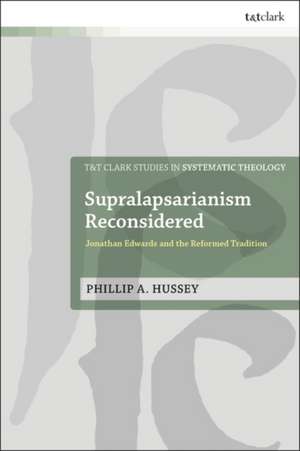
Supralapsarianism Reconsidered: Jonathan Edwards and the Reformed Tradition: T&T Clark Studies in Systematic Theology
Autor Rev. Dr. Phillip A. Husseyen Limba Engleză Paperback – 27 noi 2025
In a late notebook entry, Jonathan Edwards offered a programmatic statement on the relation between Christ and predestination: "In that grand decree of predestination, or the sum of God's decrees.the appointment of Christ, or the decree respecting his person.must be considered first." This work unpacks the scope of Edwards's statement, both in terms of setting forth an interpretation of Edwards's own theology on the relation between Christ and the decree, as well as drawing out the larger insights of Edwards's reasoning for current theological reflection.
| Toate formatele și edițiile | Preț | Express |
|---|---|---|
| Paperback (1) | 197.60 lei 43-57 zile | |
| Bloomsbury Publishing – 27 noi 2025 | 197.60 lei 43-57 zile | |
| Hardback (1) | 526.05 lei 43-57 zile | |
| Bloomsbury Publishing – 27 iun 2024 | 526.05 lei 43-57 zile |
Din seria T&T Clark Studies in Systematic Theology
- nou
 Preț: 528.20 lei
 - nou
 Preț: 200.29 lei
 - nou
 Preț: 528.06 lei
 - 17%
 Preț: 245.84 lei
 - 17%
 Preț: 266.29 lei
 - 17%
 Preț: 265.56 lei
 - 26%
 Preț: 265.56 lei
 - 25%
 Preț: 224.26 lei
 -
 Preț: 264.69 lei
 - 26%
 Preț: 229.77 lei
 - 34%
 Preț: 555.30 lei
 - 25%
 Preț: 922.53 lei
 - 26%
 Preț: 239.58 lei
 - 17%
 Preț: 265.07 lei
 -
 Preț: 264.50 lei
 - 26%
 Preț: 614.86 lei
 - 25%
 Preț: 223.44 lei
 - 26%
 Preț: 267.72 lei
 -
 Preț: 264.99 lei
 -
 Preț: 264.09 lei
 - 34%
 Preț: 920.75 lei
 -
 Preț: 264.91 lei
 - 17%
 Preț: 232.30 lei
 - 17%
 Preț: 266.48 lei
 - 17%
 Preț: 264.12 lei
 - 26%
 Preț: 243.50 lei
 - 34%
 Preț: 921.43 lei
 - 39%
 Preț: 797.57 lei
 - 26%
 Preț: 264.50 lei
 -
 Preț: 536.42 lei
 - 26%
 Preț: 264.99 lei
 - 26%
 Preț: 915.56 lei
 - 26%
 Preț: 264.22 lei
 - 14%
 Preț: 982.07 lei
 - 25%
 Preț: 982.25 lei
Preț: 197.60 lei
Preț vechi: 270.19 lei
-27%
Puncte Express: 296
Preț estimativ în valută:
34.94€ • 40.38$ • 30.19£
34.94€ • 40.38$ • 30.19£
Carte tipărită la comandă
Livrare economică 04-18 mai
Specificații
ISBN-13: 9780567714824
ISBN-10: 0567714829
Pagini: 258
Dimensiuni: 150 x 232 x 14 mm
Greutate: 0.38 kg
Editura: Bloomsbury Publishing
Colecția T&T Clark
Seria T&T Clark Studies in Systematic Theology
Locul publicării:London, United Kingdom
ISBN-10: 0567714829
Pagini: 258
Dimensiuni: 150 x 232 x 14 mm
Greutate: 0.38 kg
Editura: Bloomsbury Publishing
Colecția T&T Clark
Seria T&T Clark Studies in Systematic Theology
Locul publicării:London, United Kingdom
Cuprins
INTRODUCTION
PART I: THE REFORMED CONTEXT
1. The Contours of Lapsarianism: Diversity in Seventeenth Century Reformed Theology
2. Lapsarianism Problematized and Purified: Herman Bavinck and Karl Barth
PART II: Jonathan Edwards and Lapsarianism
3. Creation, Christ, and the Decrees
4. Covenant, Christ, and the Decrees
5. Particular Predestination, Christ, and the Decrees
PART III: SUPRALAPSARIANISM RECONSIDERED
6. A Modest Theological Sketch
Bibliography
Index
PART I: THE REFORMED CONTEXT
1. The Contours of Lapsarianism: Diversity in Seventeenth Century Reformed Theology
2. Lapsarianism Problematized and Purified: Herman Bavinck and Karl Barth
PART II: Jonathan Edwards and Lapsarianism
3. Creation, Christ, and the Decrees
4. Covenant, Christ, and the Decrees
5. Particular Predestination, Christ, and the Decrees
PART III: SUPRALAPSARIANISM RECONSIDERED
6. A Modest Theological Sketch
Bibliography
Index
Recenzii
Strangely, for all of the work that has been done on the early eighteenth-century British-American theologian Jonathan Edwards, we have yet to be given a satisfactory assessment of his lapsarianism, his views of the eternal decrees. This study takes a significant step in providing an explanation of Edwards' formulations on this key topic, and doing so within the context of the Reformed tradition that Edwards inherited-and changed. Rather than making any normative judgments about whether or not Edwards was "true" to the Reformed tradition, this work focuses on the solutions that he proposed flowing from a vision that was God-centered, trinitarian and christological.
I read this book by Phillip Hussey with great joy. Why? Because this book really practices theology. In a deep way it analyzes how infra- and supralapsarianism are structured with Turretini, Van Mastricht and Goodwin. It also becomes clear that they are not shrewd, but that there are great theological issues attached to each approach. Next, we see how it functions with Herman Bavinck and Karl Barth. From this framework, we explore what Jonathan Edwards can contribute to a contemporary supralapsarian interpretation of creation, Christology, redemption and visio beatifica. In a word: awesome.
While many think of supralapsarianism as the most uncompromising and rigid form of Calvinism, Phillip Hussey's judicious retrieval of Jonathan Edwards makes clear why we cannot easily brush off supralapsarian theological accounts: for Edwards, the splendor of Christ is the integrative center of all theology and must, therefore, precede even the fall into sin. Supralapsarianism Reconsidered not only traces in painstaking detail Edwards's own understanding of the divine decree but also situates it within the context of his Reformed predecessors and their critics. By consciously taking his position as a pupil before his teachers, Hussey models what it means to be a retrieval theologian.
This book is an excellent example of an irenic, insightful, and penetrating consideration of the tradition for constructive theological work. Hussey reasons along the contours of Reformed dogmatics to provide a theological retrieval and reconceptualization of supralapsarianism. Ultimately considering Edwards, Hussey does so critically with an eye on seventeenth-century accounts as well as Bavinck's and Barth's analyses and criticisms. Contemporary students of theology are in Hussey's debt for this well-reasoned and profound monograph.
Is Jonathan Edwards also among the supralapsarian Christological thinkers? In this carefully argued book Phillip A. Hussey shows that indeed, for "America's greatest theologian" the incarnation is not just God's response to sin but key to the whole of God's involvement with what is not God, from creation to eschaton. In doing so, Hussey not only offers a new and convincing interpretation of Edwards, but also expands our understanding of the history of supralapsarian Christology and sketches a new constructive Christological design.
[Hussey's] monograph is a laudable book which requires the full attention of the reader to trace out the tightly reasoned, logically consistent implications of Edwards's lapsarianism. Although I am not convinced that we need to resurrect the infralapsarian and supralapsarian debate, this volume is very persuasive. Anyone who deals with Edwards's order of the divine decrees will need to reckon with this volume.
I read this book by Phillip Hussey with great joy. Why? Because this book really practices theology. In a deep way it analyzes how infra- and supralapsarianism are structured with Turretini, Van Mastricht and Goodwin. It also becomes clear that they are not shrewd, but that there are great theological issues attached to each approach. Next, we see how it functions with Herman Bavinck and Karl Barth. From this framework, we explore what Jonathan Edwards can contribute to a contemporary supralapsarian interpretation of creation, Christology, redemption and visio beatifica. In a word: awesome.
While many think of supralapsarianism as the most uncompromising and rigid form of Calvinism, Phillip Hussey's judicious retrieval of Jonathan Edwards makes clear why we cannot easily brush off supralapsarian theological accounts: for Edwards, the splendor of Christ is the integrative center of all theology and must, therefore, precede even the fall into sin. Supralapsarianism Reconsidered not only traces in painstaking detail Edwards's own understanding of the divine decree but also situates it within the context of his Reformed predecessors and their critics. By consciously taking his position as a pupil before his teachers, Hussey models what it means to be a retrieval theologian.
This book is an excellent example of an irenic, insightful, and penetrating consideration of the tradition for constructive theological work. Hussey reasons along the contours of Reformed dogmatics to provide a theological retrieval and reconceptualization of supralapsarianism. Ultimately considering Edwards, Hussey does so critically with an eye on seventeenth-century accounts as well as Bavinck's and Barth's analyses and criticisms. Contemporary students of theology are in Hussey's debt for this well-reasoned and profound monograph.
Is Jonathan Edwards also among the supralapsarian Christological thinkers? In this carefully argued book Phillip A. Hussey shows that indeed, for "America's greatest theologian" the incarnation is not just God's response to sin but key to the whole of God's involvement with what is not God, from creation to eschaton. In doing so, Hussey not only offers a new and convincing interpretation of Edwards, but also expands our understanding of the history of supralapsarian Christology and sketches a new constructive Christological design.
[Hussey's] monograph is a laudable book which requires the full attention of the reader to trace out the tightly reasoned, logically consistent implications of Edwards's lapsarianism. Although I am not convinced that we need to resurrect the infralapsarian and supralapsarian debate, this volume is very persuasive. Anyone who deals with Edwards's order of the divine decrees will need to reckon with this volume.