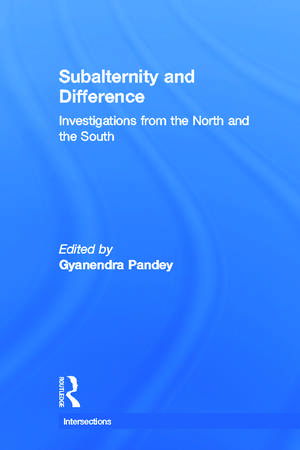
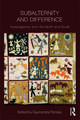
Subalternity and Difference: Investigations from the North and the South: Intersections: Colonial and Postcolonial Histories
Editat de Gyanendra Pandeyen Limba Engleză Hardback – 5 iul 2011
The resulting study is of invaluable interest to students and scholars in a wide range of disciplines, including History, Anthropology, Gender and Queer and Colonial and Postcolonial Studies.
| Toate formatele și edițiile | Preț | Express |
|---|---|---|
| Paperback (1) | 410.46 lei 6-8 săpt. | |
| Taylor & Francis – 15 ian 2012 | 410.46 lei 6-8 săpt. | |
| Hardback (1) | 1013.77 lei 6-8 săpt. | |
| Taylor & Francis – 5 iul 2011 | 1013.77 lei 6-8 săpt. |


Preț: 1013.77 lei
Preț vechi: 1236.31 lei
-18% Nou
Puncte Express: 1521
Preț estimativ în valută:
179.39€ • 210.36$ • 157.54£
179.39€ • 210.36$ • 157.54£
Carte tipărită la comandă
Livrare economică 04-18 februarie 26
Preluare comenzi: 021 569.72.76
Specificații
ISBN-13: 9780415665476
ISBN-10: 0415665477
Pagini: 208
Dimensiuni: 152 x 229 x 18 mm
Greutate: 0.45 kg
Ediția:New.
Editura: Taylor & Francis
Colecția Routledge
Seria Intersections: Colonial and Postcolonial Histories
Locul publicării:Oxford, United Kingdom
ISBN-10: 0415665477
Pagini: 208
Dimensiuni: 152 x 229 x 18 mm
Greutate: 0.45 kg
Ediția:New.
Editura: Taylor & Francis
Colecția Routledge
Seria Intersections: Colonial and Postcolonial Histories
Locul publicării:Oxford, United Kingdom
V-ar putea interesa
-
 Country Of My SkullAntjie Krog-20%Preț: 71.82 lei89.69 lei
 -
 Bury Me StandingIsabel Fonseca-20%Preț: 71.84 lei89.69 lei
 -
 She Flies Without Wings: How Horses Touch a Woman's SoulMary D. MidkiffPreț: 118.04 lei
 -
 Preț: 410.68 lei
 -
 -15%Preț: 415.17 lei488.44 lei
 -
 Preț: 415.13 lei
 -
 Education as a Political Tool in AsiaMarie LallPreț: 416.23 lei
 -
 Preț: 269.74 lei
 -
 Preț: 414.92 lei
 -
 Linguistic Stereotyping and Minority Groups in JapanNanette GottliebPreț: 409.22 lei
 -
 Ethnic Politics and Democratic Transition in RwandaDavid Kiwuwa-18%Preț: 1067.29 lei1301.56 lei
 -
 -18%Preț: 1069.56 lei1304.34 lei
 -
 In Praise of SlowCarl Honore-27%Preț: 49.95 lei68.82 lei
 -
 Race & CrimeMichael RowePreț: 360.63 lei
 -
 -24%Preț: 219.75 lei287.27 lei
Public țintă
Postgraduate and UndergraduateNotă biografică
Gyanendra Pandey is Distinguished Professor of History at Emory University, USA, and is the series editor of the Intersections: Colonial and Postcolonial Histories book series at Routledge. He is one of the leading theorists and originators of the subaltern studies approach and has published widely in the field of colonial and postcolonial studies.
Recenzii
"[T]his is a valuable collection of essays for scholars interested in ideas of minority, citizenship, difference, race, and gender. The essays each offer a suggestion regarding how to work with a politics of difference. Additionally, the sections offer some insight into the kinds of questions the intersection of difference and subalternity raises, including questions of gender and sexuality as defining features, belonging or not belonging within communities and nations, and the liberal democratic politics that create and reinforce positions of minority and subalternity. Scholars and teachers with an interest in these issues can look to this volume for several valuable essays, and they may do so with a hope that this volume will serve as the one of many attempting the kind of comparisons it begins to make." - Emily Rook-Koepsel, Ph.D., University of Oklahoma; Journal of International and Global Studies Vol. 3, No. 2 Spring 2012
Cuprins
1. Introduction: The Difference of Subalternity Gyanendra Pandey Part 1: Gender, sexuality and the regime of modernity 2. ‘At Risk’: Gender, Sexuality and Epidemic Logic Dilip K. Das 3. ‘Homosexuals from Haystacks’: Gay Liberation and the Specter of a Queer Majority in Rural California, circa 1970 Colin Johnson 4. Different Speakers, Different Loves: Female Urbanity in Rekhti Poetry Ruth VanitaPart 2: The politics of belonging 5. Roots of the Oriental Quarter in early 19th Century London Michael H. Fisher 6. Indigenous Immigrants, Religion and the Struggle for Belonging in the United States Mary E. Odem7. All Strom’s Children: Gender, Race, and Memory in the 20th Century American South Joseph Crespino Part 3: Revisiting liberalism 8. Thinking Equality: debates in Bengal, c.1870-1940 Prathama Banerjee9. Mestizo Mainstream: Reaffirmations of Natural Citizenship in Ecuador Christopher Krupa10. Viola’s Story: Re-locating Difference Gyanendra Pandey
Descriere
Focusing on concepts that have been central to investigation of the history and politics of marginalized and disenfranchised populations, this book asks how discourses of ‘subalternity’ and ‘difference’ simultaneously constitute and interrupt each other. The authors explore the historical production of conditions of marginality and minority, and challenge simplistic notions of difference as emanating from culture rather than politics.