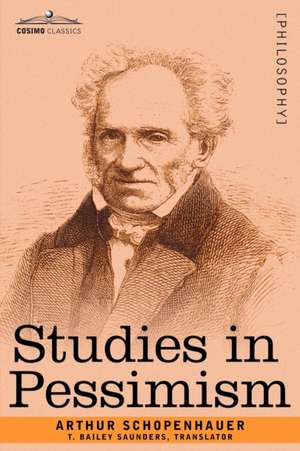
Studies in Pessimism
Autor Arthur Schopenhaueren Limba Engleză Paperback – iun 2007
Preț: 107.80 lei
Puncte Express: 162
Carte tipărită la comandă
Livrare economică 27 noiembrie-11 decembrie
Livrare prin curier în România Termenul estimat este afișat lângă disponibilitate.
Transport gratuit de la 400.00 lei Plată online sau ramburs, în funcție de opțiunile comenzii.
Retur gratuit în 14 zile Comandă securizată și suport în română.
Specificații
ISBN-13: 9781602063495
ISBN-10: 1602063494
Pagini: 108
Dimensiuni: 152 x 229 x 7 mm
Greutate: 0.17 kg
Editura: COSIMO CLASSICS
Locul publicării:United States
ISBN-10: 1602063494
Pagini: 108
Dimensiuni: 152 x 229 x 7 mm
Greutate: 0.17 kg
Editura: COSIMO CLASSICS
Locul publicării:United States
V-ar putea interesa
-
 Socrates-Arg PhilosophersGerasimos Xenophon Santas-15%Preț: 470.04 lei552.99 lei
 -
 The Death of SocratesEmily R. WilsonPreț: 334.65 lei
 -
 Plato's Meno: An InterpretationCristina Ionescu-35%Preț: 594.67 lei910.66 lei
 -
 The Law Most Beautiful and Best: Medical Argument and Magical Rhetoric in Plato's LawsRandall Baldwin Clark-29%Preț: 342.63 lei482.47 lei
 -
 In Praise of Plato's Poetic ImaginationSonja Tanner-23%Preț: 337.76 lei436.39 lei
 -
 -33%Preț: 711.73 lei1054.76 lei
 -
 Axiogenesis: An Essay in Metaphysical OptimalismNicholas Rescher-34%Preț: 633.39 lei958.50 lei
 -
 Plato versus Parmenides: The Debate over Coming-into-Being in Greek PhilosophyDr. Robert J. Roecklein-35%Preț: 595.10 lei910.91 lei
 -
 Visible and Invisible in Greek PhilosophyHideya Yamakawa-24%Preț: 371.11 lei487.60 lei
 -
 The Early Frankfurt School and ReligionM. KohlenbachPreț: 376.02 lei
 -
 Preț: 175.47 lei
 -
 Dialectica Eristica O El Arte de Tener Razon: Tools for Everyday LifeArthur SchopenhauerPreț: 50.36 lei
 -
 The World as Will and IdeaArthur SchopenhauerPreț: 216.78 lei
 -
 -27%Preț: 939.22 lei1286.59 lei
 -
 AphorismenArthur SchopenhauerPreț: 61.22 lei
Notă biografică
The writings of German philosopher ARTHUR SCHOPENHAUER (1788-1860) were a profound influence on art and aesthetics, music and literature in the 19th century. Among his many writings are On the Fourfold Root of the Principle of Sufficient Reason (1847) and The World as Will and Idea (1819), considered his masterpiece.