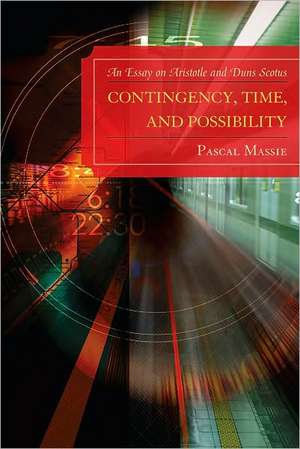
Contingency, Time, and Possibility: An Essay on Aristotle and Duns Scotus
Autor Pascal Massieen Limba Engleză Hardback – 19 noi 2010
In Contingency, Time, and Possibility: An Essay on Aristotle and Duns Scotus, Pascal Massie opens these questions by combining two approaches: First, an original inquiry that analyses the notions of chance, fate, event, contradiction, and so forth, and suggests that the distinction between potency and act arises from a confrontation with the impossible. Second, a historical inquiry that focuses on Aristotle and Duns Scotus, two key figures contributing to a fundamental transformation in the history of Western ontology; namely, the transition from a metaphysics of nature (Aristotle) to a metaphysics of the will (Scotus). In doing so, this book departs from the prevailing interpretation of the history of modal logic according to which Scotus rejected the principle of plenitude attributed to Aristotle and replaced the ancient diachronic theory of possibilities with a synchronic one, thereby contributing to a "possible world's semantics." Rather, Massie argues that in its proper ontological import, the question of possibility concerns the limit between being and non-being and that this limit must be thought in terms of temporality.
With Scotus, however, a radical shift occurs. Possibilities are understood in terms of will, creation, omnipotence, and transcending freedom. As such, they belong to the realm of what is supremely actual (i.e., superabundant activity). What used to be understood as a lesser degree of being (the quasi non-being of uninformed matter and mere possibilities) becomes the mark of omnipotence.
Preț: 711.73 lei
Preț vechi: 1054.76 lei
-33%
Puncte Express: 1068
Carte tipărită la comandă
Livrare economică 07-21 decembrie
Livrare prin curier în România Termenul estimat este afișat lângă disponibilitate.
Transport gratuit pentru acest produs Plată online sau ramburs, în funcție de opțiunile comenzii.
Retur gratuit în 14 zile Comandă securizată și suport în română.
Specificații
ISBN-13: 9780739149294
ISBN-10: 0739149296
Pagini: 305
Dimensiuni: 163 x 240 x 25 mm
Greutate: 0.64 kg
Editura: Bloomsbury Publishing
Colecția Lexington Books
Locul publicării:New York, United States
ISBN-10: 0739149296
Pagini: 305
Dimensiuni: 163 x 240 x 25 mm
Greutate: 0.64 kg
Editura: Bloomsbury Publishing
Colecția Lexington Books
Locul publicării:New York, United States
V-ar putea interesa
-
 The Nature of ThingsLucretiusPreț: 90.45 lei
 -
 Discourses and Selected WritingsEpictetus-18%Preț: 65.28 lei79.27 lei
 -
 Timaeus and CritiasPlato-31%Preț: 63.15 lei91.94 lei
 -
 Timaeus and CritiasPlato-18%Preț: 64.10 lei78.59 lei
 -
 A Guide to the Good Life: The Ancient Art of Stoic JoyWilliam B Irvine-39%Preț: 101.11 lei164.52 lei
 -
 Socratic Perplexity and the Nature of PhilosophyGareth B. Matthews-33%Preț: 657.95 lei979.87 lei
 -
 The First Philosophers: The Presocratics and SophistsRobin Waterfield-17%Preț: 66.18 lei79.80 lei
 -
 The Nature of the GodsCicero-19%Preț: 69.86 lei85.86 lei
 -
 -19%Preț: 51.71 lei63.99 lei
 -
 On Obligations: De OfficiisCicero-18%Preț: 64.64 lei78.92 lei
 -
 Oxford Studies in Ancient Philosophy: Volume XXXIVDavid Sedley-27%Preț: 374.99 lei511.92 lei
 -
 -20%Preț: 528.23 lei662.31 lei
 -
 -20%Preț: 411.71 lei515.72 lei
 -
 God and Cosmos in StoicismRicardo Salles-30%Preț: 734.73 lei1049.26 lei
 -
 Time for Aristotle: Physics IV. 10-14Ursula Coope-22%Preț: 369.76 lei471.69 lei
 -
 Remembering Socrates: Philosophical EssaysLindsay Judson-20%Preț: 363.70 lei455.33 lei
 -
 The Brute Within: Appetitive Desire in Plato and AristotleHendrik Lorenz-21%Preț: 407.55 lei515.43 lei
 -
 The Meditations of Marcus AureliusMarcus AureliusPreț: 202.72 lei
 -
 The Essential Marcus AureliusJacob NeedlemanPreț: 79.12 lei
Cuprins
Part 1 Introduction
Part 2 Part One. Contingent Encounters
Chapter 3 Chapter One. Contingency, Chance, Fortune
Chapter 4 Chapter Two. The Surprise and The Why
Part 5 Part Two. Modal Hierarchy and its Ontological Foundation
Chapter 6 Chapter Three. Contingency, Logic and Logos
Chapter 7 Chapter Four. Megarian Possibilities
Chapter 8 Chapter Five. The Master Argument
Chapter 9 Chapter Six. Aristotle's Resolution
Part 10 Part Three. Possibilities, Time, Ontology
Chapter 11 Chapter Seven. The Being of Possibilities
Chapter 12 Chapter Eight. The Priority of Actuality
Chapter 13 Chapter Nine. 'In-Either-Of-Two-Ways' Matter and Limbo
Chapter 14 Chapter Ten. The Future of Possibilities
Chapter 15 Chapter Eleven. Potentiality and Non-Being
Chapter 16 Chapter Twelve. Toward Divine Power
Part 17 Part Four. Duns Scotus and the Possibilities of the Will
Chapter 18 Chapter Thirteen. 'Ex Nihilo' and 'Post Non Esse' (Scotus'Questions On Metaphysics)
Chapter 19 Chapter Fourteen. The Will and Its Objects
Chapter 20 Chapter Fifteen. Entitative and Active Contingency
Chapter 21 Chapter Sixteen. Preliminary Remarks on a Contemporary Interpretation
Chapter 22 Chapter Seventeen. Another Sea-Battle
Chapter 23 Chapter Eighteen. Future and Eternity
Chapter 24 Chapter Nineteen. The Free Play of The Wills
Chapter 25 Chapter Twenty. Saving Contingency: Ockham's Objection
Part 26 Conclusion. Thinking the Impossible
Part 2 Part One. Contingent Encounters
Chapter 3 Chapter One. Contingency, Chance, Fortune
Chapter 4 Chapter Two. The Surprise and The Why
Part 5 Part Two. Modal Hierarchy and its Ontological Foundation
Chapter 6 Chapter Three. Contingency, Logic and Logos
Chapter 7 Chapter Four. Megarian Possibilities
Chapter 8 Chapter Five. The Master Argument
Chapter 9 Chapter Six. Aristotle's Resolution
Part 10 Part Three. Possibilities, Time, Ontology
Chapter 11 Chapter Seven. The Being of Possibilities
Chapter 12 Chapter Eight. The Priority of Actuality
Chapter 13 Chapter Nine. 'In-Either-Of-Two-Ways' Matter and Limbo
Chapter 14 Chapter Ten. The Future of Possibilities
Chapter 15 Chapter Eleven. Potentiality and Non-Being
Chapter 16 Chapter Twelve. Toward Divine Power
Part 17 Part Four. Duns Scotus and the Possibilities of the Will
Chapter 18 Chapter Thirteen. 'Ex Nihilo' and 'Post Non Esse' (Scotus'Questions On Metaphysics)
Chapter 19 Chapter Fourteen. The Will and Its Objects
Chapter 20 Chapter Fifteen. Entitative and Active Contingency
Chapter 21 Chapter Sixteen. Preliminary Remarks on a Contemporary Interpretation
Chapter 22 Chapter Seventeen. Another Sea-Battle
Chapter 23 Chapter Eighteen. Future and Eternity
Chapter 24 Chapter Nineteen. The Free Play of The Wills
Chapter 25 Chapter Twenty. Saving Contingency: Ockham's Objection
Part 26 Conclusion. Thinking the Impossible
Recenzii
Wisely choosing and faithfully following his ancient and modern sources, Pascal Massie proves himself to be a talented and dependable guide for uncovering the ontological foundations of contingency in the worlds of Aristotle and John Duns Scotus.
This book sheds new light on the ancient question of contingency. Its strength lies in its integrated approach and historical sensitivity. Recognizing that contingency is at stake in logic, ethics and ontology, Massie seeks to understand contingency prior to such disciplinary distinctions. He weaves the ideas of Aristotle and Scotus into a holistic and compelling account of contingency as a central, pressing philosophical and human concern. The result is a discussion of time and possibility that has far-reaching implications for how we understand ourselves in relation to our past and future.
This book sheds new light on the ancient question of contingency. Its strength lies in its integrated approach and historical sensitivity. Recognizing that contingency is at stake in logic, ethics and ontology, Massie seeks to understand contingency prior to such disciplinary distinctions. He weaves the ideas of Aristotle and Scotus into a holistic and compelling account of contingency as a central, pressing philosophical and human concern. The result is a discussion of time and possibility that has far-reaching implications for how we understand ourselves in relation to our past and future.