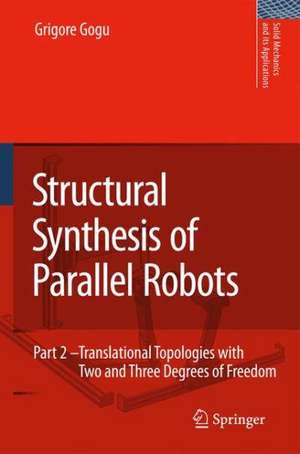
Structural Synthesis of Parallel Robots: Solid Mechanics and Its Applications, cartea 159
Autor Grigore Goguen Limba Engleză Hardback – 11 mar 2009
Din seria Solid Mechanics and Its Applications
- 18%
 Preț: 1353.76 lei
 -
 Preț: 628.16 lei
 - 18%
 Preț: 1283.23 lei
 - 15%
 Preț: 661.76 lei
 - 15%
 Preț: 731.65 lei
 - 18%
 Preț: 1166.95 lei
 - 15%
 Preț: 666.92 lei
 - 18%
 Preț: 1156.92 lei
 - 18%
 Preț: 647.44 lei
 - 18%
 Preț: 1784.98 lei
 - 15%
 Preț: 424.11 lei
 - 18%
 Preț: 1049.94 lei
 - 18%
 Preț: 775.37 lei
 - 18%
 Preț: 1279.44 lei
 - 15%
 Preț: 673.19 lei
 - 15%
 Preț: 642.19 lei
 - 18%
 Preț: 984.21 lei
 - 20%
 Preț: 636.75 lei
 - 18%
 Preț: 988.03 lei
 - 18%
 Preț: 914.83 lei
 - 18%
 Preț: 763.70 lei
 - 18%
 Preț: 1271.93 lei
 - 18%
 Preț: 1278.08 lei
 - 18%
 Preț: 934.80 lei
 - 18%
 Preț: 990.14 lei
 - 20%
 Preț: 1031.80 lei
 - 18%
 Preț: 1285.90 lei
 - 18%
 Preț: 993.09 lei
 - 18%
 Preț: 994.79 lei
 - 18%
 Preț: 981.22 lei
 - 18%
 Preț: 909.21 lei
 -
 Preț: 418.39 lei
 - 18%
 Preț: 1040.97 lei
 - 18%
 Preț: 990.58 lei
 - 15%
 Preț: 671.79 lei
 - 18%
 Preț: 1155.14 lei
 - 18%
 Preț: 960.16 lei
 - 18%
 Preț: 1269.85 lei
 - 18%
 Preț: 1285.25 lei
 - 18%
 Preț: 989.31 lei
 - 24%
 Preț: 1867.10 lei
 - 18%
 Preț: 993.52 lei
 - 24%
 Preț: 690.04 lei
 - 18%
 Preț: 1238.74 lei
Preț: 1010.46 lei
Preț vechi: 1232.27 lei
-18%
Puncte Express: 1516
Carte tipărită la comandă
Livrare economică 30 noiembrie-14 decembrie
Livrare prin curier în România Termenul estimat este afișat lângă disponibilitate.
Transport gratuit pentru acest produs Plată online sau ramburs, în funcție de opțiunile comenzii.
Retur gratuit în 14 zile Comandă securizată și suport în română.
Specificații
ISBN-13: 9781402097935
ISBN-10: 140209793X
Pagini: 780
Ilustrații: XVIII, 762 p.
Dimensiuni: 160 x 241 x 47 mm
Greutate: 1.27 kg
Ediția:2009
Editura: Springer
Colecția Solid Mechanics and Its Applications
Seria Solid Mechanics and Its Applications
Locul publicării:Dordrecht, Netherlands
ISBN-10: 140209793X
Pagini: 780
Ilustrații: XVIII, 762 p.
Dimensiuni: 160 x 241 x 47 mm
Greutate: 1.27 kg
Ediția:2009
Editura: Springer
Colecția Solid Mechanics and Its Applications
Seria Solid Mechanics and Its Applications
Locul publicării:Dordrecht, Netherlands
V-ar putea interesa
-
 Notes on the Synthesis of FormChristopher AlexanderPreț: 235.55 lei
 -
 Funicular Structures: The Art of Building EfficientlyDamon BolhassaniPreț: 384.80 leiRecomandat
 -
 The Big Book of RobotsCampbell BooksPreț: 84.16 lei
 -
 Introduction to Robotics, Global EditionJohn Craig-9%Preț: 596.70 lei655.72 lei
 -
 The LEGO Technic Idea Book: Wheeled WondersYoshihito Isogawa-19%Preț: 110.64 lei136.05 lei
 -
 The LEGO Power Functions Idea Book, Volume 1Yoshihito IsogawaPreț: 170.56 lei
 -
 The LEGO Power Functions Idea Book, Volume 2Yoshihito IsogawaPreț: 170.52 lei
 -
 Parallel Robots With Unconventional JointsPatrick Grosch-15%Preț: 657.82 lei773.90 lei
 -
 Theory of Applied RoboticsReza N. Jazar-18%Preț: 731.93 lei892.61 lei
 -
 Kinematic Synthesis of MechanismsEres Söylemez-15%Preț: 626.37 lei736.91 lei
 -
 State-of-the-Art and Innovations in Mechanism and Machine ScienceMarco Ceccarelli-24%Preț: 830.19 lei1092.35 lei
 -
 Proceedings of MSR-RoManSy 2024Pierre Larochelle-18%Preț: 1888.09 lei2302.55 lei
 -
 Walking Robots into Real WorldKarsten Berns-18%Preț: 1177.33 lei1435.77 lei
 -
 -15%Preț: 649.15 lei763.70 lei
 -
 Advances in Robot Kinematics 2016Jadran Lenar¿i¿-15%Preț: 682.23 lei802.62 lei
 -
 Topology Design of Robot MechanismsTing-Li Yang-15%Preț: 667.41 lei785.19 lei
 -
 -24%Preț: 1129.21 lei1485.81 lei
Public țintă
ResearchCuprins
Preface; Acknowledgements; List of abbreviations and notations; 1 Introduction; 1.1 Terminology; 1.2 Methodology of structural synthesis; 1.2.1 New formulae for mobility, connectivity, redundancy and overconstraint of parallel robots; 1.2.2 Evolutionary morphology approach; 1.2.3 Types of parallel robots with respect to motion coupling; 1.3 Translational parallel robots; 2 Translational parallel robots with two degrees of freedom; 2.1 T2-type translational parallel robots with coupled motions; 2.1.1 Overconstrained solutions; 2.1.2 Non overconstrained solutions; 2.2 T2-type translational parallel robots with decoupled motions; 2.2.1 Overconstrained solutions; 2.2.2 Non overconstrained solutions; 2.3 T2-type translational parallel robots with uncoupled motions; 2.3.1 Overconstrained solutions; 2.3.2 Non overconstrained solutions; 2.4 Maximally regular T2-type translational parallel robots; 2.4.1 Overconstrained solutions; 2.4.2 Non overconstrained solutions; 2.5 Other T2-type translational parallel robots; 2.5.1 Overconstrained solution; 2.5.2 Non overconstrained solutions; 3 Overconstrained T3-type TPMs with coupled motions; 3.1 Basic solutions with linear actuators; 3.2 Derived solutions with linear actuators; 3.3 Basic solutions with rotating actuators; 3.4 Derived solutions with rotating actuators; 4 Non overconstrained T3-type TPMs with coupled motions; 4.1 Basic solutions with linear actuators; 4.2 Derived solutions with linear actuators; 4.3 Basic solutions with rotating actuators; 4.4 Derived solutions with rotating actuators; 5 Overconstrained T3-type TPMs with uncoupled motions; 5.1 Basic solutions with rotating actuators; 5.2 Derived solutions with rotating actuators; 6 Non overconstrained T3-type TPMs with uncoupled motions; 6.1 Basic solutions with rotating actuators; 6.2 Derived solutions with rotating actuators; 7 Maximally regular T3-type translational parallel robots; 7.1 Overconstrained solutions; 7.1.1 Basic solutions with no idle mobilities; 7.1.2 Derived solutions with idle mobilities; 7.2 Non overconstrained solutions; References; Index
Recenzii
From the reviews:“Part 2 begins with a short summary of developed by the author new formulae for mobility, connectivity, redundancy, and over-constraint. … Parallel robotic manipulators can be considered a well-established … subject of many robotic research studies. … the author has made a significant contribution towards establishing innovative and interesting solutions for parallel mechanisms. … The presentation is at a level of a graduate textbook, and the book will be useful and enjoyed by serious graduate students and by scientists and engineers from academia and industry.” (Franz Selig, Zentralblatt MATH, Vol. 1168, 2009)
Textul de pe ultima copertă
This book represents the second part of a larger work dedicated to the structural synthesis of parallel robots.
The originality of this work resides in the fact that it combines new formulae for mobility connectivity, redundancy and overconstraint, and the evolutionary morphology in a unified approach of structural synthesis giving interesting innovative solutions for parallel robotic manipulators. This is the first book of robotics presenting solutions of coupled, decoupled, uncoupled, fully-isotropic and maximally regular translational parallel robotic manipulators systematically generated by using the structural synthesis approach proposed in Part 1. Non-redundant/redundant, overconstrained/isostatic solutions with simple/complex limbs actuated by linear/rotary actuators with/without idle mobilities are proposed. Many solutions are presented here for the first time in the literature.
The author had to make a difficult and challenging choice between protecting these solutions through patents, and releasing them directly into the public domain. The second option was adopted by publishing them in various recent scientific publications and mainly in this book. In this way, the author hopes to contribute to a rapid and widespread implementation of these solutions in future industrial products.
The originality of this work resides in the fact that it combines new formulae for mobility connectivity, redundancy and overconstraint, and the evolutionary morphology in a unified approach of structural synthesis giving interesting innovative solutions for parallel robotic manipulators. This is the first book of robotics presenting solutions of coupled, decoupled, uncoupled, fully-isotropic and maximally regular translational parallel robotic manipulators systematically generated by using the structural synthesis approach proposed in Part 1. Non-redundant/redundant, overconstrained/isostatic solutions with simple/complex limbs actuated by linear/rotary actuators with/without idle mobilities are proposed. Many solutions are presented here for the first time in the literature.
The author had to make a difficult and challenging choice between protecting these solutions through patents, and releasing them directly into the public domain. The second option was adopted by publishing them in various recent scientific publications and mainly in this book. In this way, the author hopes to contribute to a rapid and widespread implementation of these solutions in future industrial products.
Caracteristici
Structural synthesis of parallel robots with two to six degrees of freedom New families of parallel robots with decoupled, uncoupled and fully-isotropic solutions Non-redundant/redundant, overconstrained/isostatic solutions of coupled/decoupled/ uncoupled and fully-isotropic parallel manipulators with elementary/complex legs actuated by linear/rotary actuators with/without idle mobilities