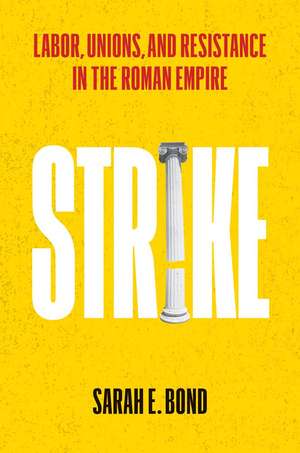
Strike: Labor, Unions, and Resistance in the Roman Empire
Autor Sarah E Bonden Limba Engleză Paperback – 10 feb 2026
A New Yorker Best Book of the Year
“First-rate. . . . A sterling example of historical revisionism.”—Publishers Weekly
From plebeians refusing to join the Roman army to bakers withholding bread, this is the first book to explore how Roman workers used strikes, boycotts, riots, and rebellion to get their voices—and their labor—acknowledged. Sarah E. Bond explores Ancient Rome from a new angle to show that the history of labor conflicts and collective action goes back thousands of years, uncovering a world far more similar to our own than we realize.
Workers often turned to their associations for solidarity and shared identity in the ancient world. Some of these groups even negotiated contracts, wages, and work conditions in a manner similar to modern labor unions. As the world begins to consider the value—and indeed the necessity—of unionization to protect workers, this book demonstrates that we can learn valuable lessons from ancient laborers and from attempts by the Roman government to limit their freedom.
| Toate formatele și edițiile | Preț | Express |
|---|---|---|
| Paperback (1) | 110.46 lei Precomandă | |
| Yale University Press – 10 feb 2026 | 110.46 lei Precomandă | |
| Hardback (1) | 195.67 lei 3-5 săpt. | +37.32 lei 7-13 zile |
| Yale University Press – 4 feb 2025 | 195.67 lei 3-5 săpt. | +37.32 lei 7-13 zile |
Preț: 110.46 lei
Precomandă
Puncte Express: 166
Preț estimativ în valută:
19.55€ • 22.92$ • 17.17£
19.55€ • 22.92$ • 17.17£
Carte nepublicată încă
Doresc să fiu notificat când acest titlu va fi disponibil:
Se trimite...
Preluare comenzi: 021 569.72.76
Specificații
ISBN-13: 9780300288599
ISBN-10: 030028859X
Pagini: 272
Ilustrații: 10 b-w illus.
Dimensiuni: 156 x 235 mm
Editura: Yale University Press
Colecția Yale University Press
ISBN-10: 030028859X
Pagini: 272
Ilustrații: 10 b-w illus.
Dimensiuni: 156 x 235 mm
Editura: Yale University Press
Colecția Yale University Press
Recenzii
A New Yorker Best Book of 2025
“An incisive history. . . . Bond shows how professional and trade associations empowered bakers, gladiators, charioteers, and the like to wield their leverage—for example, by withholding their labor—in pursuit of improved conditions.”—New Yorker
“In this first-rate study, historian Bond makes the case that organized labor was a powerful force in the ancient world. . . . A sterling example of historical revisionism, this foregrounds the human-level struggles at stake in the ancient world.”—Publishers Weekly
“Strike is a vital book to help us understand ancient society and, more broadly, given the use of ancient history in contemporary discourse, it can help us challenge reactionary politics today and the rise of fascist leaders.”—Rhakotis Magazine
“Strike offers a novel perspective to Roman history, shining a light on the lives of non-elite people and [showing] how, through belonging to associations, they could influence the Roman Empire using collective actions . . . and how the imperial system reacted to them.”—Ancient History Magazine
“A strong argument for ‘strategic anachronism.’ . . . As Bond’s book shows, partial vision is better than no vision at all.”—Rhiannon Ash, History Today
“Bond offers a compelling historical account and a provocative claim: the histories we tell about labor organizing ought to start earlier than the medieval guild system or the industrial revolution. Her argument is persuasive and she effectively balances careful historical analysis with invitations to draw connections between ancient and modern labor, a theme well served by her strategic use of modern terminology.”—Classical Journal
"Insightful. . . . This book involves more than just unhappy workers banding together for better conditions or pay. . . . It is also a story about the essential yet often invisible connective tissue of human societies."--Nadya Williams, Providence
“This book illustrates in very great detail . . . a most interesting topic.”—Peter Jones, Classics for All
“Fresh and fascinating, this book combines exceedingly meticulous history with audacious ‘strategic anachronism,’ e.g., Roman Ephesus as a ‘union town.’ This ancient labor history’s investigation of the meanings of solidarity in ancient Rome is rollickingly entertaining.”—Nell Irvin Painter, author of The History of White People
“Sarah Bond sheds refreshing new light on Roman history, revealing the role of collective bargaining, boycotts, strikes, and riots in the saga of the city and its empire. A passionate argument for the value, dignity, and radicalism of organized labor, then and now.”—Josephine Quinn, author of How the World Made the West: A 4,000 Year History
“We tend to think of strikes, unions, and industrial action as an entirely modern phenomenon. This thoroughly convincing book is especially welcome in our era of the gig economy and quiet quitting and the extreme dominance of capital over labor.”—Michael Kulikowski, author of The Tragedy of Empire
“A journey ‘from below’ throughout the Roman world, from the Early Kings to Early Byzantium. In a well-informed, highly readable synthesis, Sarah E. Bond covers the manifold aspects of associative bodies.”—Giusto Traina, Sorbonne Université
“In this carefully researched and humane study, Bond excavates a lost history of collective labor politics in ancient Rome, revealing that everyday workers and their associations were as important as emperors and armies to the making of the Roman world.”—Carlos F. Noreña, author of Imperial Ideals in the Roman West
“In this groundbreaking and indispensable work, Sarah Bond presents a detailed survey of ancient Roman labor from the earliest days of Rome through to Late Antiquity. She offers intriguing new windows onto gender, enslavement, religion, and a range of other aspects of daily life in ancient Rome that continue to resonate today.”—Jane Draycott, author of Cleopatra’s Daughter
“An incisive history. . . . Bond shows how professional and trade associations empowered bakers, gladiators, charioteers, and the like to wield their leverage—for example, by withholding their labor—in pursuit of improved conditions.”—New Yorker
“In this first-rate study, historian Bond makes the case that organized labor was a powerful force in the ancient world. . . . A sterling example of historical revisionism, this foregrounds the human-level struggles at stake in the ancient world.”—Publishers Weekly
“Strike is a vital book to help us understand ancient society and, more broadly, given the use of ancient history in contemporary discourse, it can help us challenge reactionary politics today and the rise of fascist leaders.”—Rhakotis Magazine
“Strike offers a novel perspective to Roman history, shining a light on the lives of non-elite people and [showing] how, through belonging to associations, they could influence the Roman Empire using collective actions . . . and how the imperial system reacted to them.”—Ancient History Magazine
“A strong argument for ‘strategic anachronism.’ . . . As Bond’s book shows, partial vision is better than no vision at all.”—Rhiannon Ash, History Today
“Bond offers a compelling historical account and a provocative claim: the histories we tell about labor organizing ought to start earlier than the medieval guild system or the industrial revolution. Her argument is persuasive and she effectively balances careful historical analysis with invitations to draw connections between ancient and modern labor, a theme well served by her strategic use of modern terminology.”—Classical Journal
"Insightful. . . . This book involves more than just unhappy workers banding together for better conditions or pay. . . . It is also a story about the essential yet often invisible connective tissue of human societies."--Nadya Williams, Providence
“This book illustrates in very great detail . . . a most interesting topic.”—Peter Jones, Classics for All
“Fresh and fascinating, this book combines exceedingly meticulous history with audacious ‘strategic anachronism,’ e.g., Roman Ephesus as a ‘union town.’ This ancient labor history’s investigation of the meanings of solidarity in ancient Rome is rollickingly entertaining.”—Nell Irvin Painter, author of The History of White People
“Sarah Bond sheds refreshing new light on Roman history, revealing the role of collective bargaining, boycotts, strikes, and riots in the saga of the city and its empire. A passionate argument for the value, dignity, and radicalism of organized labor, then and now.”—Josephine Quinn, author of How the World Made the West: A 4,000 Year History
“We tend to think of strikes, unions, and industrial action as an entirely modern phenomenon. This thoroughly convincing book is especially welcome in our era of the gig economy and quiet quitting and the extreme dominance of capital over labor.”—Michael Kulikowski, author of The Tragedy of Empire
“A journey ‘from below’ throughout the Roman world, from the Early Kings to Early Byzantium. In a well-informed, highly readable synthesis, Sarah E. Bond covers the manifold aspects of associative bodies.”—Giusto Traina, Sorbonne Université
“In this carefully researched and humane study, Bond excavates a lost history of collective labor politics in ancient Rome, revealing that everyday workers and their associations were as important as emperors and armies to the making of the Roman world.”—Carlos F. Noreña, author of Imperial Ideals in the Roman West
“In this groundbreaking and indispensable work, Sarah Bond presents a detailed survey of ancient Roman labor from the earliest days of Rome through to Late Antiquity. She offers intriguing new windows onto gender, enslavement, religion, and a range of other aspects of daily life in ancient Rome that continue to resonate today.”—Jane Draycott, author of Cleopatra’s Daughter
Notă biografică
Sarah E. Bond is the Erling B. “Jack” Holtsmark Associate Professor in the Classics in the Department of History at the University of Iowa. She is the author of Trade and Taboo: Disreputable Professions in the Roman Mediterranean. She lives in Iowa City, IA.