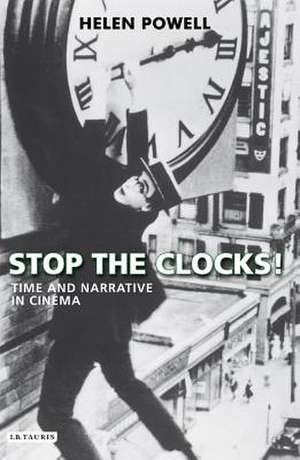
Stop the Clocks!
Autor Helen Powellen Limba Engleză Hardback – 29 feb 2012
Preț: 613.53 lei
Preț vechi: 713.41 lei
-14%
Puncte Express: 920
Carte disponibilă
Livrare economică 16-30 noiembrie
Livrare prin curier în România Termenul estimat este afișat lângă disponibilitate.
Transport gratuit pentru acest produs Plată online sau ramburs, în funcție de opțiunile comenzii.
Retur gratuit în 14 zile Comandă securizată și suport în română.
Specificații
ISBN-13: 9781780762166
ISBN-10: 178076216X
Pagini: 183
Dimensiuni: 155 x 234 x 20 mm
Greutate: 0.42 kg
Editura: I B TAURIS
ISBN-10: 178076216X
Pagini: 183
Dimensiuni: 155 x 234 x 20 mm
Greutate: 0.42 kg
Editura: I B TAURIS
V-ar putea interesa
-
 About Time: A Children's Guide to the History and Science of TimeRebecca Struthers-15%Preț: 95.29 lei112.39 lei
 -
 Sculpting in Time: Reflections on the CinemaAndrey TarkovskyPreț: 245.90 lei
 -
 Voice & Vision: A Creative Approach to Narrative FilmmakingMick Hurbis-Cherrier-8%Preț: 543.81 lei591.10 leiRecomandat
 -
 Narration in the Fiction FilmDavid BordwellPreț: 343.71 lei
 -
 The Mysteries of CinemaPeter ConradPreț: 191.44 lei
 -
 Temporality and Film AnalysisMatilda Mroz-16%Preț: 206.39 lei246.64 lei
 -
 The Theological Power of FilmJames LorenzPreț: 414.96 lei
 -
 -32%Preț: 565.96 lei830.84 lei
 -
 Cinema II: The Time-ImageGilles Deleuze-19%Preț: 171.54 lei211.01 lei
 -
 Time and WorldHartmut RosaPreț: 142.10 lei
 -
 Stardust: Cinematic Archives at the End of the WorldHannah GoodwinPreț: 217.86 lei
 -
 50 Film Ideas You Really Need to KnowHelen O’Hara-28%Preț: 50.70 lei70.25 lei
 -
 -31%Preț: 450.53 lei657.11 lei
 -
 Doctor Who: The Art of Time TravelPeter MckinstryPreț: 324.77 lei
 -
 The Art and Science of ArrivalTanya Lapointe-17%Preț: 236.16 lei284.70 lei
 -
 In the Blink of An Eye: New EditionWalter MurchPreț: 79.33 lei
 -
 The Time MachineH. G. WellsPreț: 33.23 lei
 -
 A Cinematic Mode of Existence: Perspectival Analytic of the ImageHalbe Hessel Kuipers-32%Preț: 628.64 lei926.98 lei
 -
 Read Frame Type FilmCatherine De Smet-17%Preț: 296.70 lei356.80 lei
Notă biografică
Helen Powell is Senior Lecturer in the School of Arts and Digital Industries at the University of East London. She has also worked in the advertising industry and adopts an interdisciplinary approach in her teaching, writing, and research.
Descriere
Descriere de la o altă ediție sau format:
The clock plays a significant part in our understanding of temporality, but while it simplifies, regulates and coordinates, it fails to reflect and communicate the more experiential dimensions of time. As Helen Powell demonstrates in this book, cinema has been addressing this issue since its inception. Stop the Clocks! examines filmmakers' relationship to time and its visual manipulation and representation from the birth of the medium to the digital present. It engages both with experimentation in narrative construction and with films that take time as their subject matter, such as Donnie Darko, Interview with a Vampire, Lost Highway and Pulp Fiction. Helen Powell asks what underpins the enduring appeal of the science fiction genre with filmmakers and audience and how cinematography might inform our conceptualisation of other imagined temporal worlds, including the afterlife. She examines the role of angels and vampires in contemporary cinema, as well as the distinctive time schemes of new media and their implications for rethinking time and the moving image through digitalisation. Broad based and accessible, Stop the Clocks! will appeal to a wide interdisciplinary audience and provides a useful sourcebook on undergraduate and postgraduate courses in film and other arts and media-based disciplines.
The clock plays a significant part in our understanding of temporality, but while it simplifies, regulates and coordinates, it fails to reflect and communicate the more experiential dimensions of time. As Helen Powell demonstrates in this book, cinema has been addressing this issue since its inception. Stop the Clocks! examines filmmakers' relationship to time and its visual manipulation and representation from the birth of the medium to the digital present. It engages both with experimentation in narrative construction and with films that take time as their subject matter, such as Donnie Darko, Interview with a Vampire, Lost Highway and Pulp Fiction. Helen Powell asks what underpins the enduring appeal of the science fiction genre with filmmakers and audience and how cinematography might inform our conceptualisation of other imagined temporal worlds, including the afterlife. She examines the role of angels and vampires in contemporary cinema, as well as the distinctive time schemes of new media and their implications for rethinking time and the moving image through digitalisation. Broad based and accessible, Stop the Clocks! will appeal to a wide interdisciplinary audience and provides a useful sourcebook on undergraduate and postgraduate courses in film and other arts and media-based disciplines.
Cuprins
Introduction: Cinema as Time Machine
Chapter 1: Real Time
Chapter 2: Future Time
Chapter 3: Dreaming Time
Chapter 4: Consuming Time
Chapter 5: Fractured Time
Conclusion: Time in the Digital Age
Bibliography
Index
Chapter 1: Real Time
Chapter 2: Future Time
Chapter 3: Dreaming Time
Chapter 4: Consuming Time
Chapter 5: Fractured Time
Conclusion: Time in the Digital Age
Bibliography
Index