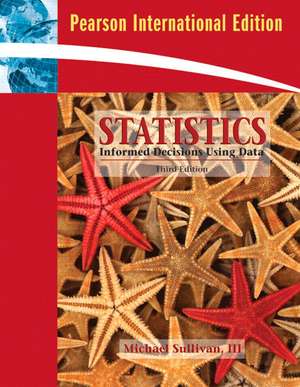
Statistics: Informed Decisions Using Data: International Edition
Autor Michael Sullivanen Limba Engleză Mixed media product – 19 oct 2008
În literatura academică dedicată statisticii introductive, adesea lipsește puntea necesară între calculul pur abstract și aplicabilitatea acestuia în deciziile complexe de zi cu zi. Considerăm că Statistics: Informed Decisions Using Data, Global Edition reușește să completeze această lacună, oferind studenților nu doar formule, ci o metodologie clară pentru interpretarea realității prin prisma datelor. Această a șaptea ediție rafinează viziunea lui Michael Sullivan, punând un accent deosebit pe integrarea tehnologiei în procesul de învățare. Descoperim aici o structură narativă pedagogică ce depășește simpla prezentare a conceptelor, utilizând analize de date actualizate pentru a demonstra interconectivitatea statisticii cu lumea largă.
Volumul extinde cadrul propus de Statistics, Books a la Carte Edition de James T. McClave cu date noi extrase din analize recente și o integrare mai profundă a resurselor MyStatLab. În timp ce McClave se concentrează pe fundamentele teoretice într-un format similar, Sullivan introduce în această ediție videoclipuri demonstrative care ghidează utilizatorul pas cu pas în utilizarea calculatoarelor TI-84 și a platformei StatCrunch. Față de lucrarea sa anterioară, Precalculus, Global Edition, unde accentul cădea pe abilitățile matematice fundamentale de pregătire a cursului, aici autorul migrează către o abordare aplicată, menită să formeze interpreți informați ai datelor, capabili să navigheze într-un mediu saturat de informații numerice. Credem că relevanța acestui manual pentru curriculumul modern rezidă tocmai în capacitatea sa de a transforma statistica dintr-o disciplină aridă într-un instrument decizional vital.
Preț: n/a
Disponibilitate incertă
Specificații
ISBN-10: 0321610962
Pagini: 928
Dimensiuni: 216 x 276 mm
Greutate: 1.91 kg
Ediția:3Nouă
Editura: Pearson Education
Colecția Pearson Education
Locul publicării:Upper Saddle River, United States
V-ar putea interesa
-
 -10%Preț: 144.36 lei160.88 lei
 -
 Preț: 218.53 lei
 -
 An Introduction to Applied Statistics: With Step-By-Step SPSS InstructionsJr. Edward T. Vieira-9%Preț: 669.64 lei735.86 lei
 -
 R-ticulateMartin Bader-23%Preț: 653.46 lei848.65 lei
 -
 -13%Preț: 590.23 lei678.43 lei
 -
 Sullivan, M: Statistics: Informed Decisions Using Data, GlobMichael Sullivan-11%Preț: 689.51 lei774.74 lei
 -
 -9%Preț: 608.62 lei668.82 lei
 -
 -9%Preț: 573.95 lei630.71 lei
 -
 Bock, D: Intro Stats, Global EditionDavid Bock-9%Preț: 542.15 lei595.76 lei
 -
 -37%Preț: 483.64 lei770.20 lei
 -
 Business Statistics For Dummies, 2nd EditionAlan AndersonPreț: 164.44 lei
 -
 Statistical Analysis with Python For DummiesJoseph SchmullerPreț: 197.44 lei
 -
 Statistics for ScientistsUmberto Michelucci-20%Preț: 279.62 lei349.53 lei
De ce să citești această carte
Recomandăm acest manual studenților și profesorilor care caută un curs de statistică aplicată, nu doar teoretică. Cititorul câștigă acces la o metodologie testată în clasă, susținută de resurse digitale avansate și tutoriale video. Este alegerea ideală pentru cei care doresc să înțeleagă cum datele influențează deciziile reale, beneficiind în același timp de un format flexibil și economic.
Despre autor
Michael Sullivan este profesor emerit în cadrul Departamentului de Matematică și Informatică de la Chicago State University, unde a predat timp de 35 de ani. Membru activ al American Mathematical Society și al Mathematical Association of America, Sullivan are o carieră de peste trei decenii în scrierea de manuale academice, având în prezent 15 titluri publicate. Experiența sa vastă la catedră se reflectă în abordarea pragmatică a textelor sale, fiind recunoscut pentru capacitatea de a face matematica și statistica accesibile și relevante pentru studenții din diverse domenii de studiu.
Descriere
This book follows the Guidelines for Assessment and Instruction in Statistics Education (GAISE), as recommended by the American Statistical Association, and emphasizes statistical literacy, use of real data and technology, conceptual understanding, and active learning.
Cuprins
Supplements
Technology Resources
An Introduction to the Applets
Applications Index
PART 1. GETTING THE INFORMATION YOU NEED
1. Data Collection
1.1 Introduction to the Practice of Statistics
1.2 Observational Studies versus Designed Experiments
1.3 Simple Random Sampling
1.4 Other Effective Sampling Methods
1.5 Bias in Sampling
1.6 The Design of Experiments
Chapter 1 Review
Chapter Test
Making an Informed Decision:What Movie Should I Go To?
Case Study: Chrysalises for Cash
PART 2. DESCRIPTIVE STATISTICS
2. Organizing and Summarizing Data
2.1 Organizing Qualitative Data
2.2 Organizing Quantitative Data:The Popular Displays
2.3 Additional Displays of Quantitative Data
2.4 Graphical Misrepresentations of Data
Chapter 2 Review
Chapter Test
Making an Informed Decision:Tables or Graphs?
Case Study: The Day the Sky Roared
3. Numerically Summarizing Data
3.1 Measures of Central Tendency
3.2 Measures of Dispersion
3.3 Measures of Central Tendency and Dispersion from Grouped Data
3.4 Measures of Position and Outliers
3.5 The Five-Number Summary and Boxplots
Chapter 3 Review
Chapter Test
Making an Informed Decision: What Car Should I Buy?
Case Study:Who Was A Mourner?
4. Describing the Relation between Two Variables
4.1 Scatter Diagrams and Correlation
4.2 Least-Squares Regression
4.3 Diagnostics on the Least-Squares Regression Line
4.4 Contingency Tables and Association
4.5 Nonlinear Regression:Transformations (on CD)
Chapter 4 Review
Chapter Test
Making an Informed Decision: What Car Should I Buy?
Case Study: Thomas Malthus, Population, and Subsistence
PART 3. PROBABILITY AND PROBABILITY DISTRIBUTIONS
5. Probability
5.1 Probability Rules
5.2 The Addition Rule and Complements
5.3 Independence and the Multiplication Rule
5.4 Conditional Probability and the General Multiplication Rule
5.5 Counting Techniques
5.6 Putting It Together:Which Method Do I Use?
5.7 Bayes’s Rule (on CD)
Chapter 5 Review
Chapter Test
Making an Informed Decision: Sports Probabilities
Case Study: The Case of the Body in the Bag
6. Discrete Probability Distributions
6.1 Discrete Random Variables
6.2 The Binomial Probability Distribution
6.3 The Poisson Probability Distribution
6.4 The Hypergeometric Probability Distribution (on CD)
Chapter 6 Review
Chapter Test
Making an Informed Decision: Should We Convict?
Case Study: The Voyage of the St. Andrew
7. The Normal Probability Distribution
7.1 Properties of the Normal Distribution
7.2 The Standard Normal Distribution
7.3 Applications of the Normal Distribution
7.4 Assessing Normality
7.5 The Normal Approximation to the Binomial Probability Distribution
Chapter 7 Review
Chapter Test
Making an Informed Decision: Join the Club
Case Study: A Tale of Blood Chemistry and Health
PART 4. INFERENCE: FROM SAMPLES TO POPULATION
8. Sampling Distributions
8.1 Distribution of the Sample Mean
8.2 Distribution of the Sample Proportion
Chapter 8 Review
Chapter Test
Making an Informed Decision: How Much Time Do You Spend in a Day...?
Case Study: Sampling Distribution of the Median
9. Estimating the Value of a Parameter Using Confidence Intervals
9.1 The Logic in Constructing Confidence Intervals for a Population Mean When the Population Standard Deviation Is Known
9.2 Confidence Intervals for a Population Mean When the Population Standard Deviation Is Unknown
9.3 Confidence Intervals for a Population Proportion
9.4 Confidence Intervals for a Population Standard Deviation
9.5 Putting It Together:Which Procedure Do I Use?
Chapter 9 Review
Chapter Test
Making an Informed Decision: Whats Your Major?
Case Study:When Model Requirements Fail
10. Hypothesis Tests Regarding a Parameter
10.1 The Language of Hypothesis Testing
10.2 Hypothesis Tests for a Population Mean–Population Standard Deviation Known
10.3 Hypothesis Tests for a Population Mean–Population Standard Deviation Unknown
10.4 Hypothesis Tests for a Population Proportion
10.5 Hypothesis Tests for a Population Standard Deviation
10.6 Putting It Together:Which Method Do I Use?
10.7 The Probability of a Type II Error and the Power of the Test
Chapter 10 Review
Chapter Test
Making an Informed Decision: What Does It Really Weigh?
Case Study: How Old Is Stonehenge?
11. Inferences on Two Samples
11.1 Inference about Two Means: Dependent Samples
11.2 Inference about Two Means: Independent Samples
11.3 Inference about Two Population Proportions
11.4 Inference for Two Population Standard Deviations
11.5 Putting It Together:Which Method Do I Use?
Chapter 11 Review
Chapter Test
Making an Informed Decision: Where Should I Invest?
Case Study: Control in the Design of an Experiment
12. Inference on Categorical Data
12.1 Goodness-of-Fit Test
12.2 Tests for Independence and the Homogeneity of Proportions
Chapter 12 Review
Chapter Test
Making an Informed Decision: Benefits of College
Case Study: Feeling Lucky? Well, Are You?
13. Comparing Three or More Means
13.1 Comparing Three or More Means (One-Way Analysis of Variance)
13.2 Post Hoc Tests on One-Way Analysis of Variance
13.3 The Randomized Complete Block Design
13.4 Two-Way Analysis of Variance
Chapter 13 Review
Chapter Test
Making an Informed Decision: Where Should I Invest? Part II
Case Study: Hat Size and Intelligence
14. Inference on the Least-Squares Regression Model and Multiple Regression
14.1 Testing the Significance of the Least-Squares Regression Model
14.2 Confidence and Prediction Intervals
14.3 Multiple Regression
Chapter 14 Review
Chapter Test
Making an Informed Decision: Buying a Car
Case Study: Housing Boom
15. Nonparametric Statistics (on CD)
15.1 An Overview of Nonparametric Statistics
15.2 Runs Test for Randomness
15.3 Inferences about Measures of Central Tendency
15.4 Inferences about the Difference between Two Medians: Dependent Samples
15.5 Inferences about the Difference between Two Medians: Independent Samples
15.6 Spearman’s Rank-Correlation Test
15.7 Kruskal—Wallis Test
Chapter Test
Making an Informed Decision: Where Should I Live?
Case Study: Evaluating Alabamas 1891 House Bill 504
Appendix A Tables
Appendix A Tables (on CD)
Appendix B Lines (on CD)
Photo Credits
Answers
Index
Notă biografică
Caracteristici
- The Putting It Together feature–found in chapter openers, sections, and exercises–helps students use statistics to understand data, and connects concepts from different chapters to show statistics as a whole rather than a series of separate procedures. These are indexed at the beginning of the book for easy reference.
- “Making an Informed Decision” chapter openers pose a question, then present the statistical concept necessary for prudent decision-making. This feature engages the reader in the statistical-thinking process and highlights the practicality of statistics.
- Use of real data throughout exercises and examples helps pique student interest and demonstrate the relevance of statistics in the real-world.
- The flexible organization allows instructors to cover the basics of correlation and regression early in the course if they wish, and scale back coverage of probability as needed to address their unique course needs.
- Step-by-Step Annotated Examples guide students from problem to solution in three easy-to-follow steps.
- “Now Work” problems follow most examples so that students can practice the concepts shown.
- Multiple types of exercises are used at the end of sections and chapters to test various skills with progressive levels of difficulty. These exercises include Concepts and Vocabulary, Skill Building, and Applying the Concepts.
- Chapter Review sections include a Chapter Summary, a list of key chapter Vocabulary, and Chapter Objectives with corresponding Review Exercises.
- Each chapter concludes with Case Studies that promote active learning and help students apply their knowledge.
- Activities in each chapter foster active learning and group work.
- Technology Step-by-Step guides show how to use Minitab®, Excel®, and the TI-83/84 graphing calculator to complete statistics processes.
- Data sets are included on the companion CD-ROM in Minitab, TI 83/84, Excel, JMP®, SPSS® and TXT formats.
- Where applicable, exercises and examples incorporate output screens from various software, including Minitab, TI 83/84, and Excel.
- Applets can be used in the classroom or as a group project. Twenty applets on the companion CD-ROM allow students to manipulate data and interact with animations.
- Accompanying Technology Manuals contain detailed tutorial instructions and worked out examples and exercises for TI-83/84 and 89 calculators, Excel, SPSS, and Minitab.
Caracteristici noi
- More than 45% new and updated exercises give instructors a variety of exercises to choose from when assigning homework. Most exercises require students to write a few sentences to explain the meaning of their statistical analysis results.
- More than 60% new and updated examples continue to engage students and provide clear, concise explanations with the Problem, Approach, Solution presentation.
- Preparing for this Section quizzes verify that students have the prerequisite knowledge for the next section, and include page numbers for quick reference.
- You Explain It! problems within select “Applying the Concepts” sections require students to explain the meaning of statistical results in their own words.
- Putting It Together problems at the end of each exercise set synthesize many of the topics already covered.
- Chapter Review answers are now available at the back of the book.
- Chapter Tests help students prepare for exams.
- Technology Answers are now included where they differ from by-hand answers.
- Expanded content includes a discussion of the differences between observational studies and designed experiments, including the various types of observational studies.
- Section 1.3 presents random sampling and simple random sampling.
- Chapter 2 now includes an increased emphasis on reading and interpreting graphs.
- Chapter 3 offers a presentation of quartiles that emphasizes conceptually what quartiles represent.
- Chapter 4 contains expanded coverage of correlation versus causation and coverage of Simpson’s Paradox.
- Chapter 5 now emphasizes using tree diagrams to determine probabilities and interpretation of a probability. A new Putting It Together section summarizing the various techniques for computing probabilities includes two flowcharts to help students choose a method for determining probabilities.
- Chapter 6 emphasizes using probabilities to identify unusual results.
- Chapter 8 includes more relevant examples that utilize simulation to demonstrate the sampling distribution of the sample mean; a new activity develops the concept of the mean and standard deviation of the sampling distribution of the sample mean, and problems foreshadow the concept of a P-value.
- Chapter 9 clarifies the interpretation of “level of confidence,” and features a discussion of bootstrapping, an algorithm for generating bootstrap samples, and methods for estimating the population proportion when the normality condition is not satisfied.
- Chapter 10 problems are written in everyday language that leads to a hypothesis test, with an emphasis on using confidence intervals to test hypotheses.
- Chapter 11 includes McNemar’s test for comparing two population proportions from dependent sampling, asking students to decide on the appropriate test.
- Chapter 12 exercises feature more relevant and interesting data sets, as well as an emphasis on examining conditional distributions to identify the major contributors to the size of the chi-square test statistic.
- Chapter 13 offers an updated discussion of one-way analysis of variance that emphasizes the logic behind the procedure.
- The Companion CD-ROM includes Data Sets formatted for MINITAB®, Excel®, the TI-83/84, JMP®, SPSS® and TXT; 20 Applets; DDXL Excel add-in to enhance Excel’s statistics capabilities; Formula and Table Card in PDF format, and an Additional Topics Folder including Sections 4.5, 5.7, 6.4, Chapter 15, and Appendix B. The CD-ROM is included with every new copy of the book.