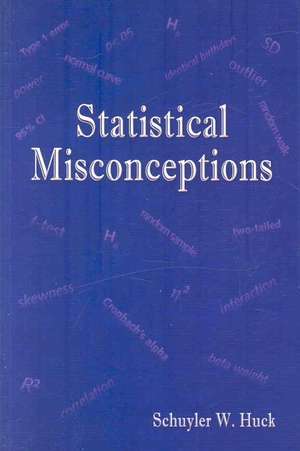
Statistical Misconceptions
Autor Schuyler W. Hucken Limba Engleză Paperback – 3 noi 2008
The author’s accessible discussion of each misconception has five parts:
- The Misconception - a brief description of the misunderstanding
- Evidence that the Misconception Exists – examples and claimed prevalence
- Why the Misconception is Dangerous – consequence of having the misunderstanding
- Undoing the Misconception - how to think correctly about the concept
- Internet Assignment - an interactive activity to help readers gain a firm grasp of the statistical concept and overcome the misconception.
Statistical Misconceptions is appropriate for courses taught in a variety of disciplines including psychology, medicine, education, nursing, business, and the social sciences. The book also will benefit independent researchers interested in undoing their statistical misconceptions.
| Toate formatele și edițiile | Preț | Express |
|---|---|---|
| Paperback (1) | 380.35 lei 43-57 zile | |
| Taylor & Francis – 3 noi 2008 | 380.35 lei 43-57 zile | |
| Hardback (1) | 1016.78 lei 43-57 zile | |
| Taylor & Francis – 3 noi 2008 | 1016.78 lei 43-57 zile |
Preț: 380.35 lei
Nou
Puncte Express: 571
Preț estimativ în valută:
67.31€ • 78.92$ • 59.11£
67.31€ • 78.92$ • 59.11£
Carte tipărită la comandă
Livrare economică 02-16 februarie 26
Preluare comenzi: 021 569.72.76
Specificații
ISBN-13: 9780805859041
ISBN-10: 0805859047
Pagini: 308
Ilustrații: 23 black & white tables
Dimensiuni: 152 x 229 x 18 mm
Greutate: 0.43 kg
Ediția:New.
Editura: Taylor & Francis
Colecția Routledge
Locul publicării:Oxford, United Kingdom
ISBN-10: 0805859047
Pagini: 308
Ilustrații: 23 black & white tables
Dimensiuni: 152 x 229 x 18 mm
Greutate: 0.43 kg
Ediția:New.
Editura: Taylor & Francis
Colecția Routledge
Locul publicării:Oxford, United Kingdom
V-ar putea interesa
-
 The Examined Life – How We Lose and Find OurselvesStephen GroszPreț: 81.03 lei
 -
 The New Dictionary of Kleinian ThoughtElizabeth Bott Spillius-5%Preț: 363.53 lei382.66 lei
 -
 Psychoanalysis in the Technoculture EraAlessandra Lemma-5%Preț: 362.73 lei381.82 lei
 -
 Changing Conceptions of Psychoanalysis: The Legacy of Merton M. GillDoris K. Silverman-34%Preț: 246.60 lei373.34 lei
 -
 Preț: 148.35 lei
 -
 Preț: 452.20 lei
 -
 Preț: 265.29 lei
 -
 -5%Preț: 302.89 lei318.83 lei
 -
 Heinz Kohut: The Chicago Institute LecturesPaul Tolpin-5%Preț: 391.03 lei411.61 lei
 -
 -15%Preț: 407.70 lei479.65 lei
 -
 Character and the Conduct of Life: Practical Psychology for EverymanWilliam McDougall-18%Preț: 1276.87 lei1557.15 lei
 -
 -5%Preț: 145.59 lei153.25 lei
 -
 The Fundamentals of Psychoanalytic TechniqueR. Horacio Etchegoyen-5%Preț: 507.24 lei533.93 lei
Cuprins
Part 1. Descriptive Statistics. 1.1. Measures of Central Tendency. 1.2. The Mean of Means. 1.3. The Mode’s Location. 1.4. The Standard Deviation. Part 2. Distributional Shape. 2.1. The Shape of the Normal Curve. 2.2. Skewed Distributions and Measures of Central Tendency. 2.3. Standard Scores and Normality. 2.4. Rectangular Distributions and Kurtosis. Part 3. Bivariate Correlation. 3.1. Correlation Coefficients. 3.2. Correlation and Causality. 3.3. The Effect of a Single Outlier on Pearson’s r. 3.4. Relationship Strength and r. 3.5. The Meaning of r = 0. Part 4. Reliability and Validity. 4.1. Statistical Indices of Reliability and Validity. 4.2. Interrater Reliability. 4.3. Cronbach’s Alpha and Unidimensionality. 4.4. Range Restriction and Predictive Validity. Part 5. Probability. 5.1. The Binomial Distribution and N. 5.2. A Random Walk With a Perfectly Fair Coin. 5.3. Two Goats and a Car. 5.4. Identical Birthdays. 5.5. The Sum of an Infinite Number of Numbers. 5.6.Being Diagnosed With a Rare Disease. 5.7. Risk Ratios and Odds Ratios. Part 6. Sampling. 6.1.The Character of Random Samples. 6.2. Random Replacements When Sampling. 6.3Precision and the Sampling Fraction. 6.4. Matched Samples. 6.5. Finite Versus Infinite Populations. Part 7. Estimation. 7.1. Interpreting a Confidence Interval. 7.2. Overlapping Confidence Intervals. 7.3. The Mean ± the Standard Error. 7.4. Confidence Intervals and Replication. Part 8. Hypothesis Testing. 8.1. Alpha and Type I Error Risk. 8.2. The Null Hypothesis. 8.3.Disproving Ho. 8.4. The Meaning of p. 8.5. Directionality and Tails. 8.6. The Relationship Between Alpha and Beta Errors. Part 9. t-Tests Involving One or Two Means. 9.1.Correlated t-Tests. 9.2. The Difference Between Two Means If p < .00001. 9.3. The Robustness of a t-Test When n1 = n2. Part 10. ANOVA and ANCOVA. 10.1. Pairwise Comparisons. 10.2. The Cause of a Significant Interaction. 10.3. Equal Covariate Means in ANCOVA. Part 11. Practical Significance, Power, and Effect Size. 11.1. Statistical Significance Versus Practical Significance. 11.2. A Priori and Post Hoc Power. 11.3. Eta Squared and Partial Eta Squared. Part 12. Regression. 12.1. Comparing Two rs; Comparing Two bs. 12.2. R2. 12.3. Predictor Variables that Are Uncorrelated with Y. 12.4. Beta Weights.
Recenzii
"There is a great need for a text to discuss the misconceptions in order to eliminate the myths... The author writes exceptionally well." - Nancy L. Leech, University of Colorado at Denver
"I sometimes feel that I spend as much time getting my students to ‘unlearn’ wrong ideas as I do getting them to learn new material ... I have always been impressed by the clarity of Dr. Huck’s writing ... I could well imagine adopting the book as a secondary text in the graduate-level introductory psychology statistics course [and] recommend it to students who come to me for statistical consulting." - Scott Maxwell, University of Notre Dame
"Readable, great examples... and actually fun... The Internet exercises will go a long way in terms of illustrating the misconception... [useful] at either the undergraduate or graduate level." - Richard Lomax, The Ohio State University
"[An] innovative and much-needed focus on the misconceptions that abound around statistical methods ... I consider [the author's books] to be among the best ... available for the undergraduate curriculum." - Joseph S. Rossi, University of Rhode Island
"I sometimes feel that I spend as much time getting my students to ‘unlearn’ wrong ideas as I do getting them to learn new material ... I have always been impressed by the clarity of Dr. Huck’s writing ... I could well imagine adopting the book as a secondary text in the graduate-level introductory psychology statistics course [and] recommend it to students who come to me for statistical consulting." - Scott Maxwell, University of Notre Dame
"Readable, great examples... and actually fun... The Internet exercises will go a long way in terms of illustrating the misconception... [useful] at either the undergraduate or graduate level." - Richard Lomax, The Ohio State University
"[An] innovative and much-needed focus on the misconceptions that abound around statistical methods ... I consider [the author's books] to be among the best ... available for the undergraduate curriculum." - Joseph S. Rossi, University of Rhode Island