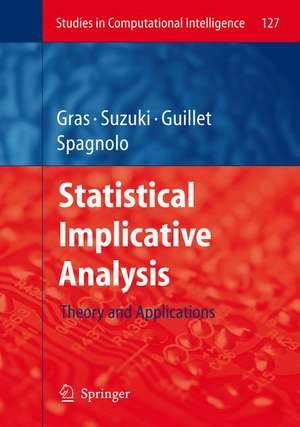
Statistical Implicative Analysis: Studies in Computational Intelligence, cartea 127
Editat de Régis Gras, Einoshin Suzuki, Fabrice Guillet, Filippo Spagnoloen Limba Engleză Hardback – 29 apr 2008
This volume collects significant research contributions of several rather distinct disciplines that benefit from SIA. Contributions range from psychological and pedagogical research, bioinformatics, knowledge management, and data mining.
Din seria Studies in Computational Intelligence
- 18%
 Preț: 924.22 lei
 - 20%
 Preț: 1229.71 lei
 - 5%
 Preț: 1058.46 lei
 - 20%
 Preț: 1030.18 lei
 - 18%
 Preț: 849.88 lei
 - 15%
 Preț: 626.20 lei
 - 20%
 Preț: 562.99 lei
 - 24%
 Preț: 891.41 lei
 - 20%
 Preț: 317.05 lei
 - 20%
 Preț: 1105.37 lei
 - 20%
 Preț: 1230.68 lei
 - 20%
 Preț: 671.27 lei
 - 18%
 Preț: 980.46 lei
 - 18%
 Preț: 980.87 lei
 - 15%
 Preț: 665.10 lei
 - 18%
 Preț: 982.36 lei
 - 20%
 Preț: 1090.62 lei
 - 20%
 Preț: 1395.65 lei
 - 20%
 Preț: 1244.59 lei
 - 15%
 Preț: 661.64 lei
 - 15%
 Preț: 658.54 lei
 - 15%
 Preț: 655.95 lei
 - 15%
 Preț: 664.69 lei
 - 18%
 Preț: 975.20 lei
 - 20%
 Preț: 1014.94 lei
 - 20%
 Preț: 1066.64 lei
 - 18%
 Preț: 1280.90 lei
 - 18%
 Preț: 950.43 lei
 - 15%
 Preț: 663.45 lei
 - 18%
 Preț: 1381.17 lei
 - 15%
 Preț: 656.62 lei
 - 18%
 Preț: 979.20 lei
 - 18%
 Preț: 980.03 lei
Preț: 1273.21 lei
Preț vechi: 1552.70 lei
-18%
Puncte Express: 1910
Carte tipărită la comandă
Livrare economică 07-21 decembrie
Livrare prin curier în România Termenul estimat este afișat lângă disponibilitate.
Transport gratuit pentru acest produs Plată online sau ramburs, în funcție de opțiunile comenzii.
Retur gratuit în 14 zile Comandă securizată și suport în română.
Specificații
ISBN-13: 9783540789826
ISBN-10: 3540789820
Pagini: 532
Ilustrații: XV, 513 p.
Dimensiuni: 160 x 241 x 33 mm
Greutate: 0.91 kg
Ediția:2008
Editura: Springer
Colecția Studies in Computational Intelligence
Seria Studies in Computational Intelligence
Locul publicării:Berlin, Heidelberg, Germany
ISBN-10: 3540789820
Pagini: 532
Ilustrații: XV, 513 p.
Dimensiuni: 160 x 241 x 33 mm
Greutate: 0.91 kg
Ediția:2008
Editura: Springer
Colecția Studies in Computational Intelligence
Seria Studies in Computational Intelligence
Locul publicării:Berlin, Heidelberg, Germany
V-ar putea interesa
-
 MATLAB DemystifiedDavid McMahonPreț: 148.50 lei
 -
 -22%Preț: 239.02 lei304.76 lei
 -
 -8%Preț: 130.57 lei141.45 lei
 -
 -20%Preț: 262.98 lei328.82 lei
 -
 The Chemistry Maths BookErich Steiner-19%Preț: 423.89 lei525.06 lei
 -
 Engineering Mathematics Through ApplicationsKuldeep Singh-20%Preț: 442.62 lei552.23 lei
 -
 Principles of Quantum MechanicsR. Shankar-15%Preț: 645.41 lei759.31 lei
 -
 Brownian Motion CalculusUbbo F. WiersemaPreț: 369.69 lei
 -
 Concepts and Applications of Finite Element AnalysisRobert D. Cook-18%Preț: 1379.65 lei1682.50 lei
 -
 Mathematical Methods for Physics and EngineeringK. F. Riley-8%Preț: 448.73 lei487.75 lei
 -
 Calculations for A Level PhysicsT L Lowe-24%Preț: 341.58 lei449.11 lei
 -
 Maths & English for ElectricalAndrew Spencer-16%Preț: 130.40 lei156.04 lei
 -
 -15%Preț: 618.50 lei727.65 lei
Public țintă
ResearchCuprins
Methodology and concepts for SIA.- An overview of the Statistical Implicative Analysis (SIA) development.- CHIC: Cohesive Hierarchical Implicative Classification.- Assessing the interestingness of temporal rules with Sequential Implication Intensity.- Application to concept learning in education, teaching, and didactics.- Student's Algebraic Knowledge Modelling: Algebraic Context as Cause of Student's Actions.- The graphic illusion of high school students.- Implicative networks of student's representations of Physical Activities.- A comparison between the hierarchical clustering of variables, implicative statistical analysis and confirmatory factor analysis.- Implications between learning outcomes in elementary bayesian inference.- Personal Geometrical Working Space: a Didactic and Statistical Approach.- A methodological answer in various application frameworks.- Statistical Implicative Analysis of DNA microarrays.- On the use of Implication Intensity for matching ontologies and textual taxonomies.- Modelling by Statistic in Research of Mathematics Education.- Didactics of Mathematics and Implicative Statistical Analysis.- Using the Statistical Implicative Analysis for Elaborating Behavioral Referentials.- Fictitious Pupils and Implicative Analysis: a Case Study.- Identifying didactic and sociocultural obstacles to conceptualization through Statistical Implicative Analysis.- Extensions to rule interestingness in data mining.- Pitfalls for Categorizations of Objective Interestingness Measures for Rule Discovery.- Inducing and Evaluating Classification Trees with Statistical Implicative Criteria.- On the behavior of the generalizations of the intensity of implication: A data-driven comparative study.- The TVpercent principle for the counterexamples statistic.- User-SystemInteraction for Redundancy-Free Knowledge Discovery in Data.- Fuzzy Knowledge Discovery Based on Statistical Implication Indexes.
Textul de pe ultima copertă
Statistical implicative analysis is a data analysis method created by Régis Gras almost thirty years ago which has a significant impact on a variety of areas ranging from pedagogical and psychological research to data mining. Statistical implicative analysis (SIA) provides a framework for evaluating the strength of implications; such implications are formed through common knowledge acquisition techniques in any learning process, human or artificial. This new concept has developed into a unifying methodology, and has generated a powerful convergence of thought between mathematicians, statisticians, psychologists, specialists in pedagogy and last, but not least, computer scientists specialized in data mining.
This volume collects significant research contributions of several rather distinct disciplines that benefit from SIA. Contributions range from psychological and pedagogical research, bioinformatics, knowledge management, and data mining.
This volume collects significant research contributions of several rather distinct disciplines that benefit from SIA. Contributions range from psychological and pedagogical research, bioinformatics, knowledge management, and data mining.
Caracteristici
Presents latest results in statistical implicative analysis Includes supplementary material: sn.pub/extras