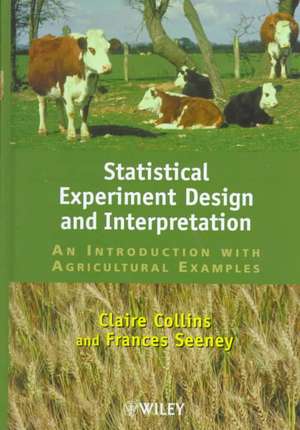
Statistical Experiment Design and Interpretation
Autor Claire A Collins, Frances M Seeneyen Limba Engleză Hardback – sep 1999
Preț: 2060.40 lei
Preț vechi: 2264.18 lei
-9%
Puncte Express: 3091
Carte tipărită la comandă
Livrare economică 02-16 decembrie
Livrare prin curier în România Termenul estimat este afișat lângă disponibilitate.
Transport gratuit pentru acest produs Plată online sau ramburs, în funcție de opțiunile comenzii.
Retur gratuit în 14 zile Comandă securizată și suport în română.
Specificații
ISBN-13: 9780471960065
ISBN-10: 0471960063
Pagini: 288
Dimensiuni: 175 x 250 x 20 mm
Greutate: 0.69 kg
Ediția:New.
Editura: Wiley
Locul publicării:Chichester, United Kingdom
ISBN-10: 0471960063
Pagini: 288
Dimensiuni: 175 x 250 x 20 mm
Greutate: 0.69 kg
Ediția:New.
Editura: Wiley
Locul publicării:Chichester, United Kingdom
V-ar putea interesa
-
 -27%Preț: 857.64 lei1174.86 lei
-
 Handbook of ProbabilityFlorescu-9%Preț: 997.83 lei1096.52 lei
-
 Adaptive TestsO'Gorman-9%Preț: 941.44 lei1034.54 lei
-
 Information Theory and Coding by ExampleMark KelbertPreț: 455.85 lei
-
 The SAGE Handbook of Multilevel ModelingMarc A. Scott-23%Preț: 1240.19 lei1610.63 lei
-
 Probability – With Applications and RRP Dobrow-27%Preț: 830.20 lei1137.26 lei
-
 Fast Sequential Monte Carlo Methods for Counting and OptimizationReuven Y Rubinstein-9%Preț: 765.18 lei840.86 lei
-
 -27%Preț: 804.81 lei1102.47 lei
-
 Introduction to Statistical Analysis of LaboratoryDataAlfred Bartolucci-9%Preț: 773.55 lei850.05 lei
-
 -18%Preț: 765.97 lei934.11 lei
-
 -18%Preț: 732.18 lei892.91 lei
-
 -5%Preț: 948.13 lei998.03 lei
-
 Preț: 375.81 lei
-
 The LORELIA Residual TestGeraldine Rauch-8%Preț: 526.01 lei571.75 lei
Public țintă
Agricultural Scientists, Researchers, Agronomists, Agricultural Research Workers involved in designing experiments and analysing data who need a practical working knowledge of Statistics, Advanced Agricultural Students.Notă biografică
Dr. Liam Collins is the executive director of the Madison Policy Forum, a senior fellow with New America, and a permanent member with the Council on Foreign Relations. Colonel (retired) Collins served in the US Army for 27 years. As a career Special Forces officer, he conducted multiple operational and combat deployments to Afghanistan, Iraq, Bosnia, South America, and the Horn of Africa. In Iraq, Liam conducted operations in Baghdad, Fallujah, Ramadi, and many other cities. Liam retired from the military in 2019 as the founding director of the Modern War Institute and the director of the Department of Military Instruction at the United States Military Academy at West Point. He holds a Bachelor of Science degree in Mechanical Engineering (Aerospace) from the United States Military Academy, and a Master's in Public Affairs and a PhD from Princeton University's School of Public and International Affairs.
Cuprins
Acknowledgements
INTRODUCTION
Notation
A little history
Population versus samples
PLANNING
Formulating the idea
Defining objectives
Defining the population
Formulating hypotheses
Hypothesis testing
Anticipating treatment differences
DESIGN
Variables
Choosing the treatments
Constraints
Replication
Blocking
Randomization
Covariants
Confounding
TRIAL STRUCTURE
Considerations
Single-treatment factor designs
Multi-treatment factor designs
Some other designs
DATA ENTRY AND EXPLORATION
Data entry
Data
Data checking
Data exploration
ANALYTICAL TECHNIQUES
Parametric techniques
Non-parametric techniques
Comparison of parametric and non-parametric techniques
OTHER STATISTICAL TECHNIQUES
Multivariate analysis
Time series analysis
ASPECTS OF COMPUTING
APPENDICES
Glossary of Statistical Terms
Analysis of Variance Formulae
INDEX
Descriere
Clearly written and free of statistical jargon, this invaluable guide concentrates on the practicalities of statistical analysis for anyone involved with agricultural research. Each section starts with the key points, giving a quick reference to the contents and plenty of examples using a reala data.