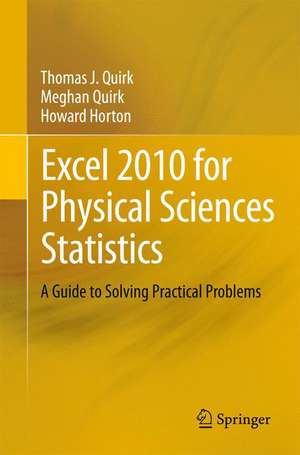
Excel 2010 for Physical Sciences Statistics: A Guide to Solving Practical Problems
Autor Thomas J. Quirk, Meghan Quirk, Howard Hortonen Limba Engleză Paperback – 3 sep 2013
Considerăm că Excel 2010 for Physical Sciences Statistics reprezintă un instrument de lucru esențial pentru studenții din ciclul de licență și practicienii care au nevoie de o metodă pragmatică pentru a gestiona analizele cantitative în științele fizice. Această ediție publicată de Springer se remarcă prin abordarea didactică progresivă, eliminând barierele tehnice pentru cei care nu sunt familiarizați cu programele de calcul sau care consideră statistica o disciplină dificilă. Găsim în acest volum o structură clară, care pornește de la concepte fundamentale precum media și deviația standard, avansând către generatorul de numere aleatorii, intervale de încredere și teste de ipoteză (One-Group și Two-Group t-Test). Finalul cărții este dedicat corelației și regresiei liniare simple, oferind astfel un parcurs complet pentru nevoile curriculare curente.
Spre deosebire de alte manuale teoretice, lucrarea semnată de Thomas J. Quirk, Meghan Quirk și Howard Horton mizează pe componenta vizuală, integrând 159 de ilustrații color care ghidează utilizatorul prin interfața software-ului. Această abordare este o constantă în opera autorului, Thomas J. Quirk dezvoltând o întreagă serie de ghiduri precum Excel 2019 for Engineering Statistics sau Excel 2019 for Biological and Life Sciences Statistics, adaptând aceeași metodologie riguroasă la diverse domenii de specialitate.
Considerăm acest volum o alternativă practică la Excel 2010 for Engineering Statistics pentru cursurile de laborator din facultățile de fizică sau chimie, având avantajul utilizării unor exemple și probleme specifice fenomenelor fizice, mai degrabă decât aplicațiilor tehnice de inginerie. Prezența exercițiilor la finalul fiecărui capitol și a unui test practic complet în apendice transformă lectura dintr-una pasivă într-un proces de învățare activă.
Preț: 375.81 lei
Carte disponibilă
Livrare economică 07-21 noiembrie
Specificații
ISBN-10: 3319006290
Pagini: 170
Ilustrații: XVII, 248 p. 159 illus., 158 illus. in color.
Dimensiuni: 155 x 235 x 15 mm
Greutate: 0.48 kg
Ediția:2013
Editura: Springer International Publishing
Colecția Springer
Locul publicării:Cham, Switzerland
V-ar putea interesa
-
 Spatial Statistics and ModelingCarlo Gaetan-18%Preț: 1156.33 lei1410.17 lei
 -
 Applied Linear Regression 4ESanford Weisberg-23%Preț: 865.68 lei1124.25 lei
 -
 -27%Preț: 830.20 lei1137.26 lei
 -
 Petroleum Big Data (SAS)Holdaway-8%Preț: 464.28 lei504.65 lei
 -
 Online Panel ResearchCallegaro-8%Preț: 626.02 lei680.45 lei
 -
 Correspondence AnalysisEric J Beh-8%Preț: 723.26 lei786.16 lei
 -
 Modern Applied Statistics with SW. N. Venables-18%Preț: 1123.42 lei1370.02 lei
 -
 Biostatistics with RBabak Shahbaba-5%Preț: 597.09 lei628.52 lei
 -
 Excel 2010 for Educational and Psychological StatisticsThomas J. QuirkPreț: 404.26 lei
 -
 -18%Preț: 788.11 lei961.10 lei
 -
 Laws of Small Numbers: Extremes and Rare EventsMichael Falk-18%Preț: 799.54 lei975.06 lei
 -
 Handbook of Brownian Motion - Facts and FormulaeAndrei N. Borodin-18%Preț: 1400.80 lei1708.29 lei
 -
 -18%Preț: 846.49 lei1032.30 lei
Public țintă
Upper undergraduateDe ce să citești această carte
Această carte se adresează studenților și cercetătorilor care doresc să stăpânească statistica aplicată fără a se pierde în demonstrații matematice complexe. Prin utilizarea unui program accesibil precum Excel, cititorul câștigă competențe imediate în prelucrarea datelor experimentale. Este un ghid de tip „cum să fac”, ideal pentru cei care preferă învățarea prin exercițiu și vizualizarea grafică a rezultatelor, oferind siguranța necesară în rezolvarea problemelor practice de laborator.
Despre autor
Thomas J. Quirk este un profesor și autor prolific, specializat în adaptarea capacităților software-ului Microsoft Excel pentru predarea statisticii în diverse domenii academice. Cu o experiență vastă în dezvoltarea materialelor educaționale, Quirk a publicat numeroase volume în colaborare cu Springer, acoperind discipline de la psihologie și educație până la inginerie și științe biologice. Abordarea sa se concentrează pe simplificarea conceptelor statistice pentru studenții care nu au o pregătire matematică avansată, transformând Excel-ul dintr-un simplu tabel de calcul într-un instrument analitic puternic. Lucrările sale sunt recunoscute pentru claritatea instrucțiunilor și orientarea către aplicații practice imediate.
Descriere scurtă
Excel, a widely available computer program for students and managers, is also an effective teaching and learning tool for quantitative analyses in science courses. Its powerful computational ability and graphical functions make learning statistics much easier than in years past. However, Excel 2010 for Physical Sciences Statistics: A Guide to Solving Practical Problems is the first book to capitalize on these improvements by teaching students and managers how to apply Excel to statistical techniques necessary in their courses and work.
Each chapter explains statistical formulas and directs the reader to use Excel commands to solve specific, easy-to-understand science problems. Practice problems are provided at the end of each chapter with their solutions in an appendix. Separately, there is a full Practice Test (with answers in an Appendix) that allows readers to test what they have learned.
Includes 159 illustrations in color
Suitable for undergraduates or graduate students
Cuprins
Recenzii
Notă biografică
Meghan H.Quirk holds both a Ph.D. in Biological Education and an M.A. in Biological Sciences from the University of NorthernColorado (UNC) and a B.A. in Biology and Religion at Principia College in Elsah, Illinois. She has done research on foodweb dynamics at Wind Cave National Park in South Dakota and research in agro-ecology in Southern Belize. She has co-authored an article on shortgrass steppe ecosystems in Photochemistry & Photobiology and has presented papers at the Shortgrass Steppe Symposium in Fort Collins, Colorado, the Long-term Ecological Research All Scientists Meeting in Estes Park, Colorado, and participated in the NSF Site Review of the Shortgrass Steppe Long Term Ecological Research in Nunn, Colorado. She was a National Science Foundation Fellow GK-12, and currently teaches in Bailey, Colorado.
Howard F. Horton holds an MS in Biological Sciences from the University of Northern Colorado (UNC) and a BS in Biological Sciences from Mesa State College. He has worked on research projects in Pawnee National Grasslands, Rocky Mountain National Park, Long Term Ecological Research at Toolik Lake, Alaska, and Wind Cave, South Dakota. He has co-authored articles in The International Journal of Speleology and The Journal of Cave and Karst Studies. He was a National Science Foundation Fellow GK-12, and is currently a District Wildlife Manager with the Colorado Division of Parks and Wildlife.
Textul de pe ultima copertă
Each chapter explains statistical formulas and directs the reader to use Excel commands to solve specific, easy-to-understand science problems. Practice problems are provided at the end of each chapter with their solutions in an appendix. Separately, there is a full Practice Test (with answers in an Appendix) that allows readers to test what they have learned.
· Includes 159 illustrations in color.
· Suitable for undergraduates or graduate students.
Professor. Thomas J. Quirk is currently a Professor of Marketing in the Walker School of Business and Technology at Webster University in St. Louis, Missouri (USA). He has published over 20 articles in professional journals and presented more than 20 papers at professional conferences. He holds a B.S. in Mathematics from John Carroll University, and both an M.A. in Education and a Ph.D. in Educational Psychology from Stanford University, as well as an M.B.A. from the University of Missouri-St. Louis.
Dr. Meghan H. Quirk holds both a Ph.D. in Biological Education and an M.A. in Biological Sciences from the University of Northern Colorado (UNC) and a B.A. in Biology and Religion at Principia College in Elsah, Illinois. She has done research on foodweb dynamics at Wind Cave National Park in South Dakota and research in agro-ecology in Southern Belize. She has co-authored an article on shortgrass steppe ecosystems in Photochemistry & Photobiology. She was a National Science Foundation Fellow GK-12, and currently teaches in Bailey, Colorado.
Howard F. Horton holds an M.S. in Biological Sciences from the University of Northern Colorado (UNC) and a B.S. in Biological Sciences from Mesa State College. He has worked on research projects in Pawnee National Grasslands, Rocky Mountain National Park, Long-Term Ecological Research at Toolik Lake, Alaska, and Wind Cave, South Dakota. He has co-authored articles in The International Journal of Speleology and The Journal of Cave and Karst Studies. He was a National Science Foundation Fellow GK-12, and a District Wildlife Manager with the Colorado Division of Parks and Wildlife. He is currently the Angler Outreach Coordinator with Colorado Parks and Wildlife.