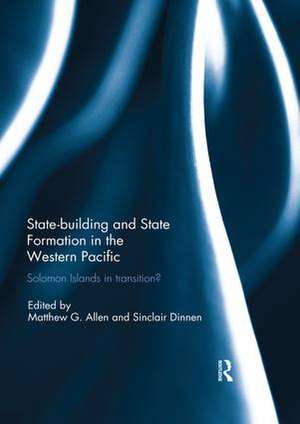
Statebuilding and State Formation in the Western Pacific: Solomon Islands in Transition?
Editat de Matthew Allen, Sinclair Dinnenen Limba Engleză Paperback – 14 ian 2019
| Toate formatele și edițiile | Preț | Express |
|---|---|---|
| Paperback (1) | 265.29 lei 6-8 săpt. | |
| Taylor & Francis – 14 ian 2019 | 265.29 lei 6-8 săpt. | |
| Hardback (1) | 670.92 lei 6-8 săpt. | |
| Taylor & Francis – 11 aug 2016 | 670.92 lei 6-8 săpt. |
Preț: 265.29 lei
Nou
Puncte Express: 398
Preț estimativ în valută:
46.94€ • 55.12$ • 41.20£
46.94€ • 55.12$ • 41.20£
Carte tipărită la comandă
Livrare economică 27 ianuarie-10 februarie 26
Preluare comenzi: 021 569.72.76
Specificații
ISBN-13: 9780367028374
ISBN-10: 0367028379
Pagini: 152
Dimensiuni: 174 x 246 x 10 mm
Greutate: 0.25 kg
Ediția:1
Editura: Taylor & Francis
Colecția Routledge
Locul publicării:Oxford, United Kingdom
ISBN-10: 0367028379
Pagini: 152
Dimensiuni: 174 x 246 x 10 mm
Greutate: 0.25 kg
Ediția:1
Editura: Taylor & Francis
Colecția Routledge
Locul publicării:Oxford, United Kingdom
Public țintă
Postgraduate and UndergraduateCuprins
1. Solomon Islands in Transition? 2. The Teleology and Romance of State-building in Solomon Islands 3. Honiara: Arrival City and Pacific Hybrid Living Space 4. From Taovia to Trustee: Urbanisation, Land Disputes and Social Differentiation in Kakabona 5. Customary Authority and State Withdrawal in Solomon Islands: Resilience or Tenacity? 6. Big Money in the Rural: Wealth and Dispossession in Western Solomons Political Economy 7. Maasina Rule beyond Recognition 8. Urban Land in Honiara: Strategies and Rights to the City
Descriere
This book provides in-depth social science analysis of this Melanesian nation at a critical juncture in its post-colonial and post-conflict history and an engagement with important global debates, with contributions from leading scholars of Solomon Islands. Organised around a central tension between change and continuity, the book examines contested narratives of changing state-society relations, the changing social relations around land and natural resources, and the critical distinction between ‘state-building’ and ‘state formation’.