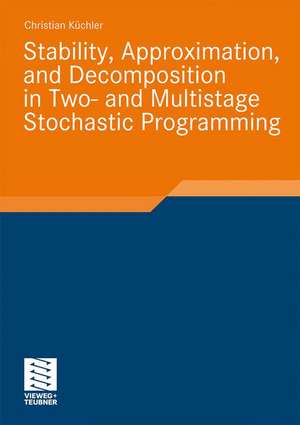
Stability, Approximation, and Decomposition in Two- and Multistage Stochastic Programming: Stochastic Programming
Autor Christian Küchleren Limba Engleză Paperback – 24 sep 2009
Preț: 365.65 lei
Puncte Express: 548
Carte tipărită la comandă
Livrare economică 25 august-08 septembrie
Livrare prin curier în România Termenul estimat este afișat lângă disponibilitate.
Transport gratuit de la 400.00 lei Plată online sau ramburs, în funcție de opțiunile comenzii.
Retur gratuit în 14 zile Comandă securizată și suport în română.
Specificații
ISBN-13: 9783834809216
ISBN-10: 3834809217
Pagini: 168
Ilustrații: 184 p. 49 illus.
Dimensiuni: 148 x 210 x 20 mm
Greutate: 0.23 kg
Ediția:2009
Editura: Vieweg+Teubner Verlag
Colecția Vieweg+Teubner Verlag
Seria Stochastic Programming
Locul publicării:Wiesbaden, Germany
ISBN-10: 3834809217
Pagini: 168
Ilustrații: 184 p. 49 illus.
Dimensiuni: 148 x 210 x 20 mm
Greutate: 0.23 kg
Ediția:2009
Editura: Vieweg+Teubner Verlag
Colecția Vieweg+Teubner Verlag
Seria Stochastic Programming
Locul publicării:Wiesbaden, Germany
V-ar putea interesa
-
 Bayesian Inference in Dynamic Econometric ModelsLuc Bauwens-14%Preț: 499.40 lei583.03 lei
 -
 Handbook in Monte Carlo SimulationPaolo Brandimarte-9%Preț: 941.39 lei1034.50 lei
 -
 -9%Preț: 677.50 lei744.51 lei
 -
 Randomized AlgorithmsRajeev Motwani-11%Preț: 589.25 lei662.08 lei
 -
 Growth Curve ModelingMichael J Panik-9%Preț: 874.95 lei961.48 lei
 -
 Mathematical and Computational ModelingRoderick Melnik-8%Preț: 637.85 lei693.32 lei
 -
 Milling SimulationWeihong Zhang-9%Preț: 964.81 lei1060.23 lei
 -
 Graphs, Maps, TreesFranco MorettiPreț: 102.95 lei
 -
 Nonlinear Physical SystemsOleg N Kirillov-23%Preț: 1174.32 lei1525.10 lei
 -
 Mathematics for Modeling and Scientific ComputingThierry Goudon-9%Preț: 977.13 lei1073.77 lei
 -
 Systems Dependability AssessmentJean-Francois Aubry-9%Preț: 965.49 lei1060.97 lei
 -
 METHODS & APPL OF WHITE NOISE ANALY IN INTERDISCIPLIN SCIBernido Christopher C-15%Preț: 558.77 lei657.38 lei
Public țintă
ResearchCuprins
Stability of Multistage Stochastic Programs.- Recombining Trees for Multistage Stochastic Programs.- Scenario Reduction with Respect to Discrepancy Distances.
Notă biografică
Dr. Christian Küchler completed his doctoral thesis at the Humboldt University, Berlin. He currently works as a quantitative analyst at Landesbank Berlin AG.
Textul de pe ultima copertă
Stochastic programming provides a framework for modelling, analyzing, and solving optimization problems with some parameters being not known up to a probability distribution. Such problems arise in a variety of applications, such as inventory control, financial planning and portfolio optimization, airline revenue management, scheduling and operation of power systems, and supply chain management.
Christian Küchler studies various aspects of the stability of stochastic optimization problems as well as approximation and decomposition methods in stochastic programming. In particular, the author presents an extension of the Nested Benders decomposition algorithm related to the concept of recombining scenario trees. The approach combines the concept of cut sharing with a specific aggregation procedure and prevents an exponentially growing number of subproblem evaluations. Convergence results and numerical properties are discussed.
Christian Küchler studies various aspects of the stability of stochastic optimization problems as well as approximation and decomposition methods in stochastic programming. In particular, the author presents an extension of the Nested Benders decomposition algorithm related to the concept of recombining scenario trees. The approach combines the concept of cut sharing with a specific aggregation procedure and prevents an exponentially growing number of subproblem evaluations. Convergence results and numerical properties are discussed.