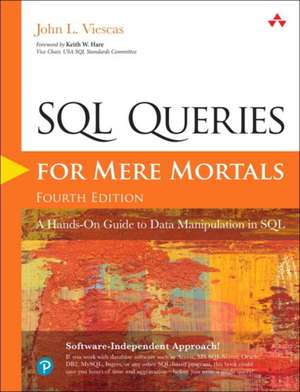
SQL Queries for Mere Mortals
Autor John Viescasen Limba Engleză Paperback – 9 feb 2018
Prin parcurgerea acestui volum, cititorul va dobândi capacitatea de a construi interogări fiabile și performante, capabile să extragă informații relevante din aproape orice sistem de baze de date relaționale modern. Notăm cu interes modul în care John Viescas demistifică procesul de scriere a interogărilor, transformând logica seturilor dintr-un concept abstract într-un instrument de lucru cotidian. Ca și Mark Simon în Leveling Up with SQL, autorul distilează experiența reală în principii acționabile, însă SQL Queries for Mere Mortals se distinge prin volumul impresionant de detalii tehnice și prin independența totală față de un anumit software. Structura lucrării este riguros organizată în șase părți, facilitând o progresie logică: se începe cu fundamentele bazei de date și verificarea integrității structurale, continuă cu elementele de bază ale limbajului SQL (SELECT, WHERE, ORDER BY) și avansează spre operațiuni complexe de tip JOIN, subinterogări și manipularea seturilor de date. Ne-a atras atenția în mod deosebit secțiunea dedicată rezolvării problemelor dificile, unde sunt abordate condițiile logice sofisticate și utilizarea tabelelor de tip „driver”. Cele două capitole noi, axate pe funcții de fereastră și raportare avansată, aduc textul la zi cu cerințele actuale de analiză a datelor, oferind soluții pentru agregări care depășesc simplul GROUP BY. Această ediție a patra reprezintă un manual tehnic exhaustiv, unde teoria este dublată de baze de date demonstrative descărcabile, permițând testarea imediată a sintaxei în medii precum SQL Server sau PostgreSQL.
Preț: 334.07 lei
Preț vechi: 417.58 lei
-20%
Carte disponibilă
Livrare economică 13-27 noiembrie
Livrare express 29 octombrie-04 noiembrie pentru 83.67 lei
Specificații
ISBN-10: 0134858336
Pagini: 960
Dimensiuni: 178 x 232 x 51 mm
Greutate: 1.45 kg
Ediția:4th edition
Editura: Pearson Education
V-ar putea interesa
-
 Language of SQL, TheLarry Rockoff-20%Preț: 141.44 lei176.80 lei
 -
 -20%Preț: 175.58 lei219.48 lei
 -
 Clean Agile: Back to BasicsRobert Martin-20%Preț: 249.66 lei312.08 lei
 -
 -20%Preț: 211.63 lei264.55 lei
 -
 MySQL Crash CourseBen Forta-20%Preț: 209.68 lei262.10 lei
 -
 Data Analysis Using SQL and ExcelGordon S LinoffPreț: 408.25 lei
 -
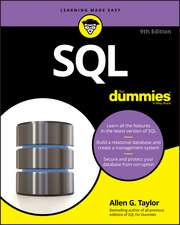 SQL For DummiesAllen G. Taylor-20%Preț: 174.83 lei218.53 lei
 -
 Database SystemsRamez Elmasri-20%Preț: 552.09 lei690.12 lei
 -
 SQL All-in-One For DummiesAllen G. Taylor-20%Preț: 173.32 lei216.65 lei
 -
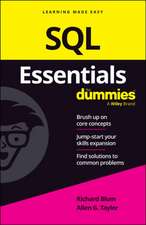 SQL Essentials for DummiesRichard Blum-20%Preț: 65.83 lei82.30 lei
 -
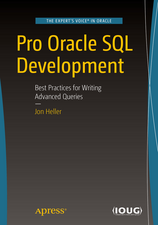 -20%Preț: 312.33 lei390.41 lei
 -
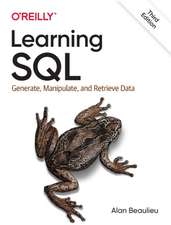 Learning SQL: Generate, Manipulate, and Retrieve DataAlan Beaulieu-20%Preț: 324.02 lei405.03 lei
 -
 Exam Ref 70-761 Querying Data with Transact-SQLItzik Ben-Gan-20%Preț: 197.41 lei246.76 lei
 -
 Learn SQL in a Month of LunchesJeff Iannucci-20%Preț: 287.75 lei359.68 lei
 -
 Practical SQL, 2nd EditionAnthony Debarros-20%Preț: 218.15 lei272.68 lei
 -
 SQL in Easy StepsMike Mcgrath-20%Preț: 73.65 lei92.06 lei
 -
 Oracle SQL and PL/SQL: (3rd Edition)Joel Murach-20%Preț: 309.10 lei386.38 lei
 -
 High-Performance Java PersistenceVlad MIhalcea-20%Preț: 280.96 lei351.20 lei
De ce să citești această carte
Recomandăm această carte oricărui profesionist care lucrează cu date, de la programatori la analiști, deoarece oferă o metodologie clară pentru a scrie cod SQL eficient și corect. Veți câștiga nu doar competențe tehnice, ci și o înțelegere profundă a modului în care trebuie structurate interogările pentru a obține rezultate precise în scenarii complexe de business. Este ghidul definitiv pentru a trece de la interogări simple la analize sofisticate de date.
Despre autor
John Viescas este un autor și consultant de renume mondial, specializat în sisteme de baze de date. Cu o experiență de peste patru decenii în domeniu, el a fost recunoscut pentru expertiza sa tehnică, fiind un nume de referință în comunitatea dezvoltatorilor. Prin seria sa de succes For Mere Mortals, publicată de Pearson Education (US), Viescas și-a dedicat cariera traducerii conceptelor tehnice aride în limbaj accesibil, fără a sacrifica rigoarea necesară implementărilor profesionale. Expertiza sa acoperă o gamă largă de platforme, de la Microsoft Access la SQL Server, fiind un fin observator al evoluției standardelor SQL.
Descriere
The #1 Easy, Common-Sense Guide to SQL Queries―Updated with More Advanced Techniques and Solutions
Foreword by Keith W. Hare, Vice Chair, USA SQL Standards Committee
SQL Queries for Mere Mortals has earned worldwide praise as the clearest, simplest tutorial on writing effective queries with the latest SQL standards and database applications. Now, author John L. Viescas has updated this hands-on classic with even more advanced and valuable techniques.
Step by step, Viescas guides you through creating reliable queries for virtually any current SQL-based database. He demystifies all aspects of SQL query writing, from simple data selection and filtering to joining multiple tables and modifying sets of data.
Building on the basics, Viescas shows how to solve challenging real-world problems, including applying multiple complex conditions on one table, performing sophisticated logical evaluations, and using unlinked tables to think “outside the box.”
In two brand-new chapters, you learn how to perform complex calculations on groups for sophisticated reporting, and how to partition data into windows for more flexible aggregation.
Practice all you want with downloadable sample databases for today’s versions of Microsoft Office Access, Microsoft SQL Server, and the open source MySQL and PostgreSQL databases. Whether you’re a DBA, developer, user, or student, there’s no better way to master SQL.
Coverage includes:
- Getting started: understanding what relational databases are, and ensuring that your database structures are sound
- SQL basics: using SELECT statements, creating expressions, sorting information with ORDER BY, and filtering data using WHERE
- Summarizing and grouping data with GROUP BY and HAVING clauses
- Drawing data from multiple tables: using INNER JOIN, OUTER JOIN, and UNION operators, and working with subqueries
- Modifying data sets with UPDATE, INSERT, and DELETE statements
- Advanced queries: complex NOT and AND, conditions, if-then-else using CASE, unlinked tables, driver tables, and more
- NEW! Using advanced GROUP BY keywords to create subtotals, roll-ups, and more
- NEW! Applying window functions to answer more sophisticated questions, and gain deeper insight into your data
Software-Independent Approach!
If you work with database software such as Access, MS SQL Server, Oracle, DB2, MySQL, Ingres, or any other SQL-based program, this book could save you hours of time and aggravation―before you write a single query!
Notă biografică
John joined Tandem Computers, Inc., in 1988, where he was responsible for the development and implementation of database marketing programs in Tandem's U.S. Western Sales region. He developed and delivered technical seminars on Tandem's relational database management system, NonStop SQL. John wrote his first book, A Quick Reference Guide to SQL (Microsoft Press, 1989), as a research project to document the similarities in the syntax among the ANSI-86 SQL standard, IBM's DB2, Microsoft's SQL Server, Oracle Corporation's Oracle, and Tandem's NonStop SQL. He wrote the first edition of Running Microsoft Access (Microsoft Press, 1992) while on sabbatical from Tandem. He has since written four editions of Running, three editions of Microsoft Office Access Inside Out (Microsoft Press, 2003, 2007, and 2010-the successor to the Running series), Building Microsoft Access Applications (Microsoft Press, 2005), and Effective SQL (Addison-Wesley, 2017).
John formed his own company in 1993. He provides information systems management consulting for a variety of small to large businesses around the world, with a specialty in the Microsoft Access and SQL Server database management products. He maintains offices in Nashua, New Hampshire, and Paris, France. He was recognized as a "Most Valuable Professional" (MVP) from 1993 to 2015 by Microsoft Product Support Services for his assistance with technical questions on public support forums. He set a landmark 20 consecutive years as an MVP in 2013.
You can visit John's Web site at www.viescas.com.
Cuprins
- Part I: Relational Databases and SQL
- Chapter 1: What Is Relational?
- Chapter 2: Ensuring Your Database Structure Is Sound
- Chapter 3: A Concise History of SQL
- Part II: SQL Basics
- Chapter 4: Creating a Simple Query
- Chapter 5: Getting More Than Simple Columns
- Chapter 6: Filtering Your Data
- Part III: Working with Multiple Tables
- Chapter 7: Thinking in Sets
- Chapter 8: INNER JOINs
- Chapter 9: OUTER JOINs
- Chapter 10: UNIONs
- Chapter 11: Subqueries
- Part IV: Summarizing and Grouping Data
- Chapter 12: Simple Totals
- Chapter 13: Grouping Data
- Chapter 14: Filtering Grouped Data
- Part V: Modifying Sets of Data
- Chapter 15: Updating Sets of Data
- Chapter 16: Inserting Sets of Data
- Chapter 17: Deleting Sets of Data
- PART VI Introduction to Solving Tough Problems
- Chapter 18 “NOT” And “AND” Problems
- Chapter 19 Condition Testing
- Chapter 20 Using Unlinked Data and “Driver” Tables
- Chapter 21 Performing Complex Calculations on Groups
- Chapter 22: More SQL Server Complex Problems to Solve
- APPENDICES
- Appendix A: SQL Standard Diagrams
- Appendix B: Schema for the Sample Databases
- Appendix C: Date and Time Functions
- Appendix D: Suggested Reading