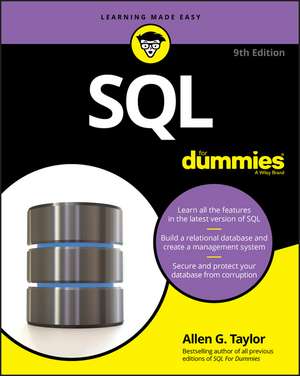
SQL For Dummies
Autor Allen G. Tayloren Limba Engleză Paperback – 11 dec 2018
ABORDAREA PRACTICĂ: Găsim în această carte un echilibru tehnic precis, unde conceptele teoretice ale modelului relațional sunt transpuse imediat în instrucțiuni SQL aplicabile. Ne-a atras atenția faptul că autorul nu se limitează la simple interogări de extragere a datelor, ci ghidează cititorul prin întreg ciclul de viață al unei baze de date: de la proiectarea structurii și definirea tabelelor, până la administrarea securității și manipularea seturilor complexe de informații. Volumul de față, ajuns la a 9-a ediție, servește drept ancoră tehnică pentru dezvoltatorii web și administratorii de sistem care au nevoie de o referință rapidă pentru sintaxa standard utilizată în Oracle, SQL Server sau MySQL. Reținem integrarea unor subiecte avansate, precum utilizarea datelor temporale, explicate într-un limbaj accesibil, specific seriei „For Dummies”. Complementar volumului SQL in Easy Steps, care pune un accent deosebit pe instalarea și configurarea serverelor MySQL în medii Windows sau Linux, SQL for Dummies acoperă zona de arhitectură a bazelor de date și implementarea designului logic, oferind o perspectivă mai largă asupra sistemelor de management al bazelor de date (DBMS). În contextul operei sale, Allen G Taylor continuă direcția începută în Database Development For Dummies, rafinând conceptele de organizare a datelor și adaptându-le la complexitatea site-urilor moderne. Structura narativă a textului este una modulară, permițând utilizatorului să sară direct la capitolul de interes, fie că este vorba despre crearea de scheme de baze de date sau despre securizarea accesului la informații. Ritmul este constant, axat pe eficiență, oferind exemple de cod care pot fi replicate imediat în mediile de producție sau de testare, fără a necesita cunoștințe prealabile de programare.
Preț: 174.83 lei
Preț vechi: 218.53 lei
-20%
Carte disponibilă
Livrare economică 15-29 decembrie
Livrare express 28 noiembrie-04 decembrie pentru 50.86 lei
Specificații
ISBN-10: 1119527074
Pagini: 512
Dimensiuni: 187 x 235 x 30 mm
Greutate: 0.96 kg
Ediția:9 ed
Editura: John Wiley & Sons, Inc.
Locul publicării:Hoboken, United States
V-ar putea interesa
-
 Language of SQL, TheLarry Rockoff-20%Preț: 141.44 lei176.80 lei
-
 SQL Queries for Mere MortalsJohn Viescas-20%Preț: 340.74 lei425.92 lei
-
 -20%Preț: 193.27 lei241.59 lei
-
 -20%Preț: 211.63 lei264.55 lei
-
 Database and Application SecurityR Sarma Danturthi-20%Preț: 306.16 lei382.71 lei
-
 A Guide to SQLMark Shellman-22%Preț: 447.20 lei576.83 lei
-
 Access 2019 For DummiesLaurie A. Ulrich-20%Preț: 170.39 lei212.98 lei
-
 Database SystemsRamez Elmasri-20%Preț: 594.63 lei743.29 lei
-
 SQL All-in-One For DummiesAllen G. Taylor-20%Preț: 212.41 lei265.51 lei
-
 SQL Essentials for DummiesRichard Blum-20%Preț: 79.20 lei99.00 lei
-
 Learning SQL: Generate, Manipulate, and Retrieve DataAlan Beaulieu-20%Preț: 330.13 lei412.65 lei
-
 Grokking Relational Database DesignQiang Hao-20%Preț: 290.31 lei362.89 lei
-
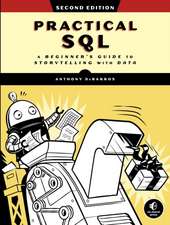 Practical SQL, 2nd EditionAnthony Debarros-20%Preț: 222.56 lei278.20 lei
-
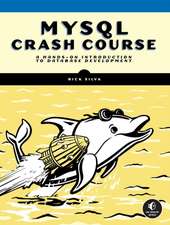 -34%Preț: 242.40 lei369.33 lei
-
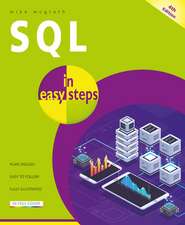 SQL in Easy StepsMike Mcgrath-20%Preț: 81.00 lei101.24 lei
-
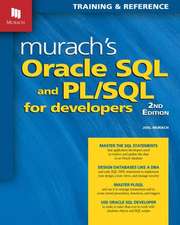 Murachs Oracle SQL & PL / SQL for DevelopersJoel Murach-20%Preț: 315.36 lei394.21 lei
-
 Murach's SQL Server 2022 for DevelopersBryan Syverson-20%Preț: 321.33 lei401.66 lei
-
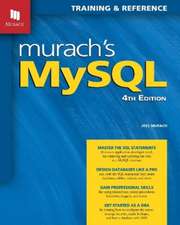 Murach's MySQL (4th Edition)Joel Murach-20%Preț: 321.49 lei401.86 lei
-
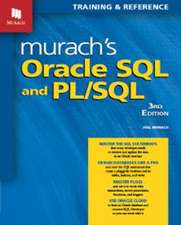 Oracle SQL and PL/SQL: (3rd Edition)Joel Murach-20%Preț: 323.62 lei404.53 lei
Public țintă
Who we are targeting: The primary audience for this book includes professional database developers, system administrators, database administrators, and web developers who want a handy, easy–to–understand reference. Secondary audiences include anyone who must retrieve information from a relational database by making ad–hoc queries.De ce să citești această carte
Recomandăm această carte profesioniștilor IT și dezvoltatorilor web care doresc să stăpânească limbajul standard pentru baze de date relaționale. Cititorul câștigă o înțelegere clară a modului în care poate structura, securiza și interoga datele eficient. Este un instrument esențial pentru oricine lucrează cu MySQL, Oracle sau SQL Server și are nevoie de un ghid practic, orientat spre rezultate imediate în administrarea datelor.
Despre autor
Allen G Taylor este un expert recunoscut în domeniul bazelor de date și al raportării de date, fiind un autor prolific în cadrul celebrei serii de ghiduri tehnice Wiley. Cu o carieră dedicată simplificării tehnologiilor complexe, Taylor a scris lucrări fundamentale precum Database Development For Dummies și ghiduri specializate pentru analiza datelor, cum ar fi Crystal Reports 2008 for Dummies și Crystal Reports 10 for Dummies. Experiența sa în predarea conceptelor de programare și design de baze de date se reflectă în claritatea cu care abordează standardele SQL, transformându-l într-o voce de referință pentru începători și profesioniști deopotrivă.
Notă biografică
Descriere scurtă
Cuprins
Introduction 1
About This Book 1
Foolish Assumptions 2
Icons Used in This Book 2
Beyond the Book 3
Where to Go from Here 3
Part 1: Getting Started with SQL 5
Chapter 1: Relational Database Fundamentals 7
Keeping Track of Things 8
What Is a Database? 9
Database Size and Complexity 10
What Is a Database Management System? 10
Flat Files 12
Database Models 13
Database Design Considerations 20
Chapter 2: SQL Fundamentals 23
What SQL Is and Isn't 23
A (Very) Little History 25
SQL Statements 26
Reserved Words 28
Data Types 28
Null Values 49
Constraints 50
Using SQL in a Client/Server System 50
Using SQL on the Internet or an Intranet 52
Chapter 3: The Components of SQL 55
Data Definition Language 56
Data Manipulation Language 68
Data Control Language 76
Part 2: Using SQL to Build Databases 83
Chapter 4: Building and Maintaining a Simple Database Structure 85
Using a RAD Tool to Build a Simple Database 86
Building POWER with SQL's DDL 98
Portability Considerations 107
Chapter 5: Building a Multi-table Relational Database 109
Designing a Database 110
Working with Indexes 119
Maintaining Data Integrity 122
Normalizing the Database 134
Part 3: Storing and Retrieving Data 141
Chapter 6: Manipulating Database Data 143
Retrieving Data 144
Creating Views 145
Updating Views 149
Adding New Data 150
Chapter 7: Handling Temporal Data 163
Understanding Times and Periods 164
Working with Application-Time Period Tables 165
Working with System-Versioned Tables 171
Tracking Even More Time Data with Bitemporal Tables 175
Formatting and Parsing Dates and Times 176
Chapter 8: Specifying Values 179
Values 179
Value Expressions 186
Functions 189
Chapter 9: Using Advanced SQL Value Expressions 209
CASE Conditional Expressions 210
CAST Data-Type Conversions 217
Row Value Expressions 221
Chapter 10: Zeroing In on the Data You Want 223
Modifying Clauses 224
FROM Clauses 225
WHERE Clauses 226
Logical Connectives 243
GROUP BY Clauses 245
HAVING Clauses 247
ORDER BY Clauses 248
Limited FETCH 250
Peering through a Window to Create a Result Set 251
Chapter 11: Using Relational Operators 259
UNION 259
INTERSECT 262
EXCEPT 264
Join Operators 265
ON versus WHERE 282
Chapter 12: Delving Deep with Nested Queries 283
What Subqueries Do 285
Chapter 13: Recursive Queries 303
What Is Recursion? 303
What Is a Recursive Query? 306
Where Might You Use a Recursive Query? 306
Where Else Might You Use a Recursive Query? 311
Part 4: Controlling Operations 313
Chapter 14: Providing Database Security 315
The SQL Data Control Language 316
User Access Levels 316
Granting Privileges to Users 318
Granting Privileges across Levels 325
Granting the Power to Grant Privileges 327
Taking Privileges Away 328
Using GRANT and REVOKE Together to Save Time and Effort 329
Chapter 15: Protecting Data 331
Threats to Data Integrity 332
Reducing Vulnerability to Data Corruption 336
Constraints Within Transactions 345
Avoiding SQL Injection Attacks 350
Chapter 16: Using SQL within Applications 351
SQL in an Application 352
Hooking SQL into Procedural Languages 354
Part 5: Taking SQL to the Real World 365
Chapter 17: Accessing Data with ODBC and JDBC 367
ODBC 368
ODBC in a Client/Server Environment 370
ODBC and the Internet 370
ODBC and an Intranet 373
JDBC 373
Chapter 18: Operating on XML Data with SQL 377
How XML Relates to SQL 377
The XML Data Type 378
Mapping SQL to XML and XML to SQL 380
SQL Functions That Operate on XML Data 385
Predicates 390
Transforming XML Data into SQL Tables 392
Mapping Non-Predefined Data Types to XML 393
The Marriage of SQL and XML 398
Chapter 19: SQL and JSON 399
Using JSON with SQL 400
The SQL/JSON Data Model 401
SQL/JSON Functions 403
SQL/JSON Path Language 411
There's More 412
Part 6: Advanced Topics 413
Chapter 20: Stepping through a Dataset with Cursors 415
Declaring a Cursor 416
Opening a Cursor 421
Fetching Data from a Single Row 422
Closing a Cursor 425
Chapter 21: Adding Procedural Capabilities with Persistent Stored Modules 427
Compound Statements 428
Flow of Control Statements 435
Stored Procedures 440
Stored Functions 442
Privileges 442
Stored Modules 443
Chapter 22: Handling Errors 445
SQLSTATE 445
WHENEVER Clause 447
Diagnostics Areas 448
Handling Exceptions 455
Chapter 23: Triggers 457
Examining Some Applications of Triggers 457
Creating a Trigger 458
Firing a Succession of Triggers 460
Referencing Old Values and New Values 461
Firing Multiple Triggers on a Single Table 462
Part 7: The Parts of Tens 463
Chapter 24: Ten Common Mistakes 465
Assuming That Your Clients Know What They Need 465
Ignoring Project Scope 466
Considering Only Technical Factors 466
Not Asking for Client Feedback 466
Always Using Your Favorite Development Environment 467
Using Your Favorite System Architecture Exclusively 467
Designing Database Tables in Isolation 467
Neglecting Design Reviews 468
Skipping Beta Testing 468
Not Documenting Your Process 468
Chapter 25: Ten Retrieval Tips 469
Verify the Database Structure 470
Try Queries on a Test Database 470
Double-Check Queries That Include Joins 470
Triple-Check Queries with Subselects 470
Summarize Data with GROUP BY 471
Watch GROUP BY Clause Restrictions 471
Use Parentheses with AND, OR, and NOT 471
Control Retrieval Privileges 472
Back Up Your Databases Regularly 472
Handle Error Conditions Gracefully 472
Appendix: ISO/IEC SQL: 2016 Reserved Words 473
Index 479