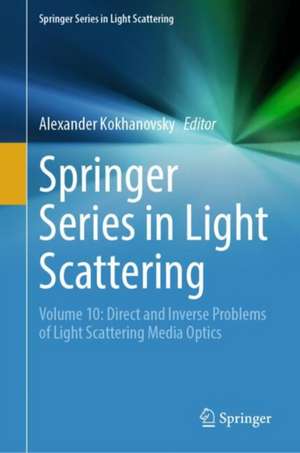
Springer Series in Light Scattering: Springer Series in Light Scattering
Editat de Alexander Kokhanovskyen Limba Engleză Hardback – 13 noi 2024


Preț: 782.62 lei
Preț vechi: 1029.76 lei
-24%
Puncte Express: 1174
Carte tipărită la comandă
Livrare economică 30 noiembrie-07 decembrie
Livrare prin curier în România Termenul estimat este afișat lângă disponibilitate.
Transport gratuit pentru acest produs Plată online sau ramburs, în funcție de opțiunile comenzii.
Retur gratuit în 14 zile Comandă securizată și suport în română.
Specificații
ISBN-13: 9783031665776
ISBN-10: 3031665775
Pagini: 228
Ilustrații: X, 240 p. 40 illus.
Dimensiuni: 160 x 241 x 18 mm
Greutate: 0.5 kg
Ediția:2024
Editura: Springer
Colecția Springer Series in Light Scattering
Seria Springer Series in Light Scattering
Locul publicării:Cham, Switzerland
ISBN-10: 3031665775
Pagini: 228
Ilustrații: X, 240 p. 40 illus.
Dimensiuni: 160 x 241 x 18 mm
Greutate: 0.5 kg
Ediția:2024
Editura: Springer
Colecția Springer Series in Light Scattering
Seria Springer Series in Light Scattering
Locul publicării:Cham, Switzerland
V-ar putea interesa
-
 -23%Preț: 1318.79 lei1712.72 lei
 -
 Into the Clear Blue SkyRob JacksonPreț: 79.10 lei
 -
 Optical Properties of SolidsMark FoxPreț: 383.52 lei
 -
 Light: A Very Short IntroductionIan A. Walmsley-19%Preț: 57.46 lei71.12 lei
 -
 SpeedVaclav SmilPreț: 137.51 lei
 -
 Introduction to Visual Optics: A Light ApproachSamantha Strong-30%Preț: 479.06 lei686.76 lei
 -
 Introduction to Radiative Heat TransferMichael F. Modest-32%Preț: 539.80 lei793.69 lei
 -
 Optically Stimulated LuminescenceEduardo G Yukihara-23%Preț: 820.69 lei1065.83 lei
 -
 -19%Preț: 532.86 lei657.84 lei
 -
 Light Scattering by Small ParticlesVan De Hulst H CPreț: 158.69 lei
 -
 Light and Photosynthesis in Aquatic EcosystemsJohn T O Kirk-8%Preț: 623.74 lei677.98 lei
 -
 Waves in Complex MediaLuca Dal Negro-9%Preț: 651.17 lei715.57 lei
 -
 Remote Sensing and Image InterpretationThomas Lillesand-18%Preț: 1378.98 lei1681.68 lei
 -
 A Book of WavesStefan HelmreichPreț: 223.80 lei
 -
 The Dark Forest Theory of the InternetBogna KoniorPreț: 86.72 lei
 -
 -32%Preț: 90.70 lei134.00 leiRecomandat
 -
 Preț: 95.24 lei
 -
 MiddlelandRory StewartPreț: 159.93 lei
 -
 Preț: 57.23 lei
 -
 Cut-out Curiosities Space, Science & Technology: A Collage BookMaximillian Malone-18%Preț: 126.31 lei153.75 lei
 -
 Percolation Theory Using PythonAnders Malthe-SørenssenPreț: 365.15 lei
 -
 -19%Preț: 594.96 lei734.52 lei
 -
 Light Scattering Reviews 3Alexander A. Kokhanovsky-18%Preț: 995.84 lei1214.44 lei
 -
 Light Scattering Reviews 10Alexander A. Kokhanovsky-18%Preț: 990.74 lei1208.22 lei
 -
 Chaos and Its ApplicationsYuncai Wang-18%Preț: 1161.45 lei1416.40 lei
 -
 Preț: 446.86 lei
 -
 Life on a Little-Known PlanetElizabeth KolbertPreț: 193.02 lei
Cuprins
The reflectance of solar light from natural surfaces.- Rayleigh scattering of the solar radiation in the terrestrial atmosphere and its assessment in the polar regions.- Analytical Solutions of Inverse Radiative Transfer Problems by Using the Structural Angular Method: Cloudy Atmospheres.- Some insights on the interaction of light with atmospheric aerosol particles comprised of disordered materials.
Notă biografică
Alexander A. Kokhanovsky graduated from the Physical Department of the Belarussian State University, Minsk, Belarus, in 1983. He has received Ph. D. degree in optical sciences from the B. I. Stepanov Institute of Physics, National Academy of Sciences of Belarus, Minsk, Belarus, in 1991. The PhD work was devoted to studies of light scattering properties of aerosol media and foams. His habilitation work (Main Geophysical Observatory, St. Petersburg, Russia, 2011) was aimed at the development of new cloud and snow remote sensing techniques based on spaceborne observations.
Alexander Kokhanovsky was a member of the atmospheric optics group at the Laboratory of Light Scattering Media Optics Laboratory at Institute of Physics in Minsk, Belarus (1983-2004) and the SCIAMACHY/ENVISAT satellite aerosol and cloud retrieval algorithms development team (Institute of Environmental Physics, University of Bremen, Bremen, Germany, 2001-2013). He has designed aerosol and cloud remote sensing algorithms for the imaging polarimeter (3MI) on board EUMETSAT Polar System-Second Generation (EPS-SG) working at EUMETSAT in Darmstadt, Germany ( 2014-2017). Currently, his research interests are directed towards modeling light propagation and scattering in terrestrial atmosphere and surface including ice and snow. He has been employed by VITROCISET/Telespazio Belgium ( Darmstadt, Germany) from 2013 till April, 2022. He has worked as a guest researcher at Max Planck Institute for Chemistry (Mainz, Germany) from April, 2022 till March, 2023. He is employed by the GFZ Potsdam since November, 2022, where he is working with EnMAP data to retrieve snow and ice properties using hyperspectral observations, Dr. Kokhanovsky is the author of books Light Scattering Media Optics: Problems and Solutions (Chichester: Springer-Praxis, 1999, 2001, 2004), Polarization Optics of Random Media (Berlin: Springer-Praxis, 2003), Cloud Optics (Amsterdam: Elsevier, 2006), Aerosol Optics (Berlin: Springer-Praxis, 2008), Foundations of Remote Sensing (Berlin: Springer, 2021, with D. Efremenko) and Snow Optics (Berlin: Springer, 2021). He published more than 350 papers in the field of environmental optics, radiative transfer, remote sensing, and light scattering.
Alexander Kokhanovsky was a member of the atmospheric optics group at the Laboratory of Light Scattering Media Optics Laboratory at Institute of Physics in Minsk, Belarus (1983-2004) and the SCIAMACHY/ENVISAT satellite aerosol and cloud retrieval algorithms development team (Institute of Environmental Physics, University of Bremen, Bremen, Germany, 2001-2013). He has designed aerosol and cloud remote sensing algorithms for the imaging polarimeter (3MI) on board EUMETSAT Polar System-Second Generation (EPS-SG) working at EUMETSAT in Darmstadt, Germany ( 2014-2017). Currently, his research interests are directed towards modeling light propagation and scattering in terrestrial atmosphere and surface including ice and snow. He has been employed by VITROCISET/Telespazio Belgium ( Darmstadt, Germany) from 2013 till April, 2022. He has worked as a guest researcher at Max Planck Institute for Chemistry (Mainz, Germany) from April, 2022 till March, 2023. He is employed by the GFZ Potsdam since November, 2022, where he is working with EnMAP data to retrieve snow and ice properties using hyperspectral observations, Dr. Kokhanovsky is the author of books Light Scattering Media Optics: Problems and Solutions (Chichester: Springer-Praxis, 1999, 2001, 2004), Polarization Optics of Random Media (Berlin: Springer-Praxis, 2003), Cloud Optics (Amsterdam: Elsevier, 2006), Aerosol Optics (Berlin: Springer-Praxis, 2008), Foundations of Remote Sensing (Berlin: Springer, 2021, with D. Efremenko) and Snow Optics (Berlin: Springer, 2021). He published more than 350 papers in the field of environmental optics, radiative transfer, remote sensing, and light scattering.
Caracteristici
Includes tips how to approach the solution of a number of practical problems related to light scattering in turbid media Numerous step-by-step tutorials help the reader to learn quickly various aspects of theoretical experimental Numerous step-by-step tutorials help the reader to learn quickly various aspects of experimental light scattering optics
Descriere
Descriere de la o altă ediție sau format:
The book is aimed at description of recent progress in studies of light extinction, absorption, and scattering in turbid media. In particular, light scattering/oceanic optics/planetary optics research communities are greatly benefit from the publication of this book.
The book is aimed at description of recent progress in studies of light extinction, absorption, and scattering in turbid media. In particular, light scattering/oceanic optics/planetary optics research communities are greatly benefit from the publication of this book.