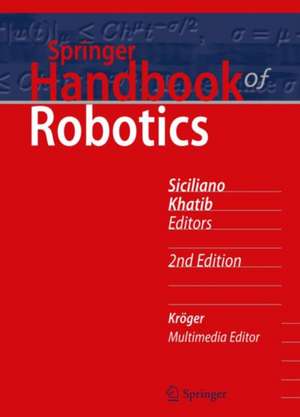
Springer Handbook of Robotics: Springer Handbooks
Editat de Bruno Siciliano, Oussama Khatiben Limba Engleză Hardback – 27 iun 2016
Analizăm, de exemplu, capitolul dedicat planificării mișcării (Motion Planning), unde algoritmii sunt prezentați nu doar teoretic, ci susținuți de resurse multimedia ce pot fi accesate instantaneu prin scanarea paginii cu un dispozitiv mobil. Această abordare practică transformă cele peste 2300 de pagini ale Springer Handbook of Robotics dintr-o enciclopedie statică într-un instrument de lucru interactiv, esențial pentru înțelegerea dinamicii complexe a roboților moderni.
Considerăm că această a doua ediție reprezintă vârful de lance al seriei Springer Handbooks, fiind restructurată pentru a acoperi frontiera interacțiunii om-robot. Progresia este riguroasă: se pornește de la fundamentele cinematicei și dinamicii în Partea A, continuând spre designul mecanismelor și actuării, până la integrarea inteligenței artificiale în planificarea sarcinilor. Complementar volumului Robotics de Bruno Siciliano, care se concentrează pe modelarea și controlul manipulatorilor, acest manual extinde spectrul către sistemele care explorează și lucrează activ în medii umane. Față de Introduction to Robotics de Saeed B. Niku, care oferă o bază solidă pentru studenți, lucrarea de față funcționează ca o resursă de referință exhaustivă pentru cercetători, integrând 15 capitole noi despre tehnologii emergente.
În contextul operei lui Bruno Siciliano, dacă Robotics for Intralogistics in Supermarkets and Retail Stores aplică robotica într-o nișă comercială specifică, Springer Handbook of Robotics oferă cadrul teoretic universal care face posibile astfel de aplicații. Tonul este unul tehnic și precis, fiecare dintre cei peste 200 de autori contribuind la un standard de rigoare care a adus volumului premiul PROSE pentru excelență în inginerie.
Din seria Springer Handbooks
- 18%
 Preț: 2490.71 lei
 - 18%
 Preț: 1932.50 lei
 - 18%
 Preț: 1847.57 lei
 - 18%
 Preț: 2477.84 lei
 - 18%
 Preț: 1916.75 lei
 - 18%
 Preț: 2110.83 lei
 - 23%
 Preț: 2648.23 lei
 - 18%
 Preț: 1906.89 lei
 - 18%
 Preț: 1924.34 lei
 - 18%
 Preț: 2481.38 lei
 - 18%
 Preț: 2097.37 lei
 - 18%
 Preț: 2128.28 lei
 - 18%
 Preț: 2975.34 lei
 - 18%
 Preț: 1650.73 lei
 - 18%
 Preț: 1681.71 lei
 - 18%
 Preț: 2098.08 lei
 - 20%
 Preț: 2268.17 lei
 - 20%
 Preț: 2023.06 lei
 - 18%
 Preț: 2097.19 lei
 - 18%
 Preț: 2299.02 lei
 - 18%
 Preț: 1935.22 lei
 - 18%
 Preț: 2092.64 lei
 - 18%
 Preț: 2199.71 lei
 - 18%
 Preț: 2092.64 lei
 - 20%
 Preț: 2005.94 lei
 - 18%
 Preț: 2113.87 lei
 - 18%
 Preț: 2464.93 lei
 - 18%
 Preț: 1931.17 lei
 - 18%
 Preț: 2763.66 lei
 - 18%
 Preț: 2092.64 lei
 - 18%
 Preț: 1947.94 lei
 - 18%
 Preț: 2449.79 lei
 - 23%
 Preț: 2339.57 lei
 - 23%
 Preț: 2265.34 lei
 - 23%
 Preț: 2353.21 lei
 - 23%
 Preț: 1700.83 lei
 - 23%
 Preț: 1697.82 lei
 - 23%
 Preț: 1990.31 lei
 - 14%
 Preț: 1323.00 lei
 - 14%
 Preț: 1323.00 lei
 - 34%
 Preț: 1733.36 lei
 - 14%
 Preț: 1323.00 lei
 - 29%
 Preț: 1583.30 lei
Preț: 2484.66 lei
Preț vechi: 3030.07 lei
-18%
Carte disponibilă
Livrare economică 16-30 mai
Specificații
ISBN-10: 3319325507
Pagini: 2350
Ilustrații: LXXVI, 2228 p. 1375 illus. in color.
Dimensiuni: 193 x 260 x 84 mm
Greutate: 3.77 kg
Ediția:2nd ed. 2017
Editura: Springer International Publishing
Colecția Springer
Seria Springer Handbooks
Locul publicării:Cham, Switzerland
V-ar putea interesa
-
 -25%Preț: 93.65 lei125.53 lei
 -
 Introduction to Autonomous Mobile RobotsDavide Scaramuzza-14%Preț: 560.34 lei651.56 lei
 -
 Principles of Robot MotionGeorge A. Kantor-14%Preț: 565.02 lei657.01 lei
 -
 Robot Modeling and ControlMark W Spong-23%Preț: 830.88 lei1079.06 lei
 -
 Introduction to Robotics, Global EditionJohn Craig-15%Preț: 549.34 lei646.29 lei
 -
 MechatronicsW. Bolton-15%Preț: 643.57 lei757.13 lei
 -
 -8%Preț: 550.89 lei598.80 lei
 -
 Robotics Research TrendsXing P Guô-29%Preț: 506.27 lei712.23 lei
 -
 Theory of Applied RoboticsReza N. Jazar-18%Preț: 697.44 lei850.53 lei
 -
 Advances in Service and Industrial RoboticsDoina Pisla-24%Preț: 1713.83 lei2255.03 lei
 -
 Walking Robots into Real WorldKarsten Berns-18%Preț: 1177.33 lei1435.77 lei
 -
 -15%Preț: 624.56 lei734.78 lei
 -
 Robotics Goes MOOC: InteractionBruno SicilianoPreț: 409.58 lei
 -
 Field and Service RoboticsAlonzo Kelly-18%Preț: 1170.41 lei1427.33 lei
 -
 Preț: 361.70 lei
 -
 The Science of Soft RobotsKoichi Suzumori-20%Preț: 569.10 lei711.38 lei
 -
 Frontiers in Robotics and ElectromechanicsAndrey Ronzhin-24%Preț: 981.82 lei1291.86 lei
 -
 Technologies of Robotic WeldingMaoai Chen-18%Preț: 969.24 lei1182.01 lei
De ce să citești această carte
Recomandăm acest manual inginerilor și cercetătorilor care au nevoie de o resursă definitivă și actualizată în domeniu. Cititorul câștigă acces la o bibliotecă vastă de expertiză, de la mecanică fină la AI, plus un avantaj tehnologic major: cele 700 de demonstrații video integrate prin realitate augmentată, care clarifică implementarea practică a conceptelor de control și senzorică.
Despre autor
Bruno Siciliano este profesor de automatică și robotică la Universitatea din Napoli, fiind recunoscut la nivel mondial ca fost președinte al IEEE Robotics and Automation Society. Este membru onorific (Fellow) al IEEE și ASME, dedicându-și cariera avansării roboticii ca disciplină științifică modernă. Oussama Khatib, profesor la Universitatea Stanford și președinte al IFRR, este un pionier în domeniul roboticii de intervenție și colaborative. Expertiza lor combinată asigură acestui manual o autoritate incontestabilă, reflectând cele mai noi direcții de cercetare din centrele de excelență globale.
Descriere scurtă
The first edition of the handbook soon became a landmark in robotics publishing and won the American Association of Publishers PROSE Award for Excellence in Physical Sciences & Mathematics as well as the organization’s Award for Engineering & Technology.The second edition of the handbook, edited by two internationally renowned scientists with the support of an outstanding team of seven part editors and more than 200 authors, continues to be an authoritative reference for robotics researchers, newcomers to the field, and scholars from related disciplines. The contents have been restructured to achieve four main objectives: the enlargement of foundational topics for robotics, the enlightenment of design of various types of robotic systems, the extension of the treatment on robots moving in the environment, and the enrichment of advanced robotics applications. Further to an extensive update, fifteen new chapters have been introduced on emerging topics, and a new generation of authors have joined the handbook’s team. A novel addition to the second edition is a comprehensive collection of multimedia references to more than 700 videos, which bring valuable insight into the contents. The videos canbe viewed directly augmented into the text with a smartphone or tablet using a unique and specially designed app.
Springer Handbook of Robotics Multimedia Extension Portal: http://handbookofrobotics.org/
Cuprins
Notă biografică
Oussama Khatib received his Doctorate degree in Electrical Engineering from Sup’Aero, Toulouse, France, in 1980. He is Professor of Computer Science at Stanford University. His research focuses on methodologies and technologies in human-centered robotics including humanoid control architectures, human motion synthesis, interactive dynamic simulation, haptics, and human-friendly robot design. He has co-authored over 300 journal papers, conference papers and book chapters. He has delivered over 100 keynote presentations and several hundreds of colloquia and seminars at institutions around the world. He is a Fellow of IEEE. He is Co-Editor of the Springer Tracts in Advanced Robotics (STAR) series and the Springer Handbook of Robotics, which received the PROSE Award for Excellence in Physical Sciences & Mathematics and was also the winner in the category Engineering & Technology. He has served on the Editorial Boards of prestigious journals, as well as Chair or Co-Chair for numerous international conferences. Professor Khatib is the President of the International Foundation of Robotics Research. He has been the recipient of several awards, including the IEEE RAS Pioneer Award in Robotics and Automation, the IEEE RAS George Saridis Leadership Award in Robotics and Automation, the IEEE RAS Distinguished Service Award, and the Japan Robot Association (JARA) Award in Research and Development.