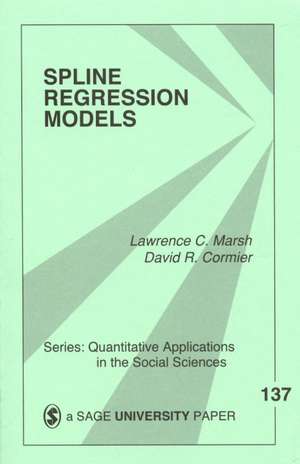
Spline Regression Models: Quantitative Applications in the Social Sciences, cartea 137
Autor Lawrence C. Marsh, David R. Cormieren Limba Engleză Paperback – 4 dec 2001
| Toate formatele și edițiile | Preț | Express |
|---|---|---|
| Paperback (1) | 331.55 lei 6-8 săpt. | |
| SAGE Publications – 4 dec 2001 | 331.55 lei 6-8 săpt. | |
| Electronic book text (1) | 114.20 lei Precomandă | |
| SAGE Publications – 29 noi 2001 | 114.20 lei Precomandă |
Din seria Quantitative Applications in the Social Sciences
-
 Preț: 371.12 lei
 -
 Preț: 371.51 lei
 -
 Preț: 319.49 lei
 -
 Preț: 372.48 lei
 -
 Preț: 371.42 lei
 -
 Preț: 367.72 lei
 -
 Preț: 371.38 lei
 -
 Preț: 367.51 lei
 -
 Preț: 371.07 lei
 -
 Preț: 372.54 lei
 -
 Preț: 372.22 lei
 -
 Preț: 300.22 lei
 -
 Preț: 309.58 lei
 -
 Preț: 371.48 lei
 -
 Preț: 313.84 lei
 -
 Preț: 314.93 lei
 -
 Preț: 370.45 lei
 -
 Preț: 314.36 lei
 -
 Preț: 316.23 lei
 -
 Preț: 337.81 lei
 -
 Preț: 332.46 lei
 -
 Preț: 331.17 lei
 -
 Preț: 332.83 lei
 -
 Preț: 332.26 lei
 -
 Preț: 333.39 lei
 -
 Preț: 331.75 lei
 -
 Preț: 341.40 lei
 -
 Preț: 333.92 lei
 -
 Preț: 331.37 lei
 -
 Preț: 331.37 lei
 -
 Preț: 332.46 lei
 -
 Preț: 332.10 lei
 -
 Preț: 331.75 lei
 -
 Preț: 331.17 lei
 -
 Preț: 333.03 lei
 -
 Preț: 333.19 lei
 -
 Preț: 331.55 lei
 -
 Preț: 331.75 lei
 -
 Preț: 333.19 lei
 -
 Preț: 331.90 lei
 -
 Preț: 331.75 lei
 -
 Preț: 333.19 lei
 -
 Preț: 331.55 lei
 -
 Preț: 331.55 lei
 -
 Preț: 333.57 lei
 -
 Preț: 332.26 lei
 -
 Preț: 332.46 lei
 -
 Preț: 332.63 lei
Preț: 331.55 lei
Puncte Express: 497
Preț estimativ în valută:
58.62€ • 67.75$ • 50.65£
58.62€ • 67.75$ • 50.65£
Carte tipărită la comandă
Livrare economică 04-18 mai
Specificații
ISBN-13: 9780761924203
ISBN-10: 0761924205
Pagini: 80
Dimensiuni: 140 x 216 x 5 mm
Greutate: 0.1 kg
Ediția:1
Editura: SAGE Publications
Colecția Sage Publications, Inc
Seria Quantitative Applications in the Social Sciences
Locul publicării:Thousand Oaks, United States
ISBN-10: 0761924205
Pagini: 80
Dimensiuni: 140 x 216 x 5 mm
Greutate: 0.1 kg
Ediția:1
Editura: SAGE Publications
Colecția Sage Publications, Inc
Seria Quantitative Applications in the Social Sciences
Locul publicării:Thousand Oaks, United States
V-ar putea interesa
-
 How to ResearchLoraine Blaxter-29%Preț: 165.75 lei233.83 lei
 -
 Quantitative Health Research: Issues and MethodsElizabeth Curtis-27%Preț: 223.25 lei307.88 lei
 -
 SAS Programming for Researchers and Social ScientistsPaul E. Spector-18%Preț: 824.01 lei1004.88 lei
 -
 How to Conduct Self-Administered and Mail SurveysLinda B. Bourque-15%Preț: 462.96 lei544.65 lei
 -
 Diagnosing Organizations: Methods, Models, and ProcessesMichael I. Harrison-15%Preț: 635.34 lei747.46 lei
 -
 Loglinear Models with Latent VariablesJacques A. P. HagenaarsPreț: 331.75 lei
 -
 -15%Preț: 642.07 lei755.38 lei
 -
 Research Methods for PostgraduatesTony GreenfieldPreț: 417.55 lei
 -
 -8%Preț: 502.04 lei545.70 lei
 -
 ReproducibilityHarald Atmanspacher-9%Preț: 690.62 lei758.92 lei
 -
 Essential Guide to Reading Biomedical PapersPhilip D LangtonPreț: 335.79 lei
 -
 Handbook on Communicating and Disseminating Behavioral ScienceMelissa K. Welch-Ross-9%Preț: 717.84 lei788.83 lei
 -
 The SAGE International Handbook of Educational EvaluationKatherine E. Ryan-27%Preț: 1049.64 lei1437.86 lei
 -
 SAGE Handbook of Mixed Methods in Social & Behavioral ResearchAbbas Tashakkori-27%Preț: 1068.95 lei1464.32 lei
 -
 An Introduction to the Philosophy of MethodologyKerry E Howell-11%Preț: 433.73 lei487.33 lei
 -
 A Companion to Survey ResearchMichael D. OrnsteinPreț: 433.59 lei
 -
 Preț: 373.97 lei
Recenzii
"I would recommend this book as a nice and easy-to-read introduction to spline models."
Cuprins
1. General Introduction
2. Introduction to Spline Models
3. Splines with Known Knot Locations
4. Splines with Unknown Knot Locations
5. Splines with an Unknown Number of Knots
6. Summary and Conclusions
2. Introduction to Spline Models
3. Splines with Known Knot Locations
4. Splines with Unknown Knot Locations
5. Splines with an Unknown Number of Knots
6. Summary and Conclusions
Notă biografică
Descriere
Spline Regression Models shows the nuts-and-bolts of using dummy variables to formulate and estimate various spline regression models. For some researchers this will involve situations where the number and location of the spline knots are known in advance, while others will need to determine the number and location of spline knots as part of the estimation process. Through the use of a number of straightforward examples, the authors will show readers how to work with both types of spline knot situations as well as offering practical, down-to-earth information on estimating splines.