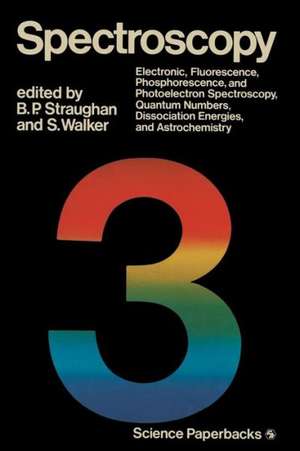
Spectroscopy: Volume Three
Editat de B. Straughanen Limba Engleză Paperback – 10 iun 1976
Preț: 671.81 lei
Preț vechi: 790.35 lei
-15%
Puncte Express: 1008
Carte tipărită la comandă
Livrare economică 04-18 decembrie
Livrare prin curier în România Termenul estimat este afișat lângă disponibilitate.
Transport gratuit pentru acest produs Plată online sau ramburs, în funcție de opțiunile comenzii.
Retur gratuit în 14 zile Comandă securizată și suport în română.
Specificații
ISBN-13: 9780412133909
ISBN-10: 0412133903
Pagini: 324
Ilustrații: X, 324 p.
Dimensiuni: 155 x 235 x 18 mm
Greutate: 0.47 kg
Ediția:Revised
Editura: SPRINGER NETHERLANDS
Colecția Springer
Locul publicării:Dordrecht, Netherlands
ISBN-10: 0412133903
Pagini: 324
Ilustrații: X, 324 p.
Dimensiuni: 155 x 235 x 18 mm
Greutate: 0.47 kg
Ediția:Revised
Editura: SPRINGER NETHERLANDS
Colecția Springer
Locul publicării:Dordrecht, Netherlands
V-ar putea interesa
-
 Vibrational Spectroscopy at Electrified InterfacesAndrzej Wieckowski-9%Preț: 1040.65 lei1143.57 lei
 -
 Secondary Ion Mass SpectrometryPaul van der Heide-9%Preț: 836.78 lei919.55 lei
 -
 -9%Preț: 824.71 lei906.27 lei
 -
 -23%Preț: 534.19 lei693.75 lei
 -
 Hydrogen Exchange Mass Spectrometry of ProteinsDavid D Weis-9%Preț: 821.18 lei902.40 lei
 -
 -23%Preț: 1204.74 lei1564.59 lei
 -
 Telescopes and TechniquesC. R. KitchinPreț: 423.04 lei
 -
 The Cosmic-Chemical BondDavid A WilliamsPreț: 236.42 lei
 -
 Using Commercial Amateur Astronomical SpectrographsJeffrey L. HopkinsPreț: 328.37 lei
 -
 -11%Preț: 524.67 lei589.52 lei
Public țintă
ResearchCuprins
1 Molecular Quantum Numbers of Diatomic Molecules.- 1.1 Formation of molecular quantum numbers.- 1.2 ‘Scripts’ giving information on the wavefunction symmetry of diatomic molecules.- 1.3 Correlation between atomic and molecular states.- 1.4 Coupling of angular momenta.- 1.5 Selection roles of diatomic molecules.- 1.6 A doubling.- 1.7 c and d classification of rotational levels.- References.- 2 Electronic Spectra of Gaseous Diatomic Molecules.- 2.l Introduction.- 2.2 Instrumentation.- 2.3 Electronic excitation of diatomic species.- 2.4 Electronic spectra of diatomic species in flames.- 2.5 More recent studies of electronic spectra.- References.- 3 Dissociation Energies of Diatomic Molecules.- 3.l Introduction.- 3.2 Evaluation of D by band convergence method.- 3.3 Evaluation of De by extrapolation to convergence limits.- 3.4 Evaluation of D by atomic fluorescence method.- 3.5 Predissociation and its use in evaluating D.- 3.6 Conclusions on the determination of dissociation energies of diatomic molecules.- 3.7 Recent dissociation energy studies for diatomic molecules.- References.- 4 Electronic Spectra of Polyatomic Molecules.- 4.1 Introduction.- 4.2 Absorption of light by a medium.- 4.3 Instrumentation.- 4.4 The electronic states of polyatomic molecules.- 4.5 Interpretation of the absorption spectra of organic compounds.- 4.6 Selection rules for electronic transitions.- 4.7 Electronic spectra of transition metal complexes.- 4.8 Charge transfer spectra.- 4.9 Electronic spectra of short lived species.- 4.10 Some applications to kinetics.- 4.11 Optical rotatory dispersion and circular dichroism.- References.- 5 Fluorescence and Phosphorescence Spectroscopy.- 5.1 Introduction.- 5.2 Fluorescence.- 5.3 Phosphorescence.- 5.4 Excitation spectra.- 5.5 Experimental methods.-5.6 Applications of fluroescence and phosphorescence.- References.- 6 Astrochemistry.- 6.1 Introduction and instrumentation.- 6.2 The Doppler effect.- 6.3 Planetary atmospheres.- 6.4 Spectra of nebulae and forbidden transitions.- 6.5 Spectra of comets.- 6.6 Stellar spectra.- 6.7 Spectral studies of the interstellar medium.- 6.8 Pulsars and quasars.- 6.9 Space probes in the mid-seventies.- References.- 7 Photoelectron Spectroscopy.- 7.1 Introduction.- 7.2 Instrumentation.- 7.3 Chemical information from photoelectron spectroscopy.- 7.4 Solid state surface studies.- 7.5 Surface charging and the calibration problem.- 7.6 Photoelectron intensities.- 7.7 Valence energy level studies.- 7.8 Additional structure in U.V. photoelectron spectra.- 7.9 Core energy level studies.- 7.10 Additional structure in X-ray photoelectron spectra.- References.- A APPENDIX.- A.1 Absorption and emission of radiation.- A.2 Energy levels of a linear rigid motor.- A.3 Selection rules for the linear rigid motor.- A.4 Energy levels of a harmonic oscillator.- A.5 Calculation of the vibrational eigen functions for a diatomic molecule.- A.6 Selection rules for changes in vibration quantum numbers.- A.7 Absolute intensities of absorptions.- A.8 Electronic transition probability and spectral intensity.