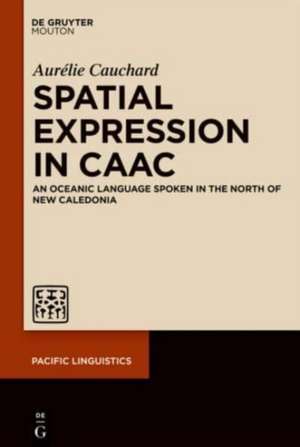
Spatial Expression in Caac
Autor Aurélie Caucharden Limba Engleză Hardback – 23 iul 2018
Preț: 880.69 lei
Preț vechi: 1143.74 lei
-23%
Puncte Express: 1321
Carte tipărită la comandă
Livrare economică 07-21 decembrie
Livrare prin curier în România Termenul estimat este afișat lângă disponibilitate.
Transport gratuit pentru acest produs Plată online sau ramburs, în funcție de opțiunile comenzii.
Retur gratuit în 14 zile Comandă securizată și suport în română.
Specificații
ISBN-13: 9781501511547
ISBN-10: 1501511548
Pagini: 324
Dimensiuni: 160 x 236 x 24 mm
Greutate: 0.59 kg
Ediția:1. Auflage
Editura: De Gruyter Mouton
Locul publicării:Berlin/Boston
ISBN-10: 1501511548
Pagini: 324
Dimensiuni: 160 x 236 x 24 mm
Greutate: 0.59 kg
Ediția:1. Auflage
Editura: De Gruyter Mouton
Locul publicării:Berlin/Boston
V-ar putea interesa
-
 Hieroglyphs: A Very Short IntroductionPenelope Wilson-19%Preț: 57.60 lei71.06 lei
 -
 CoordinationJanne Bondi Johannessen-27%Preț: 364.16 lei500.15 lei
 -
 Linear SyntaxAndreas Kathol-22%Preț: 210.21 lei269.82 lei
 -
 The Phonology of GermanRichard Wiese-27%Preț: 468.69 lei643.36 lei
 -
 Syntactic Effects of Morphological ChangeDavid W. Lightfoot-27%Preț: 368.90 lei502.89 lei
 -
 Semantics versus PragmaticsZoltan Gendler Szabo-26%Preț: 377.38 lei513.31 lei
 -
 -27%Preț: 359.83 lei492.13 lei
 -
 Linguistic Diversity in Space and TimeJohanna NicholsPreț: 334.25 lei
 -
 The Palaeography of Gothic Manuscript BooksAlbert DerolezPreț: 293.74 lei
 -
 -24%Preț: 45.19 lei59.15 lei
 -
 An Introduction to Syntax: Fundamentals of Syntactic AnalysisDr. Edith A. MoravcsikPreț: 338.97 lei
 -
 Text LinguisticsJonathan WebsterPreț: 297.56 lei
 -
 Lectures on Government and BindingNoam ChomskyPreț: 373.54 lei
 -
 Pragmatics of DiscourseAnne Barron-9%Preț: 1146.86 lei1260.29 lei
 -
 Nonverbal CommunicationMark L. Knapp-9%Preț: 1413.52 lei1553.32 lei
 -
 Phrasal VerbsStefan Thim-23%Preț: 1137.79 lei1477.65 lei
 -
 Sensuous CognitionJavier E. Díaz-Vera-23%Preț: 880.11 lei1143.00 lei
 -
 Linguistic RelativityCaleb Everett-23%Preț: 924.70 lei1200.90 lei
 -
 Introduction to SemanticsThomas Ede ZimmermannPreț: 205.41 lei
 -
 Die Grammatik des AgrammatismusMartina Penke-23%Preț: 886.76 lei1151.63 lei
Descriere
Descriere de la o altă ediție sau format:
In this study, the author describes the linguistic expression of space in Caac, an endangered and under-documented Oceanic language spoken in New Caledonia, from both a descriptive and theoretical perspective. Part I provides a concise description of Caac grammar, presenting a first formal portrait of this language to the reader. Part II describes the formal and semantic features of the linguistic resources available in Caac to encode spatial relationships. Part III presents the theoretical framework based on and exploring further the vector analysis developed by Bohnemeyer (2012) and Bohnemeyer & O'Meara (2012).
In particular, the author proposes an additional sub-category of vectors (Head-unspecified Vectors) which accounts for the uses of centrifugal forms in Caac. The resulting framework provides a systematic account of expressions of orientation as well as location and motion, and to combine the Frames of Reference typology (Pederson et al. 1998; Levinson, 1996, 2003; Bohnemeyer & Levinson, not dated) with an analysis of deictic expressions within a single framework. Special attention, moreover, is given to the use of Caac absolute and deictic directionals in spatial constructions involving Fictive Motion. The analysis of Caac data leads us to introduce an additional category of Fictive Motion beyond those previously recognised in the literature, labelled here "Anticipated Paths", which in turn shed new light on the nature of vectors and the relationship between location, motion and orientation.
In this study, the author describes the linguistic expression of space in Caac, an endangered and under-documented Oceanic language spoken in New Caledonia, from both a descriptive and theoretical perspective. Part I provides a concise description of Caac grammar, presenting a first formal portrait of this language to the reader. Part II describes the formal and semantic features of the linguistic resources available in Caac to encode spatial relationships. Part III presents the theoretical framework based on and exploring further the vector analysis developed by Bohnemeyer (2012) and Bohnemeyer & O'Meara (2012).
In particular, the author proposes an additional sub-category of vectors (Head-unspecified Vectors) which accounts for the uses of centrifugal forms in Caac. The resulting framework provides a systematic account of expressions of orientation as well as location and motion, and to combine the Frames of Reference typology (Pederson et al. 1998; Levinson, 1996, 2003; Bohnemeyer & Levinson, not dated) with an analysis of deictic expressions within a single framework. Special attention, moreover, is given to the use of Caac absolute and deictic directionals in spatial constructions involving Fictive Motion. The analysis of Caac data leads us to introduce an additional category of Fictive Motion beyond those previously recognised in the literature, labelled here "Anticipated Paths", which in turn shed new light on the nature of vectors and the relationship between location, motion and orientation.