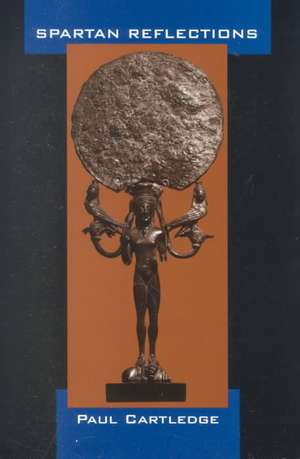
Spartan Reflections
Autor Paul Cartledgeen Limba Engleză Hardback – 29 iul 2001
Cartledge brings us up to date on what is known about the most important and intriguing aspects of Sparta: its military development, questions of gender and sexuality, and the difficult problem of artistic and literary aspects of Sparta. We learn about the institutions that distinguished Sparta from other city-states, including its religion, education process, degree of literacy, secret service, unusual system of servitude, and institutionalized pederasty. Throughout, Cartledge also makes important comparisons with Athens, helping us grasp what is really striking about Sparta.
Cartledge's writing is clear and engaging as he draws from myriad sources both ancient and modern, as well as from political and cultural theory. These essays, together with their magisterial bibliography, demonstrate his remarkable scholarly and intellectual range. "Spartan Reflections" will be an important source on the most significant issues in Sparta scholarship today as well as a fascinating look at this culture for general readers.
A Selection of the History Book Club"
Preț: 476.58 lei
Puncte Express: 715
Carte tipărită la comandă
Livrare economică 28 noiembrie-12 decembrie
Livrare prin curier în România Termenul estimat este afișat lângă disponibilitate.
Transport gratuit pentru acest produs Plată online sau ramburs, în funcție de opțiunile comenzii.
Retur gratuit în 14 zile Comandă securizată și suport în română.
Specificații
ISBN-13: 9780520231238
ISBN-10: 0520231236
Pagini: 276
Dimensiuni: 168 x 250 x 28 mm
Greutate: 0.6 kg
Editura: University of California Press
ISBN-10: 0520231236
Pagini: 276
Dimensiuni: 168 x 250 x 28 mm
Greutate: 0.6 kg
Editura: University of California Press
V-ar putea interesa
-
 LondongradMark HollingsworthPreț: 106.38 lei
 -
 Three EmperorsMiranda Carter-27%Preț: 79.63 lei109.52 lei
 -
 The Greeks: A Portrait of Self and OthersPaul Cartledge-20%Preț: 113.25 lei141.67 lei
 -
 War and PeaceLeo TolstoyPreț: 85.85 lei
 -
 Russia: A HistoryGregory L. Freeze-16%Preț: 112.35 lei133.64 lei
 -
 Ancient Greece: A Very Short IntroductionPaul Cartledge-19%Preț: 57.65 lei71.42 lei
 -
 -20%Preț: 129.43 lei161.39 lei
 -
 Russian and Soviet Diplomacy, 1900-39Alastair Kocho-Williams-15%Preț: 724.21 lei852.01 lei
 -
 Sparta and Lakonia: A Regional History 1300-362 BCPaul CartledgePreț: 420.66 lei
 -
 Preț: 240.91 lei
 -
 Alexander the GreatEngelsPreț: 179.63 lei
 -
 Preț: 270.66 lei
 -
 The Age of Cultural RevolutionsColin JonesPreț: 263.09 lei
 -
 Venice IncognitoJames H. Johnson-23%Preț: 510.34 lei662.78 lei
 -
 Europe and the People Without HistoryEric R. WolfPreț: 259.92 lei
 -
 In Search of Lost Meaning – The New Eastern EuropeAdam MichnikPreț: 251.73 lei
 -
 Preț: 247.43 lei
Notă biografică
Paul Cartledge is Professor of Greek History, University of Cambridge. He is the author of many books, including Sparta and Lakonia: A Regional History 1300 362 B. C.(1979), Agesilaos and the Crisis of Sparta(1987), The Spartans: An Epic History(November 15, 2002), and (with A. Spawforth) Hellenistic and Roman Sparta: A Tale of Two Cities (1989).
Textul de pe ultima copertă
"This is a book that scholars will read with pleasure, and a book from which advanced undergraduates and graduates will gain a sense of what Sparta was like as a culture, and (just as important) the nature and state of play of contemporary Spartan studies. And it will be accessible for the well informed lay reader as well."--Josiah Ober, author of "Political Dissent in Democratic Athens
"Paul Cartledge's aim, in this powerful collection of essays, is to shed light in dark places, to demythicize... Cartledge is shrewd, realistic, and far from starry-eyed. Over a quarter-century's exhaustive research, now updated, has gone into these densely documented and tightly argued essays. These Spartans, in the last resort, are exploitative slave-drivers, obsessed with keeping their serfs down (by annually killing off any resisters, among other things)... Modern idealizers of cold baths, black broth, mindless discipline and long route marches should read this book and, hopefully, have second thoughts."--Peter Green, author of "Alexander to Actium
Descriere
Descriere de la o altă ediție sau format:
The fascinatingly complex Spartan tradition has been central to western thinking since antiquity. Images or myths of ancient Sparta are still exceptionally influential today. Sparta is also one of the handful of ancient Greek cities well enough attested for the historian to attempt a convincing social portrait in the round. Over the past quarter-century Paul Cartledge has established himself as the leading international authority on ancient Sparta and the Spartan tradition. In addition to the three books he has authored and co-authored, he has published a score of articles and numerous reviews on this important subject. "Spartan Reflections", whose title is intended to capture both the influence of the Spartan tradition and Sparta's thought-provoking qualities, is a collection of thirteen essays, all either new or revised for publication in book form. Following a general introduction, the book is divided into three thematic sections, on Polity, Politics and Political Thought; Society, Economy and Warfare; and, the Mirage Re-Viewed.
The fascinatingly complex Spartan tradition has been central to western thinking since antiquity. Images or myths of ancient Sparta are still exceptionally influential today. Sparta is also one of the handful of ancient Greek cities well enough attested for the historian to attempt a convincing social portrait in the round. Over the past quarter-century Paul Cartledge has established himself as the leading international authority on ancient Sparta and the Spartan tradition. In addition to the three books he has authored and co-authored, he has published a score of articles and numerous reviews on this important subject. "Spartan Reflections", whose title is intended to capture both the influence of the Spartan tradition and Sparta's thought-provoking qualities, is a collection of thirteen essays, all either new or revised for publication in book form. Following a general introduction, the book is divided into three thematic sections, on Polity, Politics and Political Thought; Society, Economy and Warfare; and, the Mirage Re-Viewed.