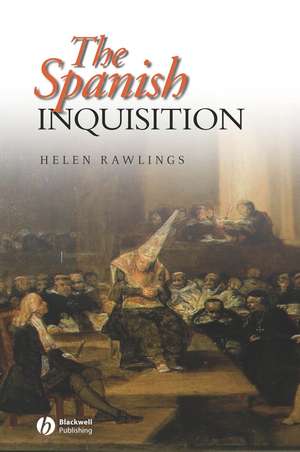
Spanish Inquisition
Autor Rawlingsen Limba Engleză Paperback – 20 iun 2005
Descoperim în acest volum, conceput ca un manual istoric riguros, o reevaluare necesară a uneia dintre cele mai controversate instituții din epoca modernă timpurie. The Spanish Inquisition de Helen Rawlings urmărește parcursul Sfântului Oficiu de la înființarea sa în 1478 sub autoritatea Monarhilor Catolici, până la dizolvarea sa definitivă în secolul al XIX-lea. Volumul nu se limitează la o simplă cronologie, ci propune o schimbare de paradigmă, utilizând datele noii generații de istorici internaționali pentru a nuanța imaginea de instrument de teroare absolută. Găsim aici o analiză a modului în care Inchiziția a funcționat nu doar ca mecanism de control social, ci și ca o forță educativă care a modelat identitatea religioasă și politică a Spaniei. Suntem de părere că autoarea reușește să demonstreze convingător că utilizarea torturii și a pedepsei capitale a fost mult mai limitată decât sugerează „Legenda Neagră”, fiind concentrată aproape exclusiv în primele decenii de activitate. Cititorii familiarizați cu Spanish Inquisition, 1478-1614 de Lu Ann Homza vor aprecia felul în care Helen Rawlings sintetizează cercetările academice recente într-o narațiune accesibilă, trecând de la analiza documentelor de curte la o perspectivă de ansamblu asupra relației dintre stat și disidență. În timp ce lucrări precum Frontiers of Heresy se concentrează pe zone geografice specifice și pe persecuția minorităților precum moriscos, volumul de față oferă o sinteză echilibrată a întregului fenomen inchizitorial spaniol, fiind un instrument de lucru esențial pentru studenții de la facultățile de istorie și limbi moderne.
Preț: 342.06 lei
Carte disponibilă
Livrare economică 19 octombrie-02 noiembrie
Livrare express 03-09 octombrie pentru 27.31 lei
Specificații
ISBN-10: 0631206000
Pagini: 184
Dimensiuni: 140 x 216 x 10 mm
Greutate: 0.24 kg
Editura: Wiley
Locul publicării:Chichester, United Kingdom
V-ar putea interesa
-
 The Second Vatican Council on Other ReligionsGerald O'Collins, SJPreț: 212.30 lei
 -
 The American Catholic Revolution: How the Sixties Changed the Church ForeverMark S. Massa, S.J.-24%Preț: 199.88 lei263.21 lei
 -
 -34%Preț: 707.55 lei1075.38 lei
 -
 -23%Preț: 278.20 lei362.69 lei
 -
 The Spanish Inquisition: A Historical RevisionHenry KamenPreț: 196.83 lei
 -
 Church, Religion and Society in Early Modern SpainHelen RawlingsPreț: 269.61 lei
 -
 Spanish InquisitionCecil RothPreț: 141.71 lei
 -
 Counter ReformationLuebke-27%Preț: 787.42 lei1078.66 lei
 -
 Torture and EucharistCavanaugh-27%Preț: 1075.37 lei1473.11 lei
 -
 The debate on the decline of SpainHelen RawlingsPreț: 125.99 lei
 -
 The Church of Mercy: A Vision for the ChurchPope FrancisPreț: 88.11 lei
 -
 -17%Preț: 128.48 lei155.12 lei
 -
 The Glories of MaryLiguoriPreț: 207.98 lei
 -
 The Great FacadeChristopher A. FerraraPreț: 191.09 lei
Public țintă
students of early modern Spanish and European history, religion and popular culture in departments of history and modern languages; general readersDe ce să citești această carte
Această lucrare este ideală pentru studenții și cititorii pasionați de istoria europeană care doresc să depășească miturile populare despre Inchiziția spaniolă. Cititorul câștigă o înțelegere nuanțată a mecanismelor administrative și juridice ale epocii, descoperind cum o instituție de control a contribuit la stabilitatea socială a Spaniei moderne timpurii prin educație și conformitate religioasă.
Despre autor
Helen Rawlings este specialistă în istoria Spaniei și lector universitar în cadrul Departamentului de Studii Hispanice de la [University of Leicester](university). Expertiza sa se concentrează pe istoria religioasă și socială a Spaniei în perioada modernă timpurie (secolele XV-XVIII). Prin activitatea sa academică, Rawlings s-a remarcat prin capacitatea de a sintetiza surse primare complexe și cercetări multidisciplinare, oferind studenților și cercetătorilor perspective actualizate asupra evoluției societății spaniole și a instituțiilor sale ecleziastice, fiind o voce respectată în studiile hispanice contemporane.
Notă biografică
Descriere scurtă
The author traces the history of the Spanish Inquisition from 1478when it was founded, through its agenda against dissenters, to its demise and abolition in the early nineteenth century. Taking account of the work of a new generation of international historians, she demonstrates that the Inquisition was a far less brutal instrument of control than hitherto envisaged, that torture and the death penalty were only rarely applied, and then almost exclusively during the early years of its history. The book also draws attention to the wider role of the Inquisition as an educative force in societythat strengthened the bonds between church and state.
Descriere
Cuprins
Acknowledgements
Chronology
1 The Historiography of the Inquisition
Introduction
Sixteenth and Seventeenth-century Literature
The Black Legend
Eighteenth and Nineteenth-century Literature
Twentieth-century Scholarship
The Inquisitorial Data-bank
The Four Seasons of the Inquisition
Conclusion
2 The Inquisition as an Institution
The Office of Inquisitor General
The Council of Inquisition
The Inquisition in the Provinces
The Procedures of the Inquisition
The Auto de Fe
The Finances of the Inquisition
Inquisitors General of Castile and Aragón, 1483-1818 (Appendix)
3 The Inquisition and the Converso
Anti-semitic Tensions in Spanish Society
The Statutes of Limpieza de Sangre
The Beginnings of the Spanish Inquisition
The Expulsion of the Jews
The Portuguese New Christians
4 The Inquisition and the Morisco
1492-1525: Coexistence and Conversion
1526-1550: Respite
1560-1570: Coercion and Revolt in Granada
1570-1600: The End of Tolerance in Aragón
1600-1609: The Route to Expulsion
1609-1614: The Aftermath
5 The Inquisition and Protestantism
Illuminism and Humanism under Attack
Innovation in Religious Life Condemned
The Protestant Challenge, 1558--1559
Inquisitorial Censorship and the 1559 Index
Biblical Scholarship under Scrutiny
6 The Inquisition and Minor Heresy
Religious Instruction
Religious Deviance:
(a) Blasphemy
(b) Bigamy and Sexual Promiscuity
(c) Solicitation
(d) Superstition and Witchcraft
7 The Decline and Abolition of the Inquisition
The Inquisition under the Bourbons
The Cortes of Cádiz, 1810--1813
Restoration and Abolition, 1814--1823
Goya's Inquisition
The balance of History
Bibliography and References
Glossary
Index