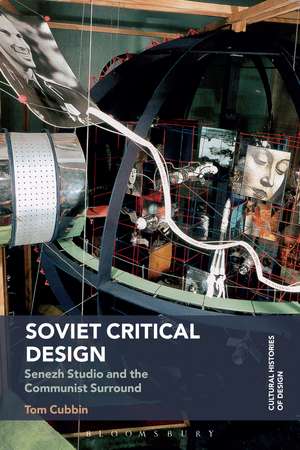
Soviet Critical Design: Senezh Studio and the Communist Surround: Cultural Histories of Design
Autor Tom Cubbinen Limba Engleză Hardback – 13 dec 2018
Tom Cubbin examines the studio as a site for the development of the design discipline in the optimistic environment of the 1960s Soviet Thaw. He also explores how designers adapted to the fast-changing Soviet Union of the 1970s and 1980s, considering their approach to critical projects highlighting the Soviet state's treatment of citizens, urban heritage and public spaces.
Drawing on previously unpublished visual material from private archives and also extensive interviews, this book presents a new history of the late socialist period in the USSR, which gives insight into the creative strategies of designers who engaged their practice as a contribution to broader discussions on alternative models for socialist existence. Cubbin shows how artistic projecteering must be read as a utopian activity which privileged the political and ideological over the functional.









Preț: 645.95 lei
Preț vechi: 1053.15 lei
-39%
Puncte Express: 969
Carte disponibilă
Livrare economică 28 octombrie-11 noiembrie
Livrare prin curier în România Termenul estimat este afișat lângă disponibilitate.
Transport gratuit pentru acest produs Plată online sau ramburs, în funcție de opțiunile comenzii.
Retur gratuit în 14 zile Comandă securizată și suport în română.
Specificații
ISBN-13: 9781350021990
ISBN-10: 1350021997
Pagini: 246
Ilustrații: 48 b/w illustrations
Dimensiuni: 156 x 234 x 16 mm
Greutate: 0.5 kg
Editura: Bloomsbury Publishing
Colecția Bloomsbury Visual Arts
Seria Cultural Histories of Design
Locul publicării:London, United Kingdom
ISBN-10: 1350021997
Pagini: 246
Ilustrații: 48 b/w illustrations
Dimensiuni: 156 x 234 x 16 mm
Greutate: 0.5 kg
Editura: Bloomsbury Publishing
Colecția Bloomsbury Visual Arts
Seria Cultural Histories of Design
Locul publicării:London, United Kingdom
V-ar putea interesa
-
 Landscapes of CommunismOwen Hatherley-27%Preț: 88.53 lei121.37 lei
 -
 Beauty is in the StreetJoachim C. HäberlenPreț: 94.61 lei
 -
 The Alienation EffectOwen HatherleyPreț: 278.10 lei
 -
 Red PlentyFrancis SpuffordPreț: 94.61 lei
 -
 Cuban Mid-Century DesignAbel Gonzalez Fernandez-8%Preț: 411.32 lei447.09 lei
 -
 SovietsDanzig Baldaev-18%Preț: 110.94 lei135.60 lei
 -
 Brutal Bloc PostcardsDamon Murray-18%Preț: 131.78 lei161.63 lei
 -
 Soviet Metro StationsChristopher Herwig-23%Preț: 162.40 lei210.18 lei
 -
 A Studious Use: Designing From The UndercommonsGiovanni Marmont-19%Preț: 135.19 lei166.13 lei
 -
 Imagine MoscowEszter Steierhoffer-19%Preț: 85.54 lei105.91 lei
 -
 VNIITEAlexandra SankovaPreț: 342.77 lei
 -
 Designing the Computational Image, Imagining Computational DesignDaniel Cardoso Llach-20%Preț: 200.53 lei250.67 lei
 -
 Tashkent Modernism XX/XXIBoris ChukhovichPreț: 394.37 lei
 -
 Resist!Bettina RichterPreț: 141.29 lei
 -
 Cosmic Communist Constructions PhotographedFrédéric ChaubinPreț: 407.67 lei
 -
 Boris BerlinVibeke P. GetherPreț: 474.14 lei
 -
 The Soviet Photobook 1920-1941Mikhail Karasik-16%Preț: 634.65 lei756.22 lei
 -
 -19%Preț: 139.17 lei171.45 lei
 -
 -18%Preț: 1459.48 lei1779.86 lei
Cuprins
Introduction: The Communist Surround
Socialist Objects as Critical Design
The Communist Surround
The Language of Soviet Design
Late Socialism
Conclusion
Chapter 1: Art, Technology and Design in the Soviet Thaw
Technical Aesthetics as a 'Science of Design'
Theories of Design in Art and Aesthetics
Problems of Design
Foreign Influences
From Chaos to Harmony
The Production Art of the Future
Objects of the Future
Conclusion
Chapter 2: Senezh Studio and the Emergence of a Critical Practice
The Artist in Design
Seminar for Design and Industrial Art - Programme of Work
Summary of Courses in Colour and Composition, 1969
Industrial Policy and Labour
Open Form
Sites of Experimentation: Socialist Spaces of the Future
Methodological Philosophy and the Reassessment of Artistic Projecteering
The Domestic Information Machine
Conclusion
Chapter 3: Semiotics, Environment, and the Historical Turn
Abandoning Industrial Design
Redefining Visual Agitation
Conservation of Architectural Heritage
Retrospectivism, Memory and History
Theatricalization
Conclusion: Opening the Semiotic Cage
Chapter 4: Design and the Projective Imagination
Environment and the 'Museification' Debate
'Projectivism' and Design
Icons of a Higher Reality
Underground Culture
Maiakovskii Square as a Theatre of Post-Authoritarian Urbanity
Conclusion
Chapter 5: A Quiet Conversation Among Things: Memory, Agency and Materiality at the End of History
Background: Cultural Ecology and Projecteering in Pushchino
The Abandoned House
Perestroika and Time
Photographs
Tables
Icons
Conclusion
Conclusion
End Matter
Appendix I - Complete List of Senezh Projects
Appendix II - Key People
Index
Socialist Objects as Critical Design
The Communist Surround
The Language of Soviet Design
Late Socialism
Conclusion
Chapter 1: Art, Technology and Design in the Soviet Thaw
Technical Aesthetics as a 'Science of Design'
Theories of Design in Art and Aesthetics
Problems of Design
Foreign Influences
From Chaos to Harmony
The Production Art of the Future
Objects of the Future
Conclusion
Chapter 2: Senezh Studio and the Emergence of a Critical Practice
The Artist in Design
Seminar for Design and Industrial Art - Programme of Work
Summary of Courses in Colour and Composition, 1969
Industrial Policy and Labour
Open Form
Sites of Experimentation: Socialist Spaces of the Future
Methodological Philosophy and the Reassessment of Artistic Projecteering
The Domestic Information Machine
Conclusion
Chapter 3: Semiotics, Environment, and the Historical Turn
Abandoning Industrial Design
Redefining Visual Agitation
Conservation of Architectural Heritage
Retrospectivism, Memory and History
Theatricalization
Conclusion: Opening the Semiotic Cage
Chapter 4: Design and the Projective Imagination
Environment and the 'Museification' Debate
'Projectivism' and Design
Icons of a Higher Reality
Underground Culture
Maiakovskii Square as a Theatre of Post-Authoritarian Urbanity
Conclusion
Chapter 5: A Quiet Conversation Among Things: Memory, Agency and Materiality at the End of History
Background: Cultural Ecology and Projecteering in Pushchino
The Abandoned House
Perestroika and Time
Photographs
Tables
Icons
Conclusion
Conclusion
End Matter
Appendix I - Complete List of Senezh Projects
Appendix II - Key People
Index
Recenzii
[This book] should be valued for establishing new directions in late Soviet visual and material culture studies-and hopefully foreshadow[s] the dramatic increase of both scholarly and general interest in the achievements and limitations of socialist design.
For many years, it seemed as if there were only two kinds of Soviet design: visionary Constructivism or Stalinist kitsch. Cubbin's vividly written and deeply researched study offers an entirely new picture. Illuminating the long history of modernism in the USSR, he examines how critical designers sought to create utopia on a human scale.
What happens when principles of Russian avant-garde of the 1920s are retooled for the needs of Soviet science and technology? In his book, Cubbin traces the emergence and demise of "technical aesthetics" created by Soviet artists-engineers in the 1960s-1980s as a communist alternative to capitalist design. Highly informative and richly documented, this book reconstructs fascinating yet barely known moments in the history of material culture and aesthetic theory of the twentieth century.
The book provides insight to the activities of Senezh studio, an important part of the USSR Union of Artists. It also explores the phenomenon of 'paper design', a particular kind of project work, characteristic of the Soviet cultural milieu. Senezh studio operated for more than twenty years, although only a fraction of its projects were ever realized. Despite this, the studio's design practices were of remarkable national importance.
For many years, it seemed as if there were only two kinds of Soviet design: visionary Constructivism or Stalinist kitsch. Cubbin's vividly written and deeply researched study offers an entirely new picture. Illuminating the long history of modernism in the USSR, he examines how critical designers sought to create utopia on a human scale.
What happens when principles of Russian avant-garde of the 1920s are retooled for the needs of Soviet science and technology? In his book, Cubbin traces the emergence and demise of "technical aesthetics" created by Soviet artists-engineers in the 1960s-1980s as a communist alternative to capitalist design. Highly informative and richly documented, this book reconstructs fascinating yet barely known moments in the history of material culture and aesthetic theory of the twentieth century.
The book provides insight to the activities of Senezh studio, an important part of the USSR Union of Artists. It also explores the phenomenon of 'paper design', a particular kind of project work, characteristic of the Soviet cultural milieu. Senezh studio operated for more than twenty years, although only a fraction of its projects were ever realized. Despite this, the studio's design practices were of remarkable national importance.