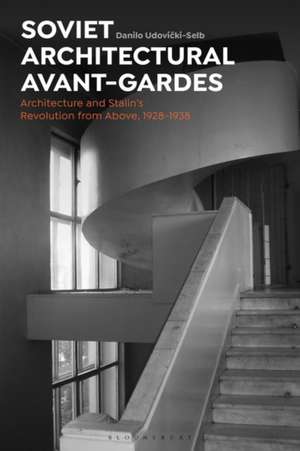
Soviet Architectural Avant-Gardes: Architecture and Stalin’s Revolution from Above, 1928-1938
Autor Dr Danilo Udovicki-Selben Limba Engleză Paperback – 13 ian 2022
Exploring iconic Soviet architecture including the Palace of Soviets and the Soviet Pavilion at the Paris 1937 World Exposition, and revealing many remarkable works that until now have been neglected by architectural historians inside and outside Russia, Soviet Architectural Avant-Gardes provides a revealing new account of the 'hidden' modernism which persisted through Stalinism. In a fascinating final chapter, it also reveals for the first time the details of Frank Lloyd Wright's triumphant welcome in Moscow in 1937, at the height of Stalin's Terror.
Preț: 219.16 lei
Preț vechi: 296.61 lei
-26%
Puncte Express: 329
Carte disponibilă
Livrare economică 28 octombrie-11 noiembrie
Livrare express 13-17 octombrie pentru 116.89 lei
Livrare prin curier în România Termenul estimat este afișat lângă disponibilitate.
Transport gratuit de la 400.00 lei Plată online sau ramburs, în funcție de opțiunile comenzii.
Retur gratuit în 14 zile Comandă securizată și suport în română.
Specificații
ISBN-13: 9781350288423
ISBN-10: 135028842X
Pagini: 264
Ilustrații: 72 bw illus
Dimensiuni: 158 x 232 x 18 mm
Greutate: 0.6 kg
Editura: Bloomsbury Publishing
Colecția Bloomsbury Visual Arts
Locul publicării:London, United Kingdom
ISBN-10: 135028842X
Pagini: 264
Ilustrații: 72 bw illus
Dimensiuni: 158 x 232 x 18 mm
Greutate: 0.6 kg
Editura: Bloomsbury Publishing
Colecția Bloomsbury Visual Arts
Locul publicării:London, United Kingdom
V-ar putea interesa
-
 Non-Design: Architecture, Liberalism, and the MarketAnthony FontenotPreț: 407.39 lei
 -
 Modern ArchitectureKenneth Frampton-12%Preț: 136.39 lei155.74 lei
 -
 The Ruins of Palmyra and Baalbek: Volumes I-IIRobert Wood-38%Preț: 1968.68 lei3156.32 lei
 -
 Echo's Chambers: Architecture and the Idea of Acoustic SpaceJoseph L. ClarkePreț: 492.75 lei
 -
 A Cultural History of the Home: Volumes 1-6Dr Amanda Flather-14%Preț: 3125.62 lei3634.44 lei
 -
 Sir Banister Fletcher's Global History of ArchitectureDr Murray Fraser-32%Preț: 3176.18 lei4651.54 lei
 -
 Scotch Baronial: Architecture and National Identity in ScotlandMiles Glendinning-31%Preț: 517.45 lei747.20 lei
 -
 -34%Preț: 541.41 lei818.54 lei
 -
 -18%Preț: 107.08 lei129.96 lei
 -
 -38%Preț: 788.36 lei1264.83 lei
 -
 -18%Preț: 358.83 lei437.58 lei
 -
 -21%Preț: 193.75 lei245.85 lei
 -
 How to Read Towns and CitiesJonathan Glancey-25%Preț: 79.66 lei106.43 lei
 -
 The Edwardians and their HousesTimothy Brittain-CatlinPreț: 402.84 lei
 -
 The Master BuilderNicholas Olsberg-15%Preț: 499.11 lei587.19 lei
 -
 Architecture through DrawingDesley Luscombe-15%Preț: 417.53 lei491.21 lei
 -
 -19%Preț: 98.15 lei121.23 lei
 -
 50 Bauhaus Icons You Should KnowStraber, Josef-10%Preț: 98.99 lei110.19 lei
 -
 Preț: 156.10 lei
Cuprins
Dedication
Comparative Chronology
Acknowledgments
Introduction
1. A Call for the Party to Defend Modern Architecture:Stalin's "Cultural Revolution" and the Aporia Of "Proletarian Architecture"
2. Continuity and Resistance: Designed Before 1932, Completed Down the Decade
3. Building Modern Architecture: "An Atmosphere Of Genuine Creativity," 1933-1939
4. The Shaping of Architecture Ideology within the Stalinist Project: Unreachable "Proletarian" Architecture Yields to Unattainable "Socialist"
5. The Improbable March to the Congress: "Soviet Architecture Eaten by a Gangrene"
Conclusion
Bibliography and Sources
Index
Comparative Chronology
Acknowledgments
Introduction
1. A Call for the Party to Defend Modern Architecture:Stalin's "Cultural Revolution" and the Aporia Of "Proletarian Architecture"
2. Continuity and Resistance: Designed Before 1932, Completed Down the Decade
3. Building Modern Architecture: "An Atmosphere Of Genuine Creativity," 1933-1939
4. The Shaping of Architecture Ideology within the Stalinist Project: Unreachable "Proletarian" Architecture Yields to Unattainable "Socialist"
5. The Improbable March to the Congress: "Soviet Architecture Eaten by a Gangrene"
Conclusion
Bibliography and Sources
Index
Recenzii
Clearly written and is difficult to put down . . . Soviet Architectural Avant-Gardes makes a significant contribution to the English-language scholarship on the history and theory of architecture during Stalinism and beyond.
After years of research, Danilo Udovicki-Selb has masterfully mapped one of the major episodes in the history of 20th-century architecture: the backlash against modernism in Stalin's USSR. Considered with subtlety, biographies, discourse and designs are intertwined in a path-breaking, fascinating chronicle.
Danilo Udovicki-Selb's new book makes an important contribution to the history of Soviet architecture. It brings attention to the dramatic story of VOPRA, the All-Union Society of Proletarian Architects, long neglected by historians as a political rather than creative movement. Working in the Russian archives, Udovicki-Selb discovered the real story of the movement, created by Lazar Kaganovich. The book convincingly shows, that once-popular idea "Stalin ordered architects to return to classical architecture," is a gross oversimplification. "The 23 April 1932 Central Committee decree," Udovicki-Selb writes, "did not impose any stylistic direction," and the party even "favored architectural plurality." This is well illustrated by juxtaposing Malevich's Arkhitekton with Boris Iofan's version of the Palace of the Soviets, clearly influenced by Malevich as well as by the Rockefeller Center in New York (which may have been influenced by Malevich as well).
An important contribution to the narrative initiated by Clement Greenberg, Reyner Banham, and Manfredo Tafurri, this book offers a trove of previously unknown documents and discusses a number of projects that until now have escaped the scrutiny of architectural historians. It adds many new nuances to the story of the clash between the revolutionary architecture of the Russian Avant-garde and the Stalinist cultural revolution "from above." This nuanced approach does not make Danilo Udovicki-Selb's account of Kaganovich's intervention that eventually ended the vibrant experiments of the 1920s any less tragic. And yet, his analysis escapes the trap of a melodrama with clear heroes and villains; Udovicki-Selb's most important accomplishment is of highlighting the talent of survivors such as Boris Iofan, Aleksej Dushkin, and the Moisej Ginzburg of the 1930s. Their attempts to preserve the legacy of the avant-garde-even if delivered in a form, acceptable to the soviet dictator-produced several truly remarkable pieces of modernist architecture.
Soviet Architectural Avant-Gardes is an important, engaging book . One of the most original contribution in this specific field of History of architecture and the XX century History of Architecture at large, which marks a significant step forward.
Danilo Udovicki-Selb deserves a lot of credit for the essential contribution given to the questioning of what has long been undisputed. The author has succeded in breaking down long-standing historiographical narratives, revealing the complexity and ambiguity of the relationships between the Verkhushka, the Stalinist political power and the multifaceted sphere of professional culture, and how the architectural avant-garde has been in able to persist and develop in in original, sometimes unexpected, and geographically articulated forms, within the unstable and nuanced rhetoric frame of the "Socialist Realism".
After years of research, Danilo Udovicki-Selb has masterfully mapped one of the major episodes in the history of 20th-century architecture: the backlash against modernism in Stalin's USSR. Considered with subtlety, biographies, discourse and designs are intertwined in a path-breaking, fascinating chronicle.
Danilo Udovicki-Selb's new book makes an important contribution to the history of Soviet architecture. It brings attention to the dramatic story of VOPRA, the All-Union Society of Proletarian Architects, long neglected by historians as a political rather than creative movement. Working in the Russian archives, Udovicki-Selb discovered the real story of the movement, created by Lazar Kaganovich. The book convincingly shows, that once-popular idea "Stalin ordered architects to return to classical architecture," is a gross oversimplification. "The 23 April 1932 Central Committee decree," Udovicki-Selb writes, "did not impose any stylistic direction," and the party even "favored architectural plurality." This is well illustrated by juxtaposing Malevich's Arkhitekton with Boris Iofan's version of the Palace of the Soviets, clearly influenced by Malevich as well as by the Rockefeller Center in New York (which may have been influenced by Malevich as well).
An important contribution to the narrative initiated by Clement Greenberg, Reyner Banham, and Manfredo Tafurri, this book offers a trove of previously unknown documents and discusses a number of projects that until now have escaped the scrutiny of architectural historians. It adds many new nuances to the story of the clash between the revolutionary architecture of the Russian Avant-garde and the Stalinist cultural revolution "from above." This nuanced approach does not make Danilo Udovicki-Selb's account of Kaganovich's intervention that eventually ended the vibrant experiments of the 1920s any less tragic. And yet, his analysis escapes the trap of a melodrama with clear heroes and villains; Udovicki-Selb's most important accomplishment is of highlighting the talent of survivors such as Boris Iofan, Aleksej Dushkin, and the Moisej Ginzburg of the 1930s. Their attempts to preserve the legacy of the avant-garde-even if delivered in a form, acceptable to the soviet dictator-produced several truly remarkable pieces of modernist architecture.
Soviet Architectural Avant-Gardes is an important, engaging book . One of the most original contribution in this specific field of History of architecture and the XX century History of Architecture at large, which marks a significant step forward.
Danilo Udovicki-Selb deserves a lot of credit for the essential contribution given to the questioning of what has long been undisputed. The author has succeded in breaking down long-standing historiographical narratives, revealing the complexity and ambiguity of the relationships between the Verkhushka, the Stalinist political power and the multifaceted sphere of professional culture, and how the architectural avant-garde has been in able to persist and develop in in original, sometimes unexpected, and geographically articulated forms, within the unstable and nuanced rhetoric frame of the "Socialist Realism".
Caracteristici
Includes
the
first
detailed
account
of
what
happened
when
Frank
Lloyd
Wright,
the
famous
US
modernist
architect,
was
welcomed
triumphantly
to
Moscow
in
1937
at
the
height
of
Stalin's
terror.
This
presents
a
major
discovery,
unknown
to
scholars
in
the
West.
Notă biografică
Danilo Udovicki-Selb holds a PhD from the Massachusetts Institute of Technology (MIT) and is Professor of Architecture at the University of Texas at Austin.