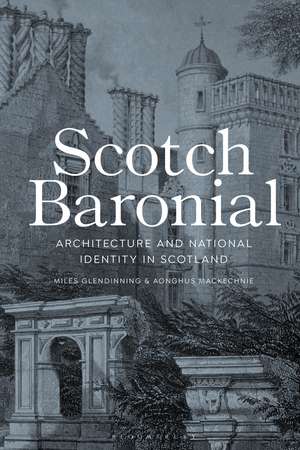
Scotch Baronial: Architecture and National Identity in Scotland
Autor Miles Glendinning, Aonghus MacKechnieen Limba Engleză Hardback – 10 ian 2019
Scotch Baronial provides a politically-framed examination of Scotland's kaleidoscopic 'castle architecture', tracing how it was used to serve successive political agendas both prior to and during the three 'unionist centuries' from the early 17th century to the 20th century. The book encompasses many of the country's most important historic buildings - from the palaces left behind by the 'lost' monarchy, to revivalist castles and the proud town halls of the Victorian age - examining their architectural styles and tracing their wildly fluctuating political and national connotations. It ends by bringing the story into the 21st century, exploring how contemporary 'neo-modernist' architecture in today's Scotland, as exemplified in the Holyrood parliament, relates to concepts of national identity in architecture over the previous centuries.
Preț: 517.45 lei
Preț vechi: 747.20 lei
-31%
Puncte Express: 776
Carte tipărită la comandă
Livrare economică 23 noiembrie-07 decembrie
Livrare prin curier în România Termenul estimat este afișat lângă disponibilitate.
Transport gratuit pentru acest produs Plată online sau ramburs, în funcție de opțiunile comenzii.
Retur gratuit în 14 zile Comandă securizată și suport în română.
Specificații
ISBN-13: 9781474283472
ISBN-10: 1474283470
Pagini: 310
Ilustrații: 91 bw illus
Dimensiuni: 156 x 236 x 24 mm
Greutate: 0.62 kg
Editura: Bloomsbury Publishing
Colecția Bloomsbury Visual Arts
Locul publicării:London, United Kingdom
ISBN-10: 1474283470
Pagini: 310
Ilustrații: 91 bw illus
Dimensiuni: 156 x 236 x 24 mm
Greutate: 0.62 kg
Editura: Bloomsbury Publishing
Colecția Bloomsbury Visual Arts
Locul publicării:London, United Kingdom
Cuprins
Introduction: Pre-1603 Scotland: Castellated Architecture and 'Martial Independence'
Part I: Absent Monarchs and Civil Strife
Chapter 1: 1603-1660: Empty royal palaces and castellated court architecture
Chapter 2: 1660-1689: From restitution to rejection of the old order
Chapter 3: 1689-1750: The architecture of dynastic struggle
Part II: From 'Romantic Scotland' to 'Imperial Scotland'
Chapter 4: 1750-1790: Enlightenment and Romanticism
Chapter 5: 1790-1820: Scotland and England in the Age of Revolutionary War
Chapter 6: 1820-40: Scott, Abbotsford and 'Scotch' Romanticism
Chapter 7: 1840-70: Billings and Bryce: mid-century Baronial
Chapter 8: 1870-1900: Traditionalism
Chapter 9: External reflections: 'national' Scottish architecture and the empire
Part III: The Twentieth Century
Chapter 10: 1914 onwards: Scottish architectural identity in the age of Modernism
Conclusion: The architecture of Unionist Nationalism - and its international significance
Bibliography
Index
Part I: Absent Monarchs and Civil Strife
Chapter 1: 1603-1660: Empty royal palaces and castellated court architecture
Chapter 2: 1660-1689: From restitution to rejection of the old order
Chapter 3: 1689-1750: The architecture of dynastic struggle
Part II: From 'Romantic Scotland' to 'Imperial Scotland'
Chapter 4: 1750-1790: Enlightenment and Romanticism
Chapter 5: 1790-1820: Scotland and England in the Age of Revolutionary War
Chapter 6: 1820-40: Scott, Abbotsford and 'Scotch' Romanticism
Chapter 7: 1840-70: Billings and Bryce: mid-century Baronial
Chapter 8: 1870-1900: Traditionalism
Chapter 9: External reflections: 'national' Scottish architecture and the empire
Part III: The Twentieth Century
Chapter 10: 1914 onwards: Scottish architectural identity in the age of Modernism
Conclusion: The architecture of Unionist Nationalism - and its international significance
Bibliography
Index
Recenzii
An ambitious and wide-ranging but closely argued and well referenced account of the complex interplay, over more than eight centuries, between castellated architecture in its original and revival forms and changing concepts of national identity in Scotland ... The authors are to be congratulated on maintaining an appropriate balance and pace across such a broad chronological span and such an intricately interwoven set of themes.
It is always a pleasure to pick up an elegantly written book, which wears its research lightly, yet doesn't skimp on scholarship.
A rich and thought-provoking overview of Scotland's pre-eminent national style.
It is always a pleasure to pick up an elegantly written book, which wears its research lightly, yet doesn't skimp on scholarship.
A rich and thought-provoking overview of Scotland's pre-eminent national style.