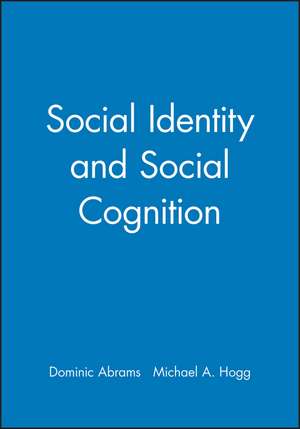
Sosical Identity
Autor Abrams, Hoggen Limba Engleză Paperback – 16 mar 1999
Preț: 471.06 lei
Preț vechi: 611.77 lei
-23%
Puncte Express: 707
Carte tipărită la comandă
Livrare economică 07-21 decembrie
Livrare prin curier în România Termenul estimat este afișat lângă disponibilitate.
Transport gratuit pentru acest produs Plată online sau ramburs, în funcție de opțiunile comenzii.
Retur gratuit în 14 zile Comandă securizată și suport în română.
Specificații
ISBN-13: 9780631206439
ISBN-10: 0631206434
Pagini: 432
Dimensiuni: 170 x 244 x 23 mm
Greutate: 0.74 kg
Ediția:New.
Editura: Wiley
Locul publicării:Chichester, United Kingdom
ISBN-10: 0631206434
Pagini: 432
Dimensiuni: 170 x 244 x 23 mm
Greutate: 0.74 kg
Ediția:New.
Editura: Wiley
Locul publicării:Chichester, United Kingdom
V-ar putea interesa
-
 -31%Preț: 739.85 lei1075.87 lei
 -
 Trust: A Very Short IntroductionKatherine Hawley-20%Preț: 56.97 lei70.82 lei
 -
 DuoethnographyRichard D. Sawyer-16%Preț: 373.90 lei444.57 lei
 -
 Evolution's Empress: Darwinian Perspectives on the Nature of WomenMaryanne L. Fisher-31%Preț: 838.70 lei1220.99 lei
 -
 Creativity in the Sciences: A Workbook Companion to Innovation GenerationIMichael L. Goodman-31%Preț: 407.00 lei589.38 lei
 -
 -32%Preț: 1218.23 lei1801.37 lei
 -
 -21%Preț: 311.54 lei395.09 lei
 -
 QuietSusan CainPreț: 106.89 lei
 -
 Preț: 417.29 lei
 -
 The Fear of FreedomErich FrommPreț: 158.63 lei
 -
 TraumaJeffrey C AlexanderPreț: 212.08 lei
 -
 Develop Your AssertivenessSue BishopPreț: 105.11 lei
 -
 Operant & Classical ConditioniMcSweeney-9%Preț: 1261.58 lei1386.36 lei
 -
 Preț: 104.99 lei
 -
 Intimate TreasonClaudia Black-5%Preț: 108.26 lei113.95 lei
Public țintă
upper level undergraduates and graduates studying social psychologyNotă biografică
Dominic Abrams is Professor of Social Psychology and Director of the Centre for the Study of Group Processes at the University of Kent at Canterbury.
Michael A. Hogg is Professor in Social Psychology and Director of the Centre for the Study of Group Processes at the University of Queensland.
Both editors have published widely in the area of group processes and social identity.
Michael A. Hogg is Professor in Social Psychology and Director of the Centre for the Study of Group Processes at the University of Queensland.
Both editors have published widely in the area of group processes and social identity.
Cuprins
List of Figures. List of Tables.
List of Contributors.
Preface and Acknowledgments.
1. Social Identity and Social Cognition: Historical Background and Current Trends: Michael Hogg and Dominic Abrams.
2. Integrating Social Identity and Social Cognition: A Framework for Bridging Diverse Perspectives: Don Operario and Susan T. Fiske.
3. Social Categorization and Social Context: Is Stereotype Change a Matter of Information or of Meaning? Penelope J. Oakes, S. Alexander Haslam and Katherine J. Reynolds.
4. Perceived Entitativity and the Social Identity Value of Group Memberships: Steven J. Sherman and David L. Hamilton.
5. Perceiving and Responding to Multiply Categorizable Individuals: Cognitive Processes and Affective Intergroup Bias: Theresa K. Vescio, Miles Hewstone, Richard J. Crisp and J. Mark Rubin.
6. Exploring Automatic Stereotype Activation: A Challenge to the Inevitability of Prejudice: Lorella Lepore and Rupert Brown.
7. Stereotyping, Processing Goals, and Social Identity: Inveterate and Fugacious Characteristics of Stereotypes: Vance Locke and Iain Walker.
8. Affective and Cognitive Implications of a Group Becoming Part of the Self: New Models of Prejudice and of the Self-Concept: Eliot R. Smith.
9. Social Identity, Social Cognition and the Self: The Flexibility and Stability of Self-Categorization: Dominic Abrams.
10. Implicit Self-Esteem: Shelly D. Farnham and Anthony G. Greenwald.
11. Joining Groups to Reduce Uncertainty: Subjective Uncertainty Reduction and Group Identification: Michael A. Hogg and Barbara A. Mullin.
12. Group Membership, Social Identity, and Attitudes: Deborah J. Terry, Michael A. Hogg, and Julie M. Duck.
13. Social Identity and Persuasion: Reconsidering the Role of Group Membership: Dean van Knippenberg.
14. Majority and Minority Influence: The Interactions of Social Identity and Social Cognition Mediators: Diane M. Mackie and Sarah B. Hunter.
References.
Subject Index.
Name Index.
List of Contributors.
Preface and Acknowledgments.
1. Social Identity and Social Cognition: Historical Background and Current Trends: Michael Hogg and Dominic Abrams.
2. Integrating Social Identity and Social Cognition: A Framework for Bridging Diverse Perspectives: Don Operario and Susan T. Fiske.
3. Social Categorization and Social Context: Is Stereotype Change a Matter of Information or of Meaning? Penelope J. Oakes, S. Alexander Haslam and Katherine J. Reynolds.
4. Perceived Entitativity and the Social Identity Value of Group Memberships: Steven J. Sherman and David L. Hamilton.
5. Perceiving and Responding to Multiply Categorizable Individuals: Cognitive Processes and Affective Intergroup Bias: Theresa K. Vescio, Miles Hewstone, Richard J. Crisp and J. Mark Rubin.
6. Exploring Automatic Stereotype Activation: A Challenge to the Inevitability of Prejudice: Lorella Lepore and Rupert Brown.
7. Stereotyping, Processing Goals, and Social Identity: Inveterate and Fugacious Characteristics of Stereotypes: Vance Locke and Iain Walker.
8. Affective and Cognitive Implications of a Group Becoming Part of the Self: New Models of Prejudice and of the Self-Concept: Eliot R. Smith.
9. Social Identity, Social Cognition and the Self: The Flexibility and Stability of Self-Categorization: Dominic Abrams.
10. Implicit Self-Esteem: Shelly D. Farnham and Anthony G. Greenwald.
11. Joining Groups to Reduce Uncertainty: Subjective Uncertainty Reduction and Group Identification: Michael A. Hogg and Barbara A. Mullin.
12. Group Membership, Social Identity, and Attitudes: Deborah J. Terry, Michael A. Hogg, and Julie M. Duck.
13. Social Identity and Persuasion: Reconsidering the Role of Group Membership: Dean van Knippenberg.
14. Majority and Minority Influence: The Interactions of Social Identity and Social Cognition Mediators: Diane M. Mackie and Sarah B. Hunter.
References.
Subject Index.
Name Index.