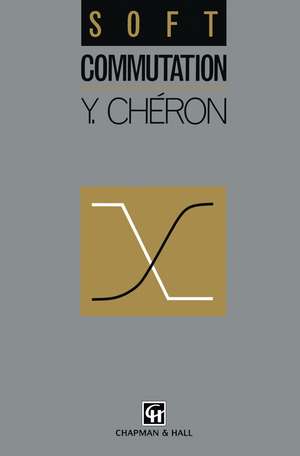
Soft Commutation
Autor Y. Cheronen Limba Engleză Hardback – 31 mai 1992
Preț: 982.31 lei
Preț vechi: 1197.93 lei
-18%
Puncte Express: 1473
Carte tipărită la comandă
Livrare economică 03-17 decembrie
Livrare prin curier în România Termenul estimat este afișat lângă disponibilitate.
Transport gratuit pentru acest produs Plată online sau ramburs, în funcție de opțiunile comenzii.
Retur gratuit în 14 zile Comandă securizată și suport în română.
Specificații
ISBN-13: 9780412395109
ISBN-10: 041239510X
Pagini: 248
Ilustrații: XI, 233 p.
Dimensiuni: 160 x 241 x 19 mm
Greutate: 0.49 kg
Ediția:1992
Editura: SPRINGER NETHERLANDS
Locul publicării:Dordrecht, Netherlands
ISBN-10: 041239510X
Pagini: 248
Ilustrații: XI, 233 p.
Dimensiuni: 160 x 241 x 19 mm
Greutate: 0.49 kg
Ediția:1992
Editura: SPRINGER NETHERLANDS
Locul publicării:Dordrecht, Netherlands
V-ar putea interesa
-
 Schaum's Outline of Basic Electricity, Second EditionMilton Gussow-9%Preț: 134.50 lei147.13 lei
 -
 Power ElectronicsMuhammad H. Rashid-23%Preț: 1603.35 lei2082.27 lei
 -
 Powers and Compensation in Circuits with Nonsinusoidal CurrentLeszek S. Czarnecki-9%Preț: 364.71 lei399.34 lei
 -
 Power Electronics HandbookMuhammad H. Rashid-29%Preț: 1305.58 lei1839.96 lei
 -
 -8%Preț: 516.06 lei560.94 lei
 -
 -19%Preț: 462.24 lei570.66 lei
 -
 -23%Preț: 804.59 lei1044.93 lei
 -
 Foundations of Analog and Digital Electronic CircuitsAnant Agarwal-28%Preț: 546.19 lei754.30 lei
 -
 -15%Preț: 505.55 lei594.76 lei
 -
 Advances in Control Power Systems and Emerging TechnologiesMohamed Bendaoud-18%Preț: 1908.84 lei2327.86 lei
 -
 -18%Preț: 924.59 lei1127.54 lei
 -
 Advanced Topics in Electric CircuitsZdzislaw Trzaska-18%Preț: 999.63 lei1219.06 lei
 -
 Components Operationally: Reversibility and System EngineeringClaudio Antares Mezzina-20%Preț: 389.32 lei486.66 lei
 -
 -11%Preț: 419.27 lei471.08 lei
 -
 Phasor Power ElectronicsChun T. Rim-18%Preț: 984.91 lei1201.11 lei
 -
 -24%Preț: 868.59 lei1142.88 lei
 -
 -18%Preț: 980.62 lei1195.87 lei
 -
 -18%Preț: 928.18 lei1131.93 lei
 -
 Flexible Electronics for Electric VehiclesSunil Kumar Goyal-18%Preț: 1910.00 lei2329.27 lei
Public țintă
ResearchCuprins
1 Constituent parts of static converters.- 1.1 Introduction.- 1.2 The concept of a switch.- 1.3 Classification of switches.- 1.4 Characterization of sources.- 1.5 Basic principles of static converters.- 1.6 Structures of static converters.- 1.7 Conclusion.- 2 The concept of duality in static converters.- 2.1 Introduction.- 2.2 Review of duality applied to graphs and circuits.- 2.3 Dual static switches.- 2.4 The dual thyristor.- 2.5 Applying duality rules in static converters.- 2.6 Extension to complex structures 2.- 2.7 Conclusion.- 3 Resonant inverters.- 3.1 Introduction.- 3.2 Resonant inverter structures.- 3.3 Review of resonant circuits.- 3.4 Properties of resonant inverters.- 3.5 Conclusion.- 4 Soft commutation.- 4.1 Introduction.- 4.2 General remarks about commutation in static converters.- 4.3 Soft commutation in an elementary commutation cell.- 4.4 Examples of converters operating in the soft commutation mode.- 4.5 Soft commutation and power control 57 4.5 Conclusion.- 5 Forced commutation.- 5.1 Introduction.- 5.2 Forced commutation in DC/DC converters.- 5.3 Forced commutation and duality.- 5.4 Forced commutation in DC/AC converters.- 5.5 Quasi-resonant converters.- 5.6 Conclusion.- 6 Static conversion through an AC link.- 6.1 Introduction.- 6.2 DC/DC conversion.- 6.3 Resonant converters.- 6.4 Power control in resonant converters.- 6.5 DC/AC conversion.- 6.6 General comments on resonant conversion.- 6.7 Conclusion.- 7 Design and applications.- 7.1 Introduction.- 7.2 Design of resonant converters.- 7.3 Applications.- 7.4 Conclusion.- 8 Conclusion.- Appendix A1 Notation — normalized units.- Appendix A2 Small signal analysis and modelling of the series resonant converter operating above the natural frequency.- A2.1 Assumptions.- A2.2 State plane analysis.- A2.3Study of the steady state mode.- A2.4 Static characteristics with fixed u.- A2.4 Small signal modelling.- Appendix A3 Detailed analysis of the series resonant converter operating above the natural frequency.- A3.1 Influence of the capacitative snubbers in the inverter.- A3.2 Influence of transformer imperfections.- Appendix A4 Optimal control of the series resonant converter.- A4.1 Introduction.- A4.2 Assumptions.- A4.3 Analysis.- A4.4 Optimal control.- A4.5 Static characteristics.- A4.5 Conclusion.- Appendix A5 Phase shift control.- A5.1 Principle.- A5.2 Characteristics.- A5.3 Limits.- Appendix A6 Controlled rectification and reversibility.- A6.1 Introduction.- A6.2 Assumptions.- A6.3 Analysis.- A6.4 Analysis.- A6.5 Analysis of the commutation.- A6.6 Component stresses.- References.
Recenzii
It provides a thorough...insight in to the design of resonant mode converters and the use of soft commutation techniques to minimise stress on the switching components. - New Electronics