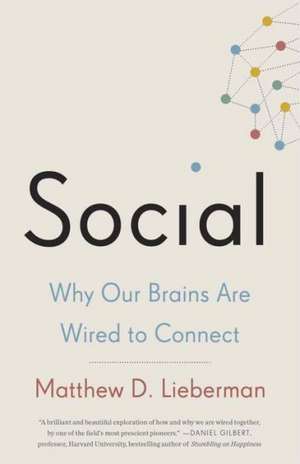
Social: Why Our Brains Are Wired to Connect
Autor Matthew D. Liebermanen Limba Engleză Paperback – 6 oct 2014
Vezi toate premiile Carte premiată
In "Social," renowned psychologist Matthew Lieberman explores groundbreaking research in social neuroscience revealing that our need to connect with other people is even more fundamental, more basic, than our need for food or shelter. Because of this, our brain uses its spare time to learn about the social world other people and our relation to them. It is believed that we must commit 10,000 hours to master a skill. According to Lieberman, each of us has spent 10,000 hours learning to make sense of people and groups "by the time we are ten."
"Social" argues that our need to reach out to and connect with others is a primary driver behind our behavior. We believe that pain and pleasure alone guide our actions. Yet, new research using fMRI including a great deal of original research conducted by Lieberman and his UCLA lab -- shows that our brains react to social pain and pleasure in much the same way as they do to physical pain and pleasure. Fortunately, the brain has evolved sophisticated mechanisms for securing our place in the social world. We have a unique ability to read other people s minds, to figure out their hopes, fears, and motivations, allowing us to effectively coordinate our lives with one another. And our most private sense of who we are is intimately linked to the important people and groups in our lives. This wiring often leads us to restrain our selfish impulses for the greater good. These mechanisms lead to behavior that might seem irrational, but is really just the result of our deep social wiring and necessary for our success as a species.
Based on the latest cutting edge research, the findings in "Social" have important real-world implications. Our schools and businesses, for example, attempt to minimalize social distractions. But this is exactly the wrong thing to do to encourage engagement and learning, and literally shuts down the social brain, leaving powerful neuro-cognitive resources untapped. The insights revealed in this pioneering book suggest ways to improve learning in schools, make the workplace more productive, and improve our overall well-being."
| Toate formatele și edițiile | Preț | Express |
|---|---|---|
| Paperback (2) | 94.92 lei 3-5 săpt. | +29.90 lei 10-14 zile |
| BROADWAY BOOKS – 6 oct 2014 | 94.92 lei 3-5 săpt. | +29.90 lei 10-14 zile |
| OUP OXFORD – 16 iul 2015 | 105.76 lei 3-5 săpt. | +12.64 lei 10-14 zile |
Preț: 94.92 lei
16.80€ • 19.55$ • 14.57£
Carte disponibilă
Livrare economică 07-21 februarie
Livrare express 27-31 ianuarie pentru 39.89 lei
Specificații
ISBN-10: 0307889106
Pagini: 374
Dimensiuni: 145 x 211 x 20 mm
Greutate: 0.3 kg
Editura: BROADWAY BOOKS
V-ar putea interesa
-
 Your Brain at WorkDavid RockPreț: 176.66 lei
 -
 -16%Preț: 135.86 lei161.27 lei
 -
 -33%Preț: 627.89 lei936.13 lei
 -
 -17%Preț: 113.00 lei135.91 lei
 -
 The Power of Now: (20th Anniversary Edition)Eckhart TollePreț: 48.65 lei
 -
 Preț: 358.06 lei
 -
 -27%Preț: 84.15 lei115.60 lei
 -
 -27%Preț: 85.29 lei116.29 lei
 -
 Cognitive and Social Factors in Early DeceptionStephen J. Ceci-15%Preț: 420.82 lei495.08 lei
 -
 -27%Preț: 64.81 lei89.37 lei
 -
 -38%Preț: 46.98 lei76.21 lei
 -
 The Developing Mind: The Developing MindDaniel J. Siegel-5%Preț: 482.95 lei508.37 lei
 -
 Active ListeningCenter for Creative LeadershipPreț: 94.53 lei
 -
 Hold on to Your KidsGabor Maté-21%Preț: 70.61 lei88.92 lei
 -
 Man's Search For MeaningViktor E. FranklPreț: 60.45 lei
 -
 The Happiness HypothesisJonathan Haidt-27%Preț: 59.86 lei81.91 lei
 -
 Theory of Mind: Beyond the Preschool YearsScott A. MillerPreț: 447.73 lei
 -
 Preț: 75.55 lei
 -
 Neue Stimmen in der psychosozialen ForschungStephen Frosh-15%Preț: 666.91 lei784.60 lei
 -
 Preț: 49.00 lei
 -
 Drive: Ce anume ne motivează cu adevăratDaniel PinkPreț: 47.00 lei
Notă biografică
Descriere
Why are we influenced by the behaviour of complete strangers? Why does the brain register similar pleasure when I perceive something as 'fair' or when I eat chocolate? Why can we be so profoundly hurt by bereavement? What are the evolutionary benefits of these traits? The young discipline of 'social cognitive neuroscience' has been exploring this fascinating interface between brain science and human behaviour since the late 1990s. Now one of its founding pioneers, Matthew D. Lieberman, presents the discoveries that he and fellow researchers have made. Using fMRI scanning and a range of other techniques, they have been able to see that the brain responds to social pain and pleasure the same way as physical pain and pleasure; and that unbeknown to ourselves, we are constantly 'mindreading' other people so that we can fit in with them. It is clear that our brains are designed respond to and be influenced by others. For good evolutionary reasons, he argues, we are wired to be social. The implications are numerous and profound. Do we have to rethink what we understand by identity, and free will? How can managers improve the way their teams relate and perform? Could we organize large social institutions in ways that would work far better? And could there be whole new methods of education?
Premii
- L.A. Times Book Prize Finalist, 2013