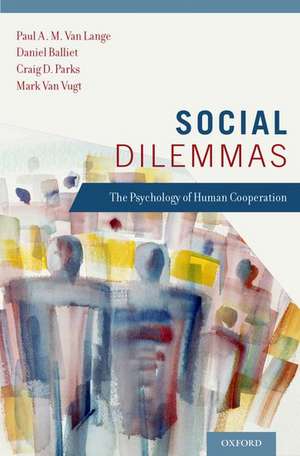
Social Dilemmas: Understanding Human Cooperation
Autor Paul Van Lange, Daniel P. Balliet, Craig D. Parks, Mark van Vugten Limba Engleză Hardback – 9 ian 2014
Monografia Social Dilemmas, publicată de Oxford University Press, reprezintă o sinteză teoretică și practică asupra unuia dintre cele mai complexe puzzle-uri ale comportamentului uman: cooperarea. Credem că valoarea acestui volum rezidă în capacitatea autorilor de a defini dilemele sociale nu doar ca exerciții de laborator, ci ca tensiuni omniprezente între egoismul imediat și binele comun durabil. Structura este riguros împărțită în trei segmente: o fundamentare istorică a teoriei jocurilor, o analiză tripartită din perspective evolutive, psihologice și culturale, și o secțiune finală dedicată aplicațiilor în lumea reală. Remarcăm abordarea pragmatică a autorilor Paul Van Lange, Daniel P. Balliet, Craig D. Parks și Mark van Vugt, care extind discuția spre domenii critice precum managementul organizațional, politicile de mediu și securitatea națională. Lucrarea completează perspectiva oferită de Trust in Social Dilemmas, adăugând o analiză sistematică a modului în care cooperarea poate fi promovată activ, dincolo de simplul mecanism al încrederii. Spre deosebire de alte volume care se limitează la modelări matematice, acest titlu integrează variabilele culturale și evolutive, oferind o viziune multidimensională. Tonul este academic și precis, iar decizia editorială de a încheia fiecare capitol cu întrebări deschise pentru cercetări viitoare transformă cartea dintr-un manual static într-un instrument de lucru dinamic pentru studenți și cercetători.
Preț: 724.22 lei
Preț vechi: 1000.19 lei
-28%
Carte tipărită la comandă
Livrare economică 26 noiembrie-02 decembrie
Specificații
ISBN-10: 0199897611
Pagini: 208
Dimensiuni: 239 x 163 x 25 mm
Greutate: 0.47 kg
Editura: Oxford University Press
Colecția OUP USA
Locul publicării:New York, United States
V-ar putea interesa
-
 -32%Preț: 715.69 lei1057.15 lei
 -
 -33%Preț: 676.74 lei1005.34 lei
 -
 DuoethnographyRichard D. Sawyer-17%Preț: 361.82 lei436.88 lei
 -
 Future Bright: A Transforming Vision of Human IntelligenceMichael E. MartinezPreț: 267.92 lei
 -
 Evolution's Empress: Darwinian Perspectives on the Nature of WomenMaryanne L. Fisher-32%Preț: 811.31 lei1199.75 lei
 -
 Creativity in the Sciences: A Workbook Companion to Innovation GenerationIMichael L. Goodman-31%Preț: 407.00 lei589.38 lei
 -
 The Political Psychology of Terrorism FearsSamuel Justin Sinclair-32%Preț: 648.04 lei959.72 lei
 -
 -22%Preț: 301.32 lei388.29 lei
 -
 Preț: 417.29 lei
 -
 Nobody Left to HateElliot AronsonPreț: 107.14 lei
 -
 The Sourcebook of Nonverbal Measures: Going Beyond WordsValerie Lynn Manusov-15%Preț: 579.94 lei682.28 lei
 -
 Identities, Boundaries and Social TiesCharles TillyPreț: 442.38 lei
De ce să citești această carte
Recomandăm această carte specialiștilor în psihologie socială, economie comportamentală și sociologie care doresc să înțeleagă mecanismele din spatele acțiunii colective. Cititorul câștigă un cadru analitic robust pentru a interpreta conflictele de interese din organizații sau societate, primind răspunsuri fundamentate științific despre motivele pentru care oamenii aleg să ajute străini sau să pedepsească încălcarea normelor, chiar și cu un cost personal ridicat.
Despre autor
Paul Van Lange este profesor de psihologie socială la Vrije Universiteit Amsterdam și un expert recunoscut la nivel internațional în studiul cooperării umane și al dilemelor sociale. Alături de coautorii Daniel P. Balliet, Craig D. Parks și Mark van Vugt, acesta a contribuit fundamental la dezvoltarea teoriei interdependenței. Expertiza lor combinată acoperă un spectru larg, de la psihologie evoluționistă la comportament organizațional, reflectând prestigiul academic asociat publicațiilor sub egida Oxford University Press. Activitatea lor de cercetare se concentrează pe mecanismele psihologice care facilitează încrederea și colaborarea în grupuri mari.