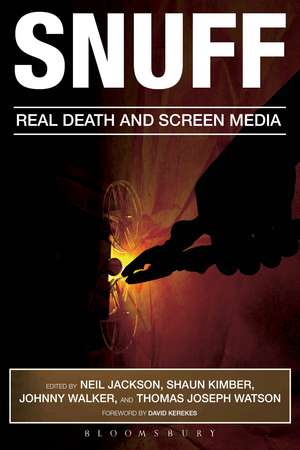
Snuff: Real Death and Screen Media
Editat de Dr Neil Jackson, Shaun Kimber, Johnny Walker, Thomas Joseph Watsonen Limba Engleză Hardback – 10 mar 2016
Preț: 901.00 lei
Preț vechi: 1192.51 lei
-24%
Puncte Express: 1352
Carte tipărită la comandă
Livrare economică 05-19 decembrie
Livrare prin curier în România Termenul estimat este afișat lângă disponibilitate.
Transport gratuit pentru acest produs Plată online sau ramburs, în funcție de opțiunile comenzii.
Retur gratuit în 14 zile Comandă securizată și suport în română.
Specificații
ISBN-13: 9781628921144
ISBN-10: 1628921145
Pagini: 344
Ilustrații: 65 bw illus
Dimensiuni: 152 x 229 x 23 mm
Greutate: 0.63 kg
Editura: Bloomsbury Publishing
Colecția Bloomsbury Academic
Locul publicării:New York, United States
ISBN-10: 1628921145
Pagini: 344
Ilustrații: 65 bw illus
Dimensiuni: 152 x 229 x 23 mm
Greutate: 0.63 kg
Editura: Bloomsbury Publishing
Colecția Bloomsbury Academic
Locul publicării:New York, United States
V-ar putea interesa
-
 Code NameJohnny WalkerPreț: 101.44 lei
 -
 -19%Preț: 314.21 lei387.89 lei
 -
 Feeling NormalF Hollis GriffinPreț: 182.65 lei
 -
 Invention of Robert BressonColin BurnettPreț: 232.76 lei
 -
 The Seductions of DarwinMatthew RampleyPreț: 252.06 lei
 -
 Representing ethnicity in contemporary French visual cultureJoseph McGonagle-23%Preț: 693.38 lei900.50 lei
 -
 Contemporary British Horror CinemaJohnny Walker-18%Preț: 596.55 lei727.49 lei
 -
 Dying in Full Detail – Mortality and Digital DocumentaryJennifer MalkowskiPreț: 237.78 lei
 -
 Film and Television Genres of the Late Soviet EraAlexander Prokhorov-23%Preț: 213.96 lei279.66 lei
 -
 Noise Matters: Towards an Ontology of NoiseAssociate Professor Greg Hainge-24%Preț: 835.84 lei1106.05 lei
 -
 Film FablesJacques Rancière-20%Preț: 161.11 lei201.48 lei
 -
 Refocus: The Films of Budd BoetticherGary D Rhodes-24%Preț: 645.37 lei848.14 lei
 -
 East, West and CentreMichael Gott-16%Preț: 211.23 lei250.66 lei
 -
 -24%Preț: 281.35 lei371.33 lei
 -
 -25%Preț: 278.18 lei369.61 lei
 -
 Lars von Trier's WomenDr Rex Butler-33%Preț: 899.33 lei1337.68 lei
 -
 -23%Preț: 862.44 lei1120.05 lei
 -
 -24%Preț: 729.01 lei955.54 lei
Cuprins
List of Figures
Foreword: A Culture of CHange
David Kerekes (Owner of Headpress and author of Killing For Culture)
Acknowledgements
Introduction: Shot, Cut and Slaughtered
Neil Jackson (University of Lincoln, UK)
Part I - The Changing Meaning of "Snuff"
Chapter 1: The Way to Digital Death
Julian Petley (Brunel University, UK)
Chapter 2: The Affective Reality of Snuff
Misha Kavka (University of Auckland, New Zealand)
Chapter 3: Animal Snuff
Simon Hobbs (University of Portsmouth, UK)
Chapter 4: Breathing New Life into Old Fears: Extreme Pornogrpahy and the Wider Politics of Snuff
Clarissa Smith (University of Sunderland, UK)
Chapter 5: From Snuff to the South: The Global Reception of Cannibal Holocaust
Nicolo Gallio (University of Bologna, Italy) and Xavier Mendik (University of Brighton, UK)
Chapter 6: A Murder Mystery in Black and Blue: The Marketing, Distribution and Cult Mythology of Snuff in the UK
Mark McKenna (University of Sunderland, UK)
Chapter 7: Traces of Snuff: Black Markets, Fan Subcultures and Underground Horror in the 90s
Johnny Walker (Northumbria University, UK)
Chapter 8: SNuff 2.0: Real Death Goes HD Ready
Mark Astley (Independent Scholar, UK)
Part II - "Snuff" Across Film and Television
Chapter 9: Unfound Footage and Unfounded Rumours: The Manson Family Murders and the Persistence of Snuff
Mark Jones & Gerry Carlin (University of Wolverhampton, UK)
Chapter 10: Wild Eyes, Dead Ladies: The Snuff Filmmaker in Realist Horror
Neil Jackson (University of Lincoln, UK)
Chapter 11: The Mediation of Death in Fictional Snuff: Reflexivity, Viewer Interpellation and Ethical Implication
Xavier Aldana Reyes (Manchester Metropolitan University, UK)
Chatper 12: "Why Would you Film It?" Snuff, Sinister and Contemporary US Horror Cinema
Shaun Kimber (Bournemouth University, UK)
Chapter 13: Cinema as Snuff: From Pre-Cinema to Shadow of the Vampire
Linda Badley (Middle Tennessee State University, USA)
Chapter 14: Affect
Tina Kendall (Anglia Ruskin University, UK)
Chapter 15: A View to Kill: Perspectives on Faux-Snuff and Self
Steve Jones (Northumbria University, UK)
Select Bibliography
Contributors
Foreword: A Culture of CHange
David Kerekes (Owner of Headpress and author of Killing For Culture)
Acknowledgements
Introduction: Shot, Cut and Slaughtered
Neil Jackson (University of Lincoln, UK)
Part I - The Changing Meaning of "Snuff"
Chapter 1: The Way to Digital Death
Julian Petley (Brunel University, UK)
Chapter 2: The Affective Reality of Snuff
Misha Kavka (University of Auckland, New Zealand)
Chapter 3: Animal Snuff
Simon Hobbs (University of Portsmouth, UK)
Chapter 4: Breathing New Life into Old Fears: Extreme Pornogrpahy and the Wider Politics of Snuff
Clarissa Smith (University of Sunderland, UK)
Chapter 5: From Snuff to the South: The Global Reception of Cannibal Holocaust
Nicolo Gallio (University of Bologna, Italy) and Xavier Mendik (University of Brighton, UK)
Chapter 6: A Murder Mystery in Black and Blue: The Marketing, Distribution and Cult Mythology of Snuff in the UK
Mark McKenna (University of Sunderland, UK)
Chapter 7: Traces of Snuff: Black Markets, Fan Subcultures and Underground Horror in the 90s
Johnny Walker (Northumbria University, UK)
Chapter 8: SNuff 2.0: Real Death Goes HD Ready
Mark Astley (Independent Scholar, UK)
Part II - "Snuff" Across Film and Television
Chapter 9: Unfound Footage and Unfounded Rumours: The Manson Family Murders and the Persistence of Snuff
Mark Jones & Gerry Carlin (University of Wolverhampton, UK)
Chapter 10: Wild Eyes, Dead Ladies: The Snuff Filmmaker in Realist Horror
Neil Jackson (University of Lincoln, UK)
Chapter 11: The Mediation of Death in Fictional Snuff: Reflexivity, Viewer Interpellation and Ethical Implication
Xavier Aldana Reyes (Manchester Metropolitan University, UK)
Chatper 12: "Why Would you Film It?" Snuff, Sinister and Contemporary US Horror Cinema
Shaun Kimber (Bournemouth University, UK)
Chapter 13: Cinema as Snuff: From Pre-Cinema to Shadow of the Vampire
Linda Badley (Middle Tennessee State University, USA)
Chapter 14: Affect
Tina Kendall (Anglia Ruskin University, UK)
Chapter 15: A View to Kill: Perspectives on Faux-Snuff and Self
Steve Jones (Northumbria University, UK)
Select Bibliography
Contributors
Recenzii
There is much to be said for this timely collection of essays ... It provides a rich archive of sources for interested readers; it is diverse in range but coherent in remit, and it addresses the topic broadly enough to appeal to many different scholars ... [This] is a serious intervention deliberately situated at the intersection of debates about violence in society and violence in representation, which has long been a somewhat sensationalized space; it is an original and stimulating contribution to an otherwise undersubscribed area of intellectual interest. This book will be valuable to anyone interested in the ongoing debate about visuality, violence and death.
These essays meticulously examine the history and mythology of the visual media's 'unholy grail'-the spectral 'real' behind film's reality effects. Tracing snuff's evolution from pornography to propaganda, from cult phenomenon to mainstream culture, this is the most comprehensive effort to date to track down the elusive phenomenon hovering at (and often defining) the boundaries between life and death, voyeurism and violence, terror and titillation, art and exploitation, realism and reality. Anyone seeking an unflinching glimpse of media in the digital age cannot ignore this collection. What was unthinkable a decade ago is now routine. Never have violence and terror been at once so visible and, as a result, so banal.
In the 1970s a toxic brew of urban decay, rising crime rates and the 'porno plague' gave rise to a new myth: that of the snuff film. Although the combination of sex and murder in the feature Snuff (1976) was quickly revealed as a hoax and the FBI could find no evidence that the real thing existed, the concept of the snuff film has endured and, ironically, taken on a life of its own. This collection of fascinating essays advances a scholarly and rigorous consideration of how the fringes of popular culture have become mainstreamed, and how media myths can become disturbing realities.
Snuff: Real Death and Screen Media is both thorough and wide-ranging in its approaches to the complex and malleable category of the snuff film. This book is destined to become the key text on the representations and public debates which underpin the charged and vital topic of real death on screen, and the cultural, commercial, legal, and affective consequences of its associated myths.
These essays meticulously examine the history and mythology of the visual media's 'unholy grail'-the spectral 'real' behind film's reality effects. Tracing snuff's evolution from pornography to propaganda, from cult phenomenon to mainstream culture, this is the most comprehensive effort to date to track down the elusive phenomenon hovering at (and often defining) the boundaries between life and death, voyeurism and violence, terror and titillation, art and exploitation, realism and reality. Anyone seeking an unflinching glimpse of media in the digital age cannot ignore this collection. What was unthinkable a decade ago is now routine. Never have violence and terror been at once so visible and, as a result, so banal.
In the 1970s a toxic brew of urban decay, rising crime rates and the 'porno plague' gave rise to a new myth: that of the snuff film. Although the combination of sex and murder in the feature Snuff (1976) was quickly revealed as a hoax and the FBI could find no evidence that the real thing existed, the concept of the snuff film has endured and, ironically, taken on a life of its own. This collection of fascinating essays advances a scholarly and rigorous consideration of how the fringes of popular culture have become mainstreamed, and how media myths can become disturbing realities.
Snuff: Real Death and Screen Media is both thorough and wide-ranging in its approaches to the complex and malleable category of the snuff film. This book is destined to become the key text on the representations and public debates which underpin the charged and vital topic of real death on screen, and the cultural, commercial, legal, and affective consequences of its associated myths.