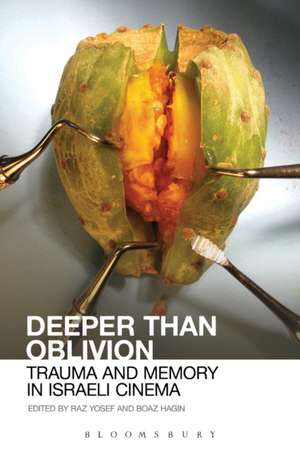
Deeper than Oblivion: Trauma and Memory in Israeli Cinema
Editat de Raz Yosef, Boaz Haginen Limba Engleză Paperback – 19 mai 2016
Tracing a long line of films from the 1940s up to the 2000s, the contributors use close readings of these films not only to reconstruct the past, but also to actively engage with it. Addressing both high-profile and lesser known fiction and non-fiction Israeli films, Deeper than Oblivion underlines the unique aesthetic choices many of these films make in their attempt to confront the difficulties, perhaps even impossibility, of representing trauma. By looking at recent and classic examples of Israeli films that turn to memory and trauma, this book addresses the pressing issues and disputes in the field today.
Preț: 281.35 lei
Preț vechi: 371.33 lei
-24%
Puncte Express: 422
Carte tipărită la comandă
Livrare economică 04-18 decembrie
Livrare prin curier în România Termenul estimat este afișat lângă disponibilitate.
Transport gratuit de la 400.00 lei Plată online sau ramburs, în funcție de opțiunile comenzii.
Retur gratuit în 14 zile Comandă securizată și suport în română.
Specificații
ISBN-13: 9781501319617
ISBN-10: 1501319612
Pagini: 384
Ilustrații: 20 bw illus
Dimensiuni: 152 x 229 x 31 mm
Greutate: 0.51 kg
Ediția:NIPPOD
Editura: Bloomsbury Publishing
Colecția Bloomsbury Academic
Locul publicării:New York, United States
ISBN-10: 1501319612
Pagini: 384
Ilustrații: 20 bw illus
Dimensiuni: 152 x 229 x 31 mm
Greutate: 0.51 kg
Ediția:NIPPOD
Editura: Bloomsbury Publishing
Colecția Bloomsbury Academic
Locul publicării:New York, United States
V-ar putea interesa
-
 -9%Preț: 399.21 lei436.45 lei
 -
 Brecht On Film & RadioBertolt Brecht-11%Preț: 348.07 lei390.66 lei
 -
 Reel Power: Hollywood Cinema and American SupremacyMatthew AlfordPreț: 281.20 lei
 -
 Deleuze and Contemporary ArtStephen Zepke-16%Preț: 239.03 lei283.99 lei
 -
 Discover Your Scottish AncestryGraham Holton-8%Preț: 147.80 lei160.65 lei
 -
 Deleuze and FilmDavid Martin-Jones-15%Preț: 213.00 lei252.00 lei
 -
 Cinematic JourneysDimitris Eleftheriotis-17%Preț: 232.56 lei280.03 lei
 -
 Deleuze and the Cinemas of PerformanceElena Del Río-16%Preț: 207.99 lei247.67 lei
 -
 Memory and the Moving ImageIsabelle Mcneill-16%Preț: 182.89 lei218.94 lei
 -
 -16%Preț: 211.29 lei252.78 lei
 -
 Why We Make ArtRichard HickmanPreț: 207.50 lei
 -
 -19%Preț: 301.92 lei373.23 lei
Cuprins
Acknowledgments
Chapter 1:
Sweet on the Inside: Trauma, Memory, and Israeli Cinema
Boaz Hagin and Raz Yosef
Chapter 2:
Postscript to Israeli Cinema: East/West and the Politics of Representation
Ella Shohat
Chapter 3:
Gender, the Military, Memory, and the Photograph: Tamar Yarom's To See If I'm Smiling and American Films about Abu Ghraib
Diane Waldman
Chapter 4:
The Event and the Picture: David Perlov's My Stills and Memories of the Eichmann Trial
Anat Zanger
Chapter 5:
The Agonies of an Eternal Victim: Zionist Guilt in Avi Mograbi's Happy Birthday, Mr. Mograbi
Shmulik Duvdevani
Chapter 6:
Traces of War: Memory, Trauma, and the Archive in Joseph Cedar's Beaufort
Raz Yosef
Chapter 7:
Memory of a Death Foretold: Fathers and Sons in Assi Dayan's "Trilogy"
Yael Munk
Chapter 8:
Queering Terror: Trauma, Race, and Nationalism in Palestinian and Israeli Gay Cinema during the Second Intifada
Raya Morag
Chapter 9:
"Our Traumas": Terrorism, Tradition, and Mind Games in Frozen Days
Boaz Hagin
Chapter 10:
History of Violence: From the Trauma of Expulsion to the Holocaust in Israeli Cinema
Nurith Gertz and Gal Hermoni
Chapter 11:
Last Train to the Holocaust
Judd Ne'eman and Nerit Grossman
Chapter 12:
Passages, Wars, and Encounters with Death: The Desert as a Site of Memory in Israeli Film
Yael Zerubavel
Chapter 13:
"Walking through walls": Documentary Film and Other Technologies of Navigation, Aspiration, and Memory
Janet Walker
Notes on Contributors
Index
Chapter 1:
Sweet on the Inside: Trauma, Memory, and Israeli Cinema
Boaz Hagin and Raz Yosef
Chapter 2:
Postscript to Israeli Cinema: East/West and the Politics of Representation
Ella Shohat
Chapter 3:
Gender, the Military, Memory, and the Photograph: Tamar Yarom's To See If I'm Smiling and American Films about Abu Ghraib
Diane Waldman
Chapter 4:
The Event and the Picture: David Perlov's My Stills and Memories of the Eichmann Trial
Anat Zanger
Chapter 5:
The Agonies of an Eternal Victim: Zionist Guilt in Avi Mograbi's Happy Birthday, Mr. Mograbi
Shmulik Duvdevani
Chapter 6:
Traces of War: Memory, Trauma, and the Archive in Joseph Cedar's Beaufort
Raz Yosef
Chapter 7:
Memory of a Death Foretold: Fathers and Sons in Assi Dayan's "Trilogy"
Yael Munk
Chapter 8:
Queering Terror: Trauma, Race, and Nationalism in Palestinian and Israeli Gay Cinema during the Second Intifada
Raya Morag
Chapter 9:
"Our Traumas": Terrorism, Tradition, and Mind Games in Frozen Days
Boaz Hagin
Chapter 10:
History of Violence: From the Trauma of Expulsion to the Holocaust in Israeli Cinema
Nurith Gertz and Gal Hermoni
Chapter 11:
Last Train to the Holocaust
Judd Ne'eman and Nerit Grossman
Chapter 12:
Passages, Wars, and Encounters with Death: The Desert as a Site of Memory in Israeli Film
Yael Zerubavel
Chapter 13:
"Walking through walls": Documentary Film and Other Technologies of Navigation, Aspiration, and Memory
Janet Walker
Notes on Contributors
Index
Recenzii
This intriguing collection of essays provides a perceptive and thought provoking look at Israeli cinema and its relations to Israeli society. It contains various approaches to the cinematic contemplations of 'trauma' in Israeli film, which shed new light on the fundamentals of the Israeli experience in the past decades. In going beyond the commonly discussed canon of Israeli films, the articles in Deeper than Oblivion illustrate the contour of a novel framework for the reading of Israeli cinema and its cultural significance. It is an essential addition to the growing scholarship on Israeli culture.
This timely collection offers a spectrum of critical perspectives on Israel's past and present through the lens of its cinema. In addition to examining a wide range of reactions to trauma and memory, the essays explore the tension between fiction and documentary, space and identity, and aesthetics and politics. The engaging book reveals the richness of Israeli cinema and its astonishing resonance for us today.
This collection of sophisticated articles exposes how Israeli cinema navigates the web of traumas that constitute the collective national memory as well as threaten the coherence of the familiar Zionist meta-narrative. Discussing traumas of wars, the Naqba, the Holocaust, the trauma of the perpetrator, of immigration and of dislocating others, of terrorism, of occupation, and of guilt and responsibility these articles offer critical reflection on Israeli histories and cultures.
Deeper Than Oblivion is an ambitious project that explores the representation of personal and collective traumas in Israeli cinema . . . [The book] does not simply constitute an introductory volume to key tropes in Israeli cinema, but presents a refreshingly in-depth study of questions of personal recollection, and collective and cultural memory . . . Yosef and Hagin have perfectly pitched their study
This timely collection offers a spectrum of critical perspectives on Israel's past and present through the lens of its cinema. In addition to examining a wide range of reactions to trauma and memory, the essays explore the tension between fiction and documentary, space and identity, and aesthetics and politics. The engaging book reveals the richness of Israeli cinema and its astonishing resonance for us today.
This collection of sophisticated articles exposes how Israeli cinema navigates the web of traumas that constitute the collective national memory as well as threaten the coherence of the familiar Zionist meta-narrative. Discussing traumas of wars, the Naqba, the Holocaust, the trauma of the perpetrator, of immigration and of dislocating others, of terrorism, of occupation, and of guilt and responsibility these articles offer critical reflection on Israeli histories and cultures.
Deeper Than Oblivion is an ambitious project that explores the representation of personal and collective traumas in Israeli cinema . . . [The book] does not simply constitute an introductory volume to key tropes in Israeli cinema, but presents a refreshingly in-depth study of questions of personal recollection, and collective and cultural memory . . . Yosef and Hagin have perfectly pitched their study