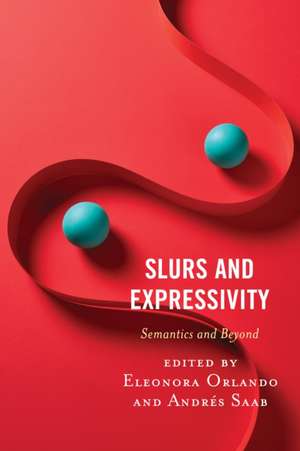
Slurs and Expressivity: Semantics and Beyond: Philosophy of Language: Connections and Perspectives
Editat de Eleonora Orlando, Andrés Saab Contribuţii de Ramiro Caso, Justina Díaz Legaspe, Nicolás Lo Guercio, Alfonso Losada, Carlos Márquez, Stefano Predelli, Ludovic Soutifen Limba Engleză Paperback – 15 mar 2023



Preț: 220.85 lei
Preț vechi: 306.97 lei
-28%
Puncte Express: 331
Carte tipărită la comandă
Livrare economică 28 noiembrie-12 decembrie
Livrare prin curier în România Termenul estimat este afișat lângă disponibilitate.
Transport gratuit de la 400.00 lei Plată online sau ramburs, în funcție de opțiunile comenzii.
Retur gratuit în 14 zile Comandă securizată și suport în română.
Specificații
ISBN-13: 9781793614384
ISBN-10: 1793614385
Pagini: 228
Ilustrații: 20 b/w illustrations;7 tables;
Dimensiuni: 152 x 227 x 17 mm
Greutate: 0.34 kg
Editura: Bloomsbury Publishing
Colecția Lexington Books
Seria Philosophy of Language: Connections and Perspectives
Locul publicării:New York, United States
ISBN-10: 1793614385
Pagini: 228
Ilustrații: 20 b/w illustrations;7 tables;
Dimensiuni: 152 x 227 x 17 mm
Greutate: 0.34 kg
Editura: Bloomsbury Publishing
Colecția Lexington Books
Seria Philosophy of Language: Connections and Perspectives
Locul publicării:New York, United States
V-ar putea interesa
-
 The Reference BookJohn Hawthorne-13%Preț: 295.19 lei338.43 lei
 -
 The Oxford Handbook of LyingJörg Meibauer-32%Preț: 1025.38 lei1512.93 lei
 -
 Cuss ControlJames V. O'ConnorPreț: 107.95 lei
 -
 Literary Semiotics: A Critical ApproachScott Simpkins-35%Preț: 741.19 lei1148.18 lei
 -
 -27%Preț: 278.84 lei379.41 lei
 -
 -34%Preț: 633.75 lei958.73 lei
 -
 -29%Preț: 567.78 lei799.08 lei
 -
 -18%Preț: 695.67 lei848.38 lei
 -
 Repairing the Athlete's Image: Studies in Sports Image RestorationJoseph R. Blaney-31%Preț: 403.74 lei581.44 lei
 -
 The Rhetoric of Black Mayors: In Their Own WordsDeborah F. Atwater-30%Preț: 214.45 lei305.13 lei
 -
 Conspiracy RhetoricThomas AdamoPreț: 62.24 lei
 -
 Durable DesignMichael J. P. LarsonPreț: 115.55 lei
 -
 1,000 Creative Writing Prompts for SeasonsBryan CohenPreț: 52.46 lei
 -
 Figuras Retoricas y Otros Ingredientes del Discurso PoliticoRicardo Garcia DamboreneaPreț: 144.76 lei
 -
 La ArgumentacionRivano Fischer, EmilioPreț: 51.20 lei
 -
 1,000 Creative Writing Prompts, Volume 2Bryan CohenPreț: 52.46 lei
 -
 -23%Preț: 717.45 lei931.76 lei
 -
 The Political Language of FoodJoe Abisaid-28%Preț: 381.41 lei530.89 lei
 -
 -34%Preț: 568.84 lei862.95 lei
 -
 Easy ResearcherElizabeth FersztPreț: 53.86 lei
 -
 Sayings and Their MeaningsR. J. ClarkePreț: 37.10 lei
 -
 The New Art of Being RightMin LiuPreț: 44.37 lei
 -
 A Booke Called the Foundacion of RhetorikeRichard RainoldePreț: 54.05 lei
 -
 A World in WordsM. Kent TravisPreț: 87.88 lei
 -
 L'Art de PersuaderBlaise PascalPreț: 54.99 lei
 -
 A Semantic and Structural Analysis of RevelationAndrew PerssonPreț: 242.83 lei
 -
 La rhétorique d'AristoteAristotePreț: 231.48 lei
 -
 Emotionalrhetorische Textanalyse ZuJulia EsauPreț: 102.56 lei
 -
 Grundlagen Der FernsehrhetorikEva HaselPreț: 92.21 lei
Cuprins
Contents
List of Tables and Figures
Preface
Chapter 1: Dualism and Monism in the Study of Slurs and Beyond
Eleonora Orlando and Andrés Saab
Chapter 2: On the Locus of Expressivity. Deriving Parallel Meaning Dimensions from Architectural Considerations
Andrés Saab
Chapter 3: The Discursive Dimension of Slurs
Nicolás Lo Guercio
Chapter 4: A Bidimensional Account of Slurs
Ramiro Caso
Chapter 5: Expressives and the Theory of Bias
Ludovic Soutif and Carlos Márquez
Chapter 6: Taboo: The Case of Slurs
Stefano Predelli
Chapter 7: Slurs, the Amoralist and the Expression of Hate
Justina Díaz Legaspe
Chapter 8: On the Moral Import of Using Slurs
Eleonora Orlando
Chapter 9: Sudaca. Slurs and Typifying
Alfonso Losada
About the Contributors
List of Tables and Figures
Preface
Chapter 1: Dualism and Monism in the Study of Slurs and Beyond
Eleonora Orlando and Andrés Saab
Chapter 2: On the Locus of Expressivity. Deriving Parallel Meaning Dimensions from Architectural Considerations
Andrés Saab
Chapter 3: The Discursive Dimension of Slurs
Nicolás Lo Guercio
Chapter 4: A Bidimensional Account of Slurs
Ramiro Caso
Chapter 5: Expressives and the Theory of Bias
Ludovic Soutif and Carlos Márquez
Chapter 6: Taboo: The Case of Slurs
Stefano Predelli
Chapter 7: Slurs, the Amoralist and the Expression of Hate
Justina Díaz Legaspe
Chapter 8: On the Moral Import of Using Slurs
Eleonora Orlando
Chapter 9: Sudaca. Slurs and Typifying
Alfonso Losada
About the Contributors
Recenzii
The essays, most by Latin American scholars, are philosophical and linguistic studies representing a variety of theoretic orientations. What brings the essays together is the issue of what it means for a word to express a derogatory concept and how such meanings are reflected in use. The nine papers cover three broad areas. One is the separation of truth-conditions and reference from expressive force-the dualism of expressive terms. Another is the so-called hyper-expressivity of slurs, which refers to the way they retain their derogatory force across contexts. The third is the moral import of slurs and the independence of expressivity from attitude. Readers will require grounding in such concepts as truth-conditional and non-truth-conditional meaning, two-dimensional semantics, and conversational and conventional implicature, among others.. Slurs and Expressivity is an excellent contribution to the literature on philosophy of language[.] Recommended. Lower-division undergraduates through faculty.
This book will be a valuable addition to a timely, important topic. Perhaps more obviously and more pressingly than with other philosophical issues, the topic of slurs has a practical and social dimension. And it's one of the virtues of this book that it broadens the sources of expert contributors on this topic, incorporating perspectives on slurs in other languages and used in other ethnic and international contexts. The book also has the virtue, more generally, of displaying-what should be more appreciated-the very high quality of philosophical work being done in Latin America.
This book is a valuable contribution to the expanding literature on slurs, collecting recent work by members of the philosophy of language group of the SADAF and invited researchers. The essays in the volume fit right into ongoing debates, tackling both foundational and applied issues. Thus, the contributors offer new insights into the semantics of slurs, propose new ways of dealing with some of the most pressing questions surrounding them (e.g., their hyper-projectability), and explore their relationship with broader moral, cultural, and social aspects. Among the nice features of the volume is that it features discussions of slurs from other languages than English (which has been the focus of most literature on slurs so far).
This book will be a valuable addition to a timely, important topic. Perhaps more obviously and more pressingly than with other philosophical issues, the topic of slurs has a practical and social dimension. And it's one of the virtues of this book that it broadens the sources of expert contributors on this topic, incorporating perspectives on slurs in other languages and used in other ethnic and international contexts. The book also has the virtue, more generally, of displaying-what should be more appreciated-the very high quality of philosophical work being done in Latin America.
This book is a valuable contribution to the expanding literature on slurs, collecting recent work by members of the philosophy of language group of the SADAF and invited researchers. The essays in the volume fit right into ongoing debates, tackling both foundational and applied issues. Thus, the contributors offer new insights into the semantics of slurs, propose new ways of dealing with some of the most pressing questions surrounding them (e.g., their hyper-projectability), and explore their relationship with broader moral, cultural, and social aspects. Among the nice features of the volume is that it features discussions of slurs from other languages than English (which has been the focus of most literature on slurs so far).