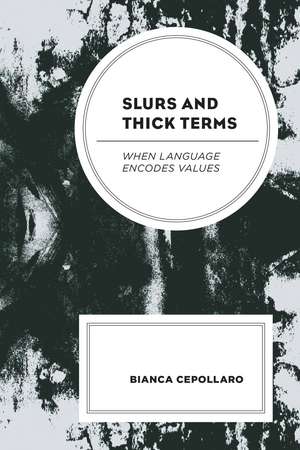
Slurs and Thick Terms: When Language Encodes Values: Philosophy of Language: Connections and Perspectives
Autor Bianca Cepollaroen Limba Engleză Hardback – 31 aug 2020



Preț: 550.09 lei
Preț vechi: 815.71 lei
-33%
Puncte Express: 825
Carte tipărită la comandă
Livrare economică 08-22 decembrie
Livrare prin curier în România Termenul estimat este afișat lângă disponibilitate.
Transport gratuit pentru acest produs Plată online sau ramburs, în funcție de opțiunile comenzii.
Retur gratuit în 14 zile Comandă securizată și suport în română.
Specificații
ISBN-13: 9781793610522
ISBN-10: 1793610525
Pagini: 188
Dimensiuni: 152 x 232 x 18 mm
Greutate: 0.44 kg
Editura: Bloomsbury Publishing
Colecția Lexington Books
Seria Philosophy of Language: Connections and Perspectives
Locul publicării:New York, United States
ISBN-10: 1793610525
Pagini: 188
Dimensiuni: 152 x 232 x 18 mm
Greutate: 0.44 kg
Editura: Bloomsbury Publishing
Colecția Lexington Books
Seria Philosophy of Language: Connections and Perspectives
Locul publicării:New York, United States
V-ar putea interesa
-
 -33%Preț: 711.82 lei1054.81 lei
 -
 Audience Responses to Real Media Violence: The Knockout GameMary Grace Antony-23%Preț: 310.69 lei405.36 lei
 -
 -29%Preț: 345.00 lei483.69 lei
 -
 Mediating Cultures: Parenting in Intercultural ContextsAlberto González-28%Preț: 349.46 lei482.20 lei
 -
 Communication and Control: Tools, Systems, and New DimensionsRobert MacDougall-33%Preț: 649.67 lei975.93 lei
 -
 -28%Preț: 273.80 lei378.71 lei
 -
 Perception and Communication in Intercultural SpacesLily A. Arasaratnam-27%Preț: 254.12 lei349.18 lei
 -
 Communication Efficiency and Rural Development in Africa: The Case of CameroonEmmanuel K. Ngwainmbi-33%Preț: 389.08 lei576.69 lei
 -
 Social Media: Principles and ApplicationsPavica Sheldon-23%Preț: 311.74 lei405.90 lei
 -
 Social Media and Social MovementsBaris Çoban-23%Preț: 722.14 lei937.85 lei
 -
 Preț: 104.83 lei
 -
 Preț: 214.86 lei
 -
 Preț: 150.15 lei
 -
 Les Barbou Imprimeurs, Lyon-Limoges-Paris (1524-1820)Paul DucourtieuxPreț: 215.65 lei
 -
 Preț: 94.27 lei
 -
 Description d'un projet de bibliothèque composé à Rome en 1833, pour la ville de ParisAntoine-François MauduitPreț: 82.51 lei
 -
 Preț: 215.25 lei
 -
 Conseils Pour Former Une Bibliotheque Peu Nombreuse, Mais ChoisieJohann Heinrich Samuel FormeyPreț: 200.29 lei
 -
 Preț: 120.86 lei
 -
 Antiquités Typographiques de la France...Anatole ClaudinPreț: 113.15 lei
 -
 Preț: 97.92 lei
 -
 Le Rôle Et La Liberté de la Presse, Par Dupont-WhiteCharles Dupont-WhitePreț: 82.30 lei
 -
 Frontiers in ICTZoran LevnajicPreț: 220.97 lei
 -
 Preț: 242.60 lei
 -
 Preț: 242.18 lei
 -
 Preț: 429.86 lei
 -
 Ansprache von Emotionen und Gefühlen im NeuromarketingChristoph ElsserPreț: 376.88 lei
Descriere
What is the relation between language, communication, and values? In Slurs and Thick Terms: When Language Encodes Values, Bianca Cepollaro explores the ways in which certain pieces of evaluative language not only reflect speakers' moral perspectives, but also contribute to promoting their evaluative stance. She focuses on slurs-the prototypical example of hate speech, including racial and homophobic epithets-and so-called thick terms, that is, those expressions, much discussed in metaethics, that mix description and evaluation such as "lewd," "chaste," "generous," or "selfish." This book argues that in employing such terms, speakers not only say something purely factual about people and things, but also presuppose certain values, as if they were common ground among the conversation participants. Cepollaro illustrates how this linguistic mechanism effectively explains the pervasive social and moral effects of evaluative language. Using a multidisciplinary approach, she tackles issues in philosophy of language, linguistics, ethics, and metaethics. Moreover, the theoretical investigation takes into consideration and discusses empirical data from psychology and experimental philosophy.
Cuprins
Acknowledgements
Introduction
Part I. The Presuppositional Account of Hybrid Evaluatives
Chapter 1. Hybrid Evaluatives: a New Class
Chapter 2. The Semantics of Hybrid Evaluatives
Chapter 3. The Dynamics of Hybrid Evaluatives: Complicity, Propaganda, Rejection, Negotiation
Chapter 4. Defending a Uniform Presuppositional Account of Slurs and Thick Terms
Chapter 5. Non-standard Uses of Hybrid Evaluatives
Part II. Rival Theories
Chapter 6. Truth-conditional Theories: It's Just a Matter of Semantics
Chapter 7. Deflationary Theories: It's Just a Matter of Pragmatics
Chapter 8. An alternative Hybrid Theory: Conventional Implicature
Conclusion
Introduction
Part I. The Presuppositional Account of Hybrid Evaluatives
Chapter 1. Hybrid Evaluatives: a New Class
Chapter 2. The Semantics of Hybrid Evaluatives
Chapter 3. The Dynamics of Hybrid Evaluatives: Complicity, Propaganda, Rejection, Negotiation
Chapter 4. Defending a Uniform Presuppositional Account of Slurs and Thick Terms
Chapter 5. Non-standard Uses of Hybrid Evaluatives
Part II. Rival Theories
Chapter 6. Truth-conditional Theories: It's Just a Matter of Semantics
Chapter 7. Deflationary Theories: It's Just a Matter of Pragmatics
Chapter 8. An alternative Hybrid Theory: Conventional Implicature
Conclusion
Recenzii
Cepollaro skillfully bridges two otherwise distinct subfields of philosophy; she brings work on slur terms from the philosophy of language into direct contact with meta-ethical debates about thick evaluative terms. The result is more than just an enhancement of each subfield; it is a testament to the fruitfulness of such inter-subfield exploration. Cepollaro offers us a nuanced, beautifully-defended unified account of hybrid evaluatives. The book is clear, detailed, empirically-informed, and thorough; it also provides insight into such hot topics as propaganda, hate speech, and reclamation; this book rewards its reader throughout.
In recent years, philosophy of language has taken a pragmatic turn, focusing on communication in political and socially significant contexts, and generally on the semantics and pragmatics of moral, aesthetic, and broadly evaluative discourse. Bianca Cepollaro's remarkable book, Slurs and Thick Terms: When Language Encodes Values, is an important contribution to this growing literature in applied philosophy of language. This book offers a robust defense of an account of a subclass of evaluatives: slurs and thick terms. On the hybrid semantic account offered, these evaluative terms have a descriptive truth-conditional content, and presuppose values as if they were common ground. Cepollaro gives a meticulous analysis of the presuppositional behavior of these expressions with respect to projection and rejection, while illustrating the dynamics of their use in concrete contexts of propaganda and hate speech. She also convincingly shows that the hybrid evaluative semantic theory she develops is preferable to truth-conditional and to deflationary accounts of slurs and thick terms.
In recent years, philosophy of language has taken a pragmatic turn, focusing on communication in political and socially significant contexts, and generally on the semantics and pragmatics of moral, aesthetic, and broadly evaluative discourse. Bianca Cepollaro's remarkable book, Slurs and Thick Terms: When Language Encodes Values, is an important contribution to this growing literature in applied philosophy of language. This book offers a robust defense of an account of a subclass of evaluatives: slurs and thick terms. On the hybrid semantic account offered, these evaluative terms have a descriptive truth-conditional content, and presuppose values as if they were common ground. Cepollaro gives a meticulous analysis of the presuppositional behavior of these expressions with respect to projection and rejection, while illustrating the dynamics of their use in concrete contexts of propaganda and hate speech. She also convincingly shows that the hybrid evaluative semantic theory she develops is preferable to truth-conditional and to deflationary accounts of slurs and thick terms.