
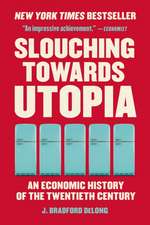
Slouching Towards Utopia: An Economic History of the Twentieth Century
Autor Brad de Longen Limba Engleză Paperback – 6 iul 2023
Structura acestei lucrări monumentale este construită în jurul unei teze provocatoare: 'secolul al XX-lea lung' a început în 1870, odată cu fuziunea dintre laboratorul de cercetare industrială și corporația modernă, și s-a încheiat în 2010. Brad de Long propune un parcurs analitic ce pornește de la mizeria extremă pre-1870, trece prin explozia bogăției materiale și ajunge la crizele de legitimitate ale prezentului. Subliniem modul în care autorul nu se limitează la cifre, ci construiește o narațiune despre eșecul umanității de a transforma abundența tehnologică în utopia promisă.
Observăm în text o rigoare academică dublată de o perspectivă practică, trăsătură explicabilă prin experiența autorului la vârful Trezoreriei SUA. Cartea explică mecanismele prin care inovația a 'distrus creativ' economia în mod repetat, eliberând omenirea de foamete, dar lăsând în urmă inegalități profunde și încălzire globală. Pe linia practică a volumului The Cambridge Economic History of the Modern World: Volume 2, 1870 to the Present, dar cu focus pe tensiunea dintre progresul economic și eșecul politic de a gestiona acest surplus, Slouching Towards Utopia oferă o perspectivă critică asupra capitalismului global. De asemenea, în timp ce Vaclav Smil în Creating and Transforming the Twentieth Century se concentrează pe fundamentele tehnice ale inovației, DeLong pune întrebarea fundamentală: de ce, deși suntem atât de bogați, suntem atât de nefericiți? Rezultatul este o istorie economică densă, dar fluidă, care transformă datele statistice într-o lecție despre natura umană și organizarea socială.
Preț: 82.44 lei
Preț vechi: 109.57 lei
-25%
Carte disponibilă
Livrare economică 31 octombrie-14 noiembrie
Livrare express 20-24 octombrie pentru 57.16 lei
Specificații
ISBN-10: 1399803433
Pagini: 624
Dimensiuni: 130 x 196 x 48 mm
Greutate: 0.43 kg
Editura: John Murray Press
Colecția Basic Books
Locul publicării:London, United Kingdom
V-ar putea interesa
-
 GrowthDaniel SusskindPreț: 93.52 lei
 -
 -12%Preț: 237.97 lei271.66 lei
 -
 Global Economic History: A Very Short IntroductionRobert C. AllenPreț: 68.53 lei
 -
 Preț: 195.76 lei
 -
 Leave Me Alone and I'll Make You Rich: How the Bourgeois Deal Enriched the WorldDeirdre Nansen McCloskeyPreț: 142.66 lei
 -
 How Much is Enough?Edward Skidelsky-31%Preț: 62.52 lei91.20 lei
 -
 Rich World, Poor World: The Struggle to Escape PovertyAli A. AllawiPreț: 226.44 lei
 -
 Preț: 113.11 lei
 -
 Wealth And Poverty Of NationsDavid S. Landes-25%Preț: 93.28 lei124.10 lei
 -
 A Brief History of EqualityThomas PikettyPreț: 108.34 lei
 -
 Capital in the Twenty-First CenturyThomas PikettyPreț: 163.01 lei
 -
 The Great EscapeAngus DeatonPreț: 109.86 lei
 -
 The Rise and Fall of American GrowthRobert J. GordonPreț: 192.78 lei
 -
 -25%Preț: 82.68 lei109.92 lei
 -
 The World Under CapitalismBranko MilanovicPreț: 145.00 lei
 -
 The Journey of HumanityOded Galor-31%Preț: 64.65 lei93.25 lei
 -
 Slouching Towards UtopiaJ Bradford DeLongPreț: 138.18 lei
 -
 Peak HumanJohan Norberg-16%Preț: 99.51 lei118.59 lei
 -
 Being VictorianJamie CamplinPreț: 193.61 lei
De ce să citești această carte
Recomandăm această carte cititorilor care doresc să înțeleagă forțele economice care au modelat lumea modernă. Veți învăța cum s-a schimbat ritmul inovației după 1870 și de ce creșterea economică nu a rezolvat problemele sociale fundamentale. Este o lectură esențială pentru profesioniști și studenți care caută un cadru istoric riguros pentru a descifra inegalitățile și instabilitatea politică a secolului XXI.
Despre autor
Brad de Long este profesor de economie la Universitatea California, Berkeley, și a fost cercetător asociat la NBER între 1990 și 2018. Cu o carieră care îmbină mediul academic cu cel politic, a servit ca asistent al Secretarului Trezoreriei SUA în perioada 1993-1995. Este recunoscut la nivel mondial pentru blogul său 'Grasping for Reality', unde analizează intersecția dintre economie, istorie și politici publice. Experiența sa vastă în administrația americană și cercetarea istorică îi oferă o perspectivă unică asupra modului în care deciziile macroeconomice influențează cursul istoriei pe termen lung.
Descriere
AN INSTANT NEW YORK TIMES AND WALL STREET JOURNAL BESTSELLER
LONGLISTED FOR THE FINANCIAL TIMES BUSINESS BOOK OF THE YEAR
A FINANCIAL TIMES BEST ECONOMICS BOOK OF THE YEAR AND THE ECONOMIST BOOK OF THE YEAR
From one of the world's leading economists, a sweeping new history of the twentieth century - a century that left us vastly richer, yet still profoundly dissatisfied.
Before 1870, most people lived in dire poverty, the benefits of the slow crawl of invention continually offset by a growing population. Then came a great shift: invention sprinted forward, doubling our technological capabilities each generation, and creatively destroying the economy again and again.
Slouching Towards Utopia tells the story of the major economic and technological shifts of the 20th century in a bold and ambitious, grand narrative. In vivid and compelling detail, DeLong charts the unprecedented explosion of material wealth after 1870 which transformed living standards around the world, freeing humanity from centuries of poverty, but paradoxically has left us now with unprecedented inequality, global warming, and widespread dissatisfaction with the status quo.
How did the long twentieth century fail to deliver the utopia our ancestors believed would be the inevitable result of such material wellbeing?
How did humanity end up less on a march to progress than a slouch in the right direction?
And what can we learn from the past in pursuit of a better world?
Recenzii
This is a brilliant and important book. It offers an original and penetrating analysis of what its author calls "the long 20th century", the period of unprecedented economic advance that began roughly in 1870 and ended, he asserts, in 2010. Material abundance poured upon humanity. Previous generations would have thought such wealth to be a guarantee of utopia. Yet the age of material progress has ended not in a utopia, but in recrimination and discord. No book has explained the successes and failures of this extraordinary period with comparable insight
The period 1870-2010 - what DeLong calls the "long twentieth century" - saw the world break decisively free of its Malthusian chains, with levels of per capita economic growth without any parallel in human history. This wonderfully researched and written book explains the roots of this vertiginous ascent towards utopia, while also exposing the causes of the subsequent flat-lining in our economic fortunes and what action is now needed to ensure the long century is viewed by future historians as the historical rule, not the exception
History provides the only data we have for charting a course forward in these turbulent times. I have not seen a more revealing and illuminating book about economics and what it means in a very long time. Slouching Towards Utopia should be required reading for anybody who cares about the future of the global system, and that should be everyone
What a joy to finally have Brad DeLong's masterful interpretation of twentieth-century economic history down on paper. Slouching Towards Utopia is engaging, important, and awe-inspiring in its breadth and creativity
An intellectually exciting and entertaining gallop along the arc of twentieth century economic history. DeLong puts together the puzzle of the past to tell a story of remarkable achievements as well as setbacks. A great way to understand the forces that have shaped the world today
Brad DeLong manages brilliantly to combine detailed analysis of a huge sweep of global history with an accessible and engaging narrative. The result is a book full of well founded and penetrating insights that will appeal to anyone interested in the causes and consequences of modern economic growth
Impressed . . . eloquent and clear . . . makes one sad for the utopian possibilities that might have been realized
Like many people, I've been eagerly anticipating Brad Delong's Slouching Towards Utopia: An Economic History of the 20th Century, and it doesn't disappoint . . . it (is) an unmissable book . . . The strength of the book - as well as its immense scope and depth . . . is that it's a work of political economy, braiding the different strands of ideas, Hayek, Polanyi and Keynes . . . In addition, there are plenty of pleasing asides and details. Definitely one to read.
A magisterial history . . . asks the right questions and teaches us a lot of crucial history along the way
A masterfully sweeping account . . . a joy to read. Few economic historians have as fluent a grasp of political or military history or, more important, write as lucidly and with such great flair about these subjects
I've been waiting for Brad [DeLong]'s big economic history opus for a long time now
Slouching Towards Utopia is an impressive achievement, written with wit and style and a formidable command of detail
DeLong explores the slice of history he has chosen - the "long twentieth century" from 1870 to 2010 - in depth, and he often writes with verve combined with thought-provoking detail
Accessible and illuminating explanations of key historical shifts and the socio-economic forces driving them . . . A sprawling but carefully argued, edifying account of modern economic history and its impact on global well-being
Conveys a wealth of information in elegant, accessible prose, combining grand, epochal perspectives with fascinating discursions on everything from alternating-current electricity to the gender wage gap. The result is a cogent interpretation of economic modernity that illuminates both its nigh-miraculous achievements and its seething discontents
This volume, partly an economic history but mostly a thorough record of the global economy's connection with politics, is destined to become a classic in its category
One of the most ambitious and admirable economic history books of the year . . . DeLong is a guide whose conclusions I cannot fault
A fantastic read . . . you don't have to be an economist or historian to enjoy this book or reach for the smelling salts to revive you from boredom
Deeply engaging . . . a work of strikingly expansive breadth and scope
DeLong written the most entertaining End Times narrative since The Late Great Planet Earth
Worries that the future will be worse than the present are an excellent reason to read economic histories such as Bradford DeLong's new book, Slouching Towards Utopia
A masterpiece
A magisterial new economic history
If you want to follow the conversation right now on global economic history, you should check out Brad DeLong's Slouching Towards Utopia
Notă biografică
J. Bradford DeLong is a professor of economics at UC Berkeley and was a research associate at the NBER, 1990-2018. He was Deputy Assistant Secretary of the US Treasury, 1993-1995. Throughout his career and in his blog Grasping for Reality he has tried to straddle the fields of economics, history, and public education. Previous books include The End of Influence (Basic US, 2010) and Concrete Economics (Harvard Business School, 2016).