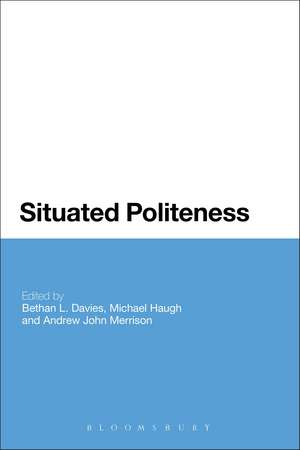
Situated Politeness
Editat de Dr Bethan L. Davies, Michael Haugh, Andrew John Merrisonen Limba Engleză Paperback – 22 noi 2012
Although politeness research often concentrates on examining how speeches or discourses themselves are situated with regards to different places and contexts, the focus on just one situation, and various text types within it, can also be of value. Situated Politeness is concerned with disentangling the factors which govern our behaviour within a given social context as well as across them. A range of expanding disciplines, including corpus linguistics, critical discourse analysis, and conversation analysis, are brought to bear on the topic, and this work will be of interest to a diverse global audience.
Preț: 284.88 lei
Puncte Express: 427
Carte tipărită la comandă
Livrare economică 07-21 decembrie
Livrare prin curier în România Termenul estimat este afișat lângă disponibilitate.
Transport gratuit de la 400.00 lei Plată online sau ramburs, în funcție de opțiunile comenzii.
Retur gratuit în 14 zile Comandă securizată și suport în română.
Specificații
ISBN-13: 9781623561307
ISBN-10: 1623561302
Pagini: 304
Dimensiuni: 152 x 232 x 18 mm
Greutate: 0.46 kg
Editura: Bloomsbury Publishing
Colecția Bloomsbury Academic
Locul publicării:London, United Kingdom
ISBN-10: 1623561302
Pagini: 304
Dimensiuni: 152 x 232 x 18 mm
Greutate: 0.46 kg
Editura: Bloomsbury Publishing
Colecția Bloomsbury Academic
Locul publicării:London, United Kingdom
V-ar putea interesa
-
 Minimal SemanticsEmma Borg-18%Preț: 342.00 lei415.89 lei
 -
 Representing Time: An Essay on Temporality as ModalityKasia M. Jaszczolt-19%Preț: 311.19 lei386.36 lei
 -
 Structuring Sense: Volume 1: In Name OnlyHagit Borer-27%Preț: 461.36 lei633.60 lei
 -
 Linguistic CategorizationJohn R. Taylor-21%Preț: 375.58 lei475.10 lei
 -
 Donald Davidson's Truth-Theoretic SemanticsErnest Lepore-20%Preț: 530.06 lei663.37 lei
 -
 Interfaces in Linguistics: New Research PerspectivesRaffaella Folli-22%Preț: 450.76 lei578.68 lei
 -
 PragmaticsSiobhan Chapman-24%Preț: 267.09 lei353.41 lei
 -
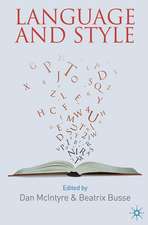 Language and StyleDan McIntyrePreț: 347.51 lei
 -
 SemanticsKate Kearns-23%Preț: 258.55 lei337.21 lei
 -
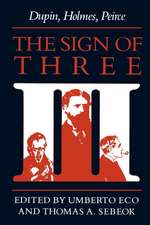 The Sign of Three – Dupin, Holmes, PeirceUmberto EcoPreț: 147.11 lei
 -
 The Language of ComicsMario SaraceniPreț: 266.34 lei
 -
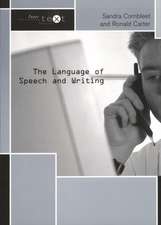 The Language of Speech and WritingSandra CornbleetPreț: 235.71 lei
 -
 Narrative: A Critical Linguistic IntroductionMichael J ToolanPreț: 471.89 lei
 -
 PragmaticsStephen C. Levinson-19%Preț: 533.29 lei658.39 lei
 -
 Preț: 350.43 lei
 -
 -23%Preț: 544.32 lei706.91 lei
 -
 Language and Symbolic PowerPierre BourdieuPreț: 160.63 lei
 -
 Key Terms in SemioticsBronwen Martin-17%Preț: 206.96 lei248.17 lei
 -
 Understanding PolitenessDániel Z. KádárPreț: 391.44 lei
 -
 Preț: 232.46 lei
 -
 Preț: 342.73 lei
 -
 Talk in ActionHeritagePreț: 354.57 lei
 -
 Contemporary StylisticsProfessor Marina Lambrou-37%Preț: 236.37 lei373.88 lei
 -
 Discourse StudiesTeun A. van Dijk-8%Preț: 525.49 lei571.18 lei
Cuprins
1. Situating politeness, Michael Haugh, Bethan Davies, and Andrew John Merrison
Part I. Politeness in Institutional Settings
2. Relativity rules: politic talk in ethnicized workplaces, Janet Holmes and Meredith Marra
3. That's not very polite! Discursive struggle and situated politeness in the Mexican English-language classroom, Gerrard Mugford
4. Communities of practice and politeness, Sara Mills
5. Relational work in a sporting community of practice, Jodie Clark
Part II. Politeness in Interpersonal Settings
6. Situated functions of addressee honorifics in Japanese television drama, Andrew Barke
7. Do you want to do it yourself like? Hedging in Irish traveller and settled family discourse, Brian Clancy
8. Unpacking the hearer's interpretation of situated politeness, Noriko Inagaki
9. Humour, im/politeness and face in getting acquainted, Michael Haugh
Part III. Politeness in Public Settings
10. Situated impoliteness: the interface between relational work and identity construction, Miriam Locher
11. Negative politeness features and impoliteness in institutional discourse: a corpus-assisted approach, Charlotte Taylor
12. National face and national face threatening acts: politeness and the European Constitution, Elena Magistro
13. Tourist advertising of Australia: impolite or situation-appropriate? Or a uniquely Aussie invite lost in
translation, Angela Ardington
14. Epilogue, Bethan Davies, Andrew John Merrison and Michael Haugh
Bibliography
Index
Part I. Politeness in Institutional Settings
2. Relativity rules: politic talk in ethnicized workplaces, Janet Holmes and Meredith Marra
3. That's not very polite! Discursive struggle and situated politeness in the Mexican English-language classroom, Gerrard Mugford
4. Communities of practice and politeness, Sara Mills
5. Relational work in a sporting community of practice, Jodie Clark
Part II. Politeness in Interpersonal Settings
6. Situated functions of addressee honorifics in Japanese television drama, Andrew Barke
7. Do you want to do it yourself like? Hedging in Irish traveller and settled family discourse, Brian Clancy
8. Unpacking the hearer's interpretation of situated politeness, Noriko Inagaki
9. Humour, im/politeness and face in getting acquainted, Michael Haugh
Part III. Politeness in Public Settings
10. Situated impoliteness: the interface between relational work and identity construction, Miriam Locher
11. Negative politeness features and impoliteness in institutional discourse: a corpus-assisted approach, Charlotte Taylor
12. National face and national face threatening acts: politeness and the European Constitution, Elena Magistro
13. Tourist advertising of Australia: impolite or situation-appropriate? Or a uniquely Aussie invite lost in
translation, Angela Ardington
14. Epilogue, Bethan Davies, Andrew John Merrison and Michael Haugh
Bibliography
Index
Recenzii
For those interested in politeness - which surely includes most of us - this book is essential reading. Covering a range of theoretical approaches, settings, languages and cultures, Situated Politeness explores some of the key issues in current im/politeness research by some of the leading scholars in the field. The book adopts a new three-way division of politeness into institutional, interpersonal and public settings, including a variety of contexts and cultures, such as New Zealand workplaces, classrooms in Mexico a university hockey club in Sheffield, Japanese television drama, and a national advertising campaign in Australia. Particularly significant, Situated Politeness is primarily concerned not only with the local negotiation of both politeness and impoliteness but how these are, crucially, played out against a wider backdrop of social and cultural practices and beliefs. Not least, the style is highly accessible, and the various chapters offer a wide range of relevant and fascinating data.
The idea is, as the editors point out, to disentangle the relationship between pragmatic meaning, social meaning and identity. They do not achieve a final solution (which may be impossible) nor do they steer clear of the complexities of this matter. On the contrary, by drawing on empirical research, the authors present different fine-grained theoretical tools and approaches that, undoubtedly, constitute an advance in this discipline... Very interesting and critically enlightening reading for a specialist who wants to be at the cutting edge of this discipline...Reading Situated Politeness allows for improvement in our comprehension of...complicated concepts. Combining this advancement with the variety of approaches covered in the volume make it an important step forward for the field of socio-pragmatics.
The idea is, as the editors point out, to disentangle the relationship between pragmatic meaning, social meaning and identity. They do not achieve a final solution (which may be impossible) nor do they steer clear of the complexities of this matter. On the contrary, by drawing on empirical research, the authors present different fine-grained theoretical tools and approaches that, undoubtedly, constitute an advance in this discipline... Very interesting and critically enlightening reading for a specialist who wants to be at the cutting edge of this discipline...Reading Situated Politeness allows for improvement in our comprehension of...complicated concepts. Combining this advancement with the variety of approaches covered in the volume make it an important step forward for the field of socio-pragmatics.