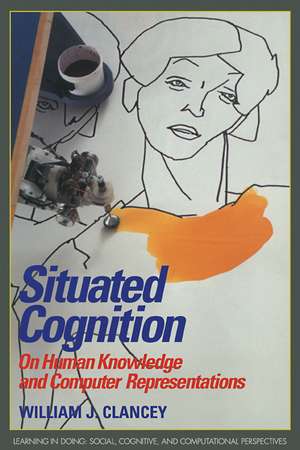
Situated Cognition
Autor William J. Clancey Editat de Roy Pea, John Seely Brownen Limba Engleză Paperback – 30 sep 2008
Preț: 453.27 lei
Puncte Express: 680
Carte tipărită la comandă
Livrare economică 04-18 decembrie
Livrare prin curier în România Termenul estimat este afișat lângă disponibilitate.
Transport gratuit pentru acest produs Plată online sau ramburs, în funcție de opțiunile comenzii.
Retur gratuit în 14 zile Comandă securizată și suport în română.
Specificații
ISBN-13: 9780521448710
ISBN-10: 0521448719
Pagini: 428
Ilustrații: 42 b/w illus. 16 tables
Dimensiuni: 152 x 229 x 25 mm
Greutate: 0.69 kg
Ediția:New.
Editura: Cambridge University Press
Locul publicării:New York, United States
ISBN-10: 0521448719
Pagini: 428
Ilustrații: 42 b/w illus. 16 tables
Dimensiuni: 152 x 229 x 25 mm
Greutate: 0.69 kg
Ediția:New.
Editura: Cambridge University Press
Locul publicării:New York, United States
V-ar putea interesa
-
 The Power of Physical IntelligenceTony BuzanPreț: 58.25 lei
 -
 Fundamentals of Motor ControlMark L. Latash-27%Preț: 372.37 lei512.15 lei
 -
 -31%Preț: 645.29 lei937.01 lei
 -
 SubliminalLeonard MlodinowPreț: 101.39 lei
 -
 Thinking, Fast and SlowDaniel KahnemanPreț: 110.13 lei
 -
 PicoeconomicsGeorge AinsliePreț: 383.54 lei
 -
 Grounding CognitionDiane PecherPreț: 466.81 lei
 -
 Judgment under UncertaintyDaniel KahnemanPreț: 443.18 lei
 -
 Human ErrorJames ReasonPreț: 413.52 lei
 -
 The Cambridge Handbook of Situated CognitionPhilip Robbins-11%Preț: 442.02 lei496.66 lei
 -
 Choices, Values, and FramesDaniel Kahneman-19%Preț: 682.55 lei842.66 lei
 -
 Grammars of SpaceStephen C. LevinsonPreț: 505.45 lei
 -
 Taking Appearance SeriouslyHenri BortoftPreț: 141.58 lei
 -
 Zig Zag - The Surprising Path to Greater CreativityKeith SawyerPreț: 189.07 lei
 -
 Great Myths of the BrainChristian JarrettPreț: 124.46 lei
 -
 The Confidence Workbook: Teach YourselfAdrian Tannock-25%Preț: 92.80 lei122.93 lei
 -
 -43%Preț: 97.24 lei171.68 lei
Cuprins
Part I. Representations and Memory: 1. Aaron's drawing; 2. Mycin's map; 3. Remembering controversies; 4. Sensorimotor maps vs. encodings; Part II. Situated Robots: 5. Navigating without reading maps; 6. Perceiving without describing; 7. Remembering without matching; 8. Engineering transactional systems; Part III. Ecological Theories: 9. Transactional experience; 10. Dialectic mechanism; 11. Ecological psychology; 12. Couplin vs. inference; 13. The varieties of symbol systems; 14. Reformulated dilemmas; 15. Conclusions: lessons for cognitive science.
Descriere
This 1997 book examines recent changes in the design of intelligent machines which afford heightened interactivity with the environment.