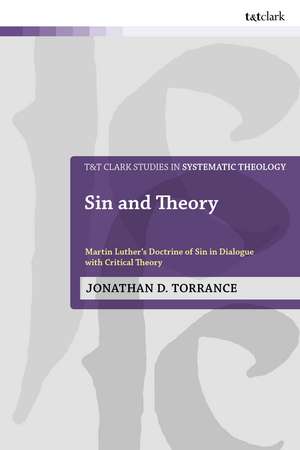
Sin and Theory: Martin Luther’s Doctrine of Sin in Dialogue with Critical Theory: T&T Clark Studies in Systematic Theology
Autor Rev'd Dr Jonathan D. Torranceen Limba Engleză Hardback – 22 ian 2026
Recently, there has been little enthusiasm for the doctrine in its traditional Augustinian form, especially as expressed by Protestant Reformers like Martin Luther. Torrance defends the claim that Luther's radical doctrine of sin in fact retains important insights and continues to have explanatory power in the contemporary world. He explores this with a productive dialogue between theology and critical theory. This volume reveals that Luther's hamartiology is robust and far more able to respond to contemporary issues than many competing hamartiologies.
At the same time, Torrance reveals how critical theory can work constructively with theology. By working in tandem, they allow creative exploration of questions such as the effect of sin on human reason, the nature of structural pathologies, and the experience of human shame. In and through these dialogues, Luther's doctrine of sin shows itself as a plausible, robust and psychologically astute doctrine for the present day.
The ebook editions of this book are available open access under a CC BY-NC-ND 4.0 licence on bloomsburycollections.com. This work was supported by the Arts and Humanities Research Council [AH/R012709/1].
Din seria T&T Clark Studies in Systematic Theology
- 25%
 Preț: 243.79 lei
 - 24%
 Preț: 234.61 lei
 - 25%
 Preț: 278.06 lei
 - 25%
 Preț: 255.56 lei
 - 16%
 Preț: 242.61 lei
 - 16%
 Preț: 277.20 lei
 - 25%
 Preț: 277.39 lei
 - 32%
 Preț: 203.12 lei
 - 25%
 Preț: 961.68 lei
 - 25%
 Preț: 278.68 lei
 - 15%
 Preț: 279.48 lei
 - 25%
 Preț: 277.58 lei
 - 24%
 Preț: 238.41 lei
 -
 Preț: 278.18 lei
 -
 Preț: 562.91 lei
 - 32%
 Preț: 596.58 lei
 -
 Preț: 281.77 lei
 -
 Preț: 285.21 lei
 - 25%
 Preț: 277.58 lei
 - 16%
 Preț: 278.27 lei
 - 16%
 Preț: 278.68 lei
 - 24%
 Preț: 963.46 lei
 - 24%
 Preț: 257.61 lei
 - 15%
 Preț: 263.67 lei
 -
 Preț: 277.79 lei
 -
 Preț: 277.20 lei
 - 24%
 Preț: 247.47 lei
 - 25%
 Preț: 1025.27 lei
 - 24%
 Preț: 281.04 lei
 - 33%
 Preț: 961.42 lei
 - 14%
 Preț: 1042.16 lei
 - 33%
 Preț: 961.68 lei
 - 15%
 Preț: 279.74 lei
Preț: 550.09 lei
Preț vechi: 817.17 lei
-33%
Puncte Express: 825
Carte tipărită la comandă
Livrare economică 30 noiembrie-14 decembrie
Livrare prin curier în România Termenul estimat este afișat lângă disponibilitate.
Transport gratuit pentru acest produs Plată online sau ramburs, în funcție de opțiunile comenzii.
Retur gratuit în 14 zile Comandă securizată și suport în română.
Specificații
ISBN-13: 9780567722393
ISBN-10: 0567722392
Pagini: 200
Dimensiuni: 154 x 236 x 16 mm
Greutate: 0.44 kg
Editura: Bloomsbury Publishing
Colecția T&T Clark
Seria T&T Clark Studies in Systematic Theology
Locul publicării:London, United Kingdom
ISBN-10: 0567722392
Pagini: 200
Dimensiuni: 154 x 236 x 16 mm
Greutate: 0.44 kg
Editura: Bloomsbury Publishing
Colecția T&T Clark
Seria T&T Clark Studies in Systematic Theology
Locul publicării:London, United Kingdom
Cuprins
Acknowledgments
Abbreviations
1. Introduction
2. Luther's Doctrine of Sin
3. Pessimism and Paranoia: Reason, Hermeneutics and the Noetic Effects of Sin
4. Structural Sin, Moral Responsibility and the Bound Will
5. Shame, Sin, and Grace: An Affective Embodied Account
Conclusion
Bibliography
Abbreviations
1. Introduction
2. Luther's Doctrine of Sin
3. Pessimism and Paranoia: Reason, Hermeneutics and the Noetic Effects of Sin
4. Structural Sin, Moral Responsibility and the Bound Will
5. Shame, Sin, and Grace: An Affective Embodied Account
Conclusion
Bibliography
Recenzii
This is a hugely exciting and much-needed work that brushes the dust off of classical Protestant theology to engage with central questions facing the Humanities today. Deftly exploring contemporary caricatures of Martin Luther's theological legacy, Torrance demonstrates striking affinities between Luther's theology of sin and contemporary critical theory. At the heart of the book is a persuasive case for the power of a theological horizon for moving beyond the impasse between the hermeneutics of suspicion and the possibility of a more hopeful, 'postcritical' vision of the world. This is must-read theology for anyone concerned either with the theological legacy of the Protestant Reformation or with the relationship between theology and 21st century intellectual life.
Torrance's book is brilliant, illuminating and innovative. He brings together two things that might seem to have little to say to each other: Luther's unfashionable doctrine of sin and contemporary critical theory, to find they have surprising points of convergence that shed light on the value of both. Yet he skilfully shows how Luther's horizons are more hopeful and optimistic and offer rich resources not just for scholarship but for life in our complex world.
The effort to offer a non-moralistic, genuinely theological account of sin is part of the ongoing desiderata of Christian theology and practice. How will we understand 'salvation' if we do not take 'sin' into account? What are we 'saved' from? Our culture, including all too often contemporary Christianity, gladly but superficially portrays sin as a moralistic, individual affair. Torrance's book is a significant contribution toward articulating a Christian, indeed Protestant teaching about sin for our own time, in conversation with critical theory, which exposes for us, notably, the noetic dimensions of sin. In close conversation with Luther, who was much less interested in 'actual sin(s)' or in the 'metaphysics' of sin than in sin as the state of 'fallen' humanity, Torrance helpfully considers sin not prior to or independently from grace itself: how we are saved indeed ought to determine Christian theological discourses concerning what we are saved from. 'Sin' may still be a necessary theological category, one that does not have to lead to a joyless, shame- and guilt-inducing religiosity. There is much to learn and consider from this remarkable book!
Sin might seem like a theological idea whose day had long since passed, but in Torrance's new book, we see both that pathology remains a vital question for contemporary society and that naming and engaging with pathology precisely as sin opens pathways to wholeness otherwise inaccessible. This book does what theological writing should do: it draws from the time-honored theological tradition while engaging squarely with the challenges of the present. Torrance brings out from his storeroom new treasures as well as old. Luther suddenly appears as he is: contemporary and urgently relevant.
Torrance's book is brilliant, illuminating and innovative. He brings together two things that might seem to have little to say to each other: Luther's unfashionable doctrine of sin and contemporary critical theory, to find they have surprising points of convergence that shed light on the value of both. Yet he skilfully shows how Luther's horizons are more hopeful and optimistic and offer rich resources not just for scholarship but for life in our complex world.
The effort to offer a non-moralistic, genuinely theological account of sin is part of the ongoing desiderata of Christian theology and practice. How will we understand 'salvation' if we do not take 'sin' into account? What are we 'saved' from? Our culture, including all too often contemporary Christianity, gladly but superficially portrays sin as a moralistic, individual affair. Torrance's book is a significant contribution toward articulating a Christian, indeed Protestant teaching about sin for our own time, in conversation with critical theory, which exposes for us, notably, the noetic dimensions of sin. In close conversation with Luther, who was much less interested in 'actual sin(s)' or in the 'metaphysics' of sin than in sin as the state of 'fallen' humanity, Torrance helpfully considers sin not prior to or independently from grace itself: how we are saved indeed ought to determine Christian theological discourses concerning what we are saved from. 'Sin' may still be a necessary theological category, one that does not have to lead to a joyless, shame- and guilt-inducing religiosity. There is much to learn and consider from this remarkable book!
Sin might seem like a theological idea whose day had long since passed, but in Torrance's new book, we see both that pathology remains a vital question for contemporary society and that naming and engaging with pathology precisely as sin opens pathways to wholeness otherwise inaccessible. This book does what theological writing should do: it draws from the time-honored theological tradition while engaging squarely with the challenges of the present. Torrance brings out from his storeroom new treasures as well as old. Luther suddenly appears as he is: contemporary and urgently relevant.