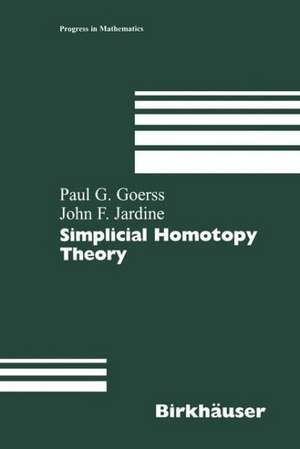
Simplicial Homotopy Theory: Progress in Mathematics, cartea 174
Autor Paul G. Goerss, John F. Jardineen Limba Engleză Paperback – 14 oct 2012
În volumul Simplicial Homotopy Theory, descoperim o organizare riguroasă a metodelor simpliciale, piloni esențiali atât pentru calcul, cât și pentru teoria de bază în topologia algebrică modernă. Structura materialului reflectă o metodologie didactică precisă: autorii Paul G. Goerss și John F. Jardine pornesc de la definițiile de bază ale seturilor simpliciale și complexelor Kan (Capitolul I), pentru a construi fundamentul necesar abordării algebrei homotopice prin prisma categoriilor model (Capitolul II). Reținem că această progresie nu este doar teoretică, ci urmărește integrarea tehnicilor de categorii model în studiul algebrei omologice neabeliene.
Suntem de părere că relevanța acestui manual pentru curriculumul de cercetare este majoră, deoarece extinde cadrul propus de Simplicial Objects in Algebraic Topology de J. P. May cu date noi și o perspectivă modernă asupra structurilor de model închis. În timp ce textul lui May rămâne o referință istorică pentru bazele seturilor simpliciale, Simplicial Homotopy Theory aduce la zi literatura de specialitate, integrând rezultate care anterior erau dispersate în articole de cercetare. Cuprinsul indică o acoperire vastă, de la rezultate clasice precum harta Hurewicz, până la subiecte avansate ca seturile bisimpliciale și teorema Bousfield-Friedlander.
Stilul de prezentare este unul tehnic, dar accesibil, fiecare capitol fiind precedat de un scurt rezumat care facilitează navigarea prin demonstrații complexe. Deși subiectul este dens, autorii reușesc să mențină un ritm constant, făcând din această ediție Modern Birkhäuser Classics un instrument de lucru indispensabil pentru oricine dorește să aplice tehnici simpliciale în K-teoria algebrică sau geometria algebrică.
Din seria Progress in Mathematics
- 18%
 Preț: 720.26 lei
 - 18%
 Preț: 952.90 lei
 - 24%
 Preț: 947.60 lei
 - 24%
 Preț: 964.92 lei
 - 24%
 Preț: 954.12 lei
 - 24%
 Preț: 1206.70 lei
 - 15%
 Preț: 556.24 lei
 -
 Preț: 377.48 lei
 -
 Preț: 379.84 lei
 -
 Preț: 362.51 lei
 -
 Preț: 374.86 lei
 - 18%
 Preț: 692.27 lei
 - 15%
 Preț: 627.31 lei
 - 15%
 Preț: 621.29 lei
 - 18%
 Preț: 863.10 lei
 -
 Preț: 370.46 lei
 -
 Preț: 376.17 lei
 -
 Preț: 364.19 lei
 - 15%
 Preț: 511.16 lei
 - 15%
 Preț: 615.01 lei
 - 15%
 Preț: 640.39 lei
 -
 Preț: 366.76 lei
 -
 Preț: 377.48 lei
 -
 Preț: 401.02 lei
 - 15%
 Preț: 672.25 lei
 -
 Preț: 626.55 lei
 -
 Preț: 370.32 lei
 - 18%
 Preț: 867.63 lei
 - 18%
 Preț: 775.27 lei
 - 15%
 Preț: 615.35 lei
 - 18%
 Preț: 1085.89 lei
 - 15%
 Preț: 496.49 lei
 - 15%
 Preț: 568.92 lei
 - 15%
 Preț: 561.28 lei
 - 18%
 Preț: 1287.84 lei
 -
 Preț: 361.97 lei
Preț: 740.15 lei
Preț vechi: 902.62 lei
-18%
Carte tipărită la comandă
Livrare economică 19 august-02 septembrie
Specificații
ISBN-10: 3034897375
Pagini: 532
Ilustrații: XV, 510 p.
Dimensiuni: 155 x 235 x 28 mm
Greutate: 0.74 kg
Ediția:Softcover reprint of the original 1st ed. 1999
Editura: Birkhäuser Basel
Colecția Birkhäuser
Seria Progress in Mathematics
Locul publicării:Basel, Switzerland
V-ar putea interesa
-
 -12%Preț: 602.21 lei687.29 lei
 -
 -23%Preț: 537.38 lei700.09 lei
 -
 From Kant to Hilbert Volume 2William Bragg Ewald-27%Preț: 818.61 lei1118.88 lei
 -
 The Mathematics of DiffusionJohn Crank-34%Preț: 905.68 lei1365.33 lei
 -
 Further Pure MathematicsBrian Gaulter-34%Preț: 390.44 lei587.62 lei
 -
 Strategic Learning and its LimitsH. Peyton Young-11%Preț: 469.96 lei528.05 lei
 -
 Optimization Theory and MethodsWenyu Sun-18%Preț: 1138.59 lei1388.53 lei
 -
 Preț: 182.33 lei
 -
 Primer In Game Theory, ARobert Gibbons-9%Preț: 615.43 lei676.30 lei
 -
 Useful Math & Physical FormulaeM WatkinsPreț: 52.17 lei
 -
 InequalitiesRadmila Bulajich ManfrinoPreț: 454.59 lei
 -
 Handbook of Brownian Motion - Facts and FormulaeAndrei N. Borodin-18%Preț: 1400.80 lei1708.29 lei
 -
 Optimal Stopping and Free-Boundary ProblemsGoran Peskir-18%Preț: 871.89 lei1063.29 lei
Public țintă
ResearchDe ce să citești această carte
Recomandăm această carte cercetătorilor și studenților la masterat care au nevoie de o expunere modernă a teoriei homotopiei. Câștigați acces la o sinteză unică a metodelor de categorii model și seturi simpliciale, esențială pentru cercetarea actuală. Este resursa ideală pentru a trece de la conceptele clasice de topologie la tehnicile avansate de algebră homotopică, oferind claritate acolo unde literatura anterioară era fragmentată.
Cuprins
Descriere scurtă
Discussed here are the homotopy theory of simplicial sets, and other basic topics such as simplicial groups, Postnikov towers, and bisimplicial sets. The more advanced material includes homotopy limits and colimits, localization with respect to a map and with respect to a homology theory, cosimplicial spaces, and homotopy coherence. Interspersed throughout are many results and ideas well-known to experts, but uncollected in the literature.
Intended for second-year graduate students and beyond, this book introduces many of the basic tools of modern homotopy theory. An extensive background in topology is not assumed.
Reviews:
"… a book filling an obvious gap in the literature and the authors have done an excellent job on it. No monograph or expository paper has been published on this topic in the last twenty-eight years." - Analele Universitatii din Timisoara
"… is clearly presented and a brief summary preceding every chapter is useful to the reader. The book should prove enlightening to a broad range of readers including prospective students and researchers who want to apply simplicial techniques for whatever reason." - Zentralblatt MATH
"… they succeed. The book is an excellent account of simplicial homotopy theory from a modern point of view […] The bookis well written. […] The book can be highly recommended to anybody who wants to learn and to apply simplicial techniques and/or the theory of (simplicial) closed model categories." - Mathematical Reviews
Recenzii
"… a book filling an obvious gap in the literature and the authors have done an excellent job on it. No monograph or expository paper has been published on this topic in the last twenty-eight years." - Analele Universitatii din Timisoara
"… is clearly presented and a brief summary preceding every chapter is useful to the reader. The book should prove enlightening to a broad range of readers including prospective students and researchers who want to apply simplicial techniques for whatever reason." - Zentralblatt MATH
"… they succeed. The book is an excellent account of simplicial homotopy theory from a modern point of view […] The book is well written. […] The book can be highly recommended to anybody who wants to learn and to apply simplicial techniques and/or the theory of (simplicial) closed model categories." - Mathematical Reviews