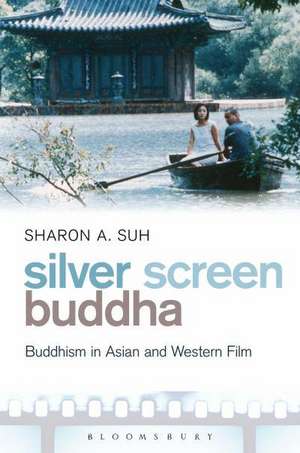
Silver Screen Buddha: Buddhism in Asian and Western Film
Autor Dr. Sharon A. Suhen Limba Engleză Paperback – 29 ian 2015
Silver Screen Buddha is the first book to explore the intersecting representations of Buddhism, race, and gender in contemporary films. Sharon A. Suh examines the cinematic encounter with Buddhism that has flourished in Asia and in the West in the past century - from images of Shangri-La in Frank Capra's 1937 Lost Horizon to Kim Ki-Duk's 2003 international box office success Spring, Summer, Fall, Winter...and Spring.
The book helps readers see that representations of Buddhism in Asia and in the West are fraught with political, gendered, and racist undertones. Silver Screen Buddha draws significant attention to ordinary lay Buddhism, a form of the tradition given little play in popular film. By uncovering the differences between a fictionalized, commodified, and exoticized Buddhism, Silver Screen Buddha brings to light expressions of the tradition that highlight laity and women, on the one hand, and Asian and Asian Americans, on the other. Suh engages in a re-visioning of Buddhism that expands the popular understanding of the tradition, moving from the dominance of meditating monks to the everyday world of raced, gendered, and embodied lay Buddhists.
Preț: 235.51 lei
Preț vechi: 274.18 lei
-14%
Puncte Express: 353
Carte tipărită la comandă
Livrare economică 07-21 decembrie
Livrare prin curier în România Termenul estimat este afișat lângă disponibilitate.
Transport gratuit de la 400.00 lei Plată online sau ramburs, în funcție de opțiunile comenzii.
Retur gratuit în 14 zile Comandă securizată și suport în română.
Specificații
ISBN-13: 9781441105363
ISBN-10: 1441105360
Pagini: 232
Ilustrații: 15 bw illus
Dimensiuni: 150 x 232 x 16 mm
Greutate: 0.36 kg
Editura: Bloomsbury Publishing
Colecția Bloomsbury Academic
Locul publicării:London, United Kingdom
ISBN-10: 1441105360
Pagini: 232
Ilustrații: 15 bw illus
Dimensiuni: 150 x 232 x 16 mm
Greutate: 0.36 kg
Editura: Bloomsbury Publishing
Colecția Bloomsbury Academic
Locul publicării:London, United Kingdom
V-ar putea interesa
-
 The Pixar TouchDavid A. PricePreț: 117.66 lei
 -
 Audrey Hepburn: A BiographyMartin GitlinPreț: 238.25 lei
 -
 Psycho in the Shower: The History of Cinema's Most Famous ScenePhilip J. Skerry-41%Preț: 132.03 lei223.35 lei
 -
 Zombie HolocaustDavid Flint-27%Preț: 92.39 lei127.21 lei
 -
 Amateur Filmmaking: The Home Movie, the Archive, the WebLaura RascaroliPreț: 262.29 lei
 -
 Cinema II: The Time-ImageGilles Deleuze-19%Preț: 171.54 lei211.01 lei
 -
 The Universal ExceptionSlavoj Zizek-24%Preț: 184.32 lei242.25 lei
 -
 -26%Preț: 165.83 lei223.50 lei
 -
 Hollywood's Ancient WorldsJeffrey RichardsPreț: 322.34 lei
 -
 Preț: 401.52 lei
 -
 Writings, 1922-1934: Sergei Eisenstein Selected Works, Volume 1Sergei EisensteinPreț: 200.23 lei
 -
 -20%Preț: 99.71 lei124.89 lei
Cuprins
1. Introduction: Buddhism and Film
2. Longing for Otherness through Buddhism
3. Zen Appetites: Consuming Religion and Otherness through Film
4. Plus ça change, plus c'est la même chose: Women as Snares of Samsara
5. Coming Down from the Mountaintop: Engaged Buddhism in the World
6. The Ordinary as Extraordinary
7. Film as Sutra
8. Toward a Re-Visioning of the Role of Lay Women in Buddhism
9. Conclusion: Re-creating the Buddhist World Anew-But in Whose Image?
Bibliography
Index
2. Longing for Otherness through Buddhism
3. Zen Appetites: Consuming Religion and Otherness through Film
4. Plus ça change, plus c'est la même chose: Women as Snares of Samsara
5. Coming Down from the Mountaintop: Engaged Buddhism in the World
6. The Ordinary as Extraordinary
7. Film as Sutra
8. Toward a Re-Visioning of the Role of Lay Women in Buddhism
9. Conclusion: Re-creating the Buddhist World Anew-But in Whose Image?
Bibliography
Index
Recenzii
Silver Screen Buddha is a gem of a book. And Sharon Suh is a cultural critic of the highest order. With this book, Suh has emerged at the forefront of cultural studies of religion. Through lucid prose and provocative insights, Suh provides vivid access to the embodied spiritual economies of lay Buddhist lives. Her deep dive into film widens our engagement with the cultural imaginary of Buddhism well beyond the rarefied and stubbornly Orientalist accounts of ascetic meditation practices. By rightfully demanding that we draw our attention to the funk and mess of ordinary Buddhist practice, Suh reveals paths that are singular and utterly invaluable for understanding the mutual world making of film and everyday religious life. What an achievement!
Suh's provocative analysis of the "hidden transcripts" of Buddhist film turns the cinematographic lens on producer, director, viewer, and viewed. Her evocative prose places critical analysis alongside artistic imagery in imaginative juxtaposition. Is Buddhism the sum of its portrayals or something different altogether?
Sharon Suh invites the reader to re-imagine Buddhism through the lens of film, a genre that is too often dismissed as 'entertainment'. She offers fresh insights that illuminate previously overlooked dimensions of Buddhist thought and culture in vivid and original terms.
A strength of "Silver Screen Buddha" is certainly the heterogeneity of the sample of movies it analyzes. Suh explores movies from the beginning of the 20th century together with contemporary ones, and American movies together with Asian ones; furthermore, she not only elaborates a criticism of Buddhist representations, but she also offers an analysis of movies that realistically describe Buddhist practices and lifestyles.
Suh's provocative analysis of the "hidden transcripts" of Buddhist film turns the cinematographic lens on producer, director, viewer, and viewed. Her evocative prose places critical analysis alongside artistic imagery in imaginative juxtaposition. Is Buddhism the sum of its portrayals or something different altogether?
Sharon Suh invites the reader to re-imagine Buddhism through the lens of film, a genre that is too often dismissed as 'entertainment'. She offers fresh insights that illuminate previously overlooked dimensions of Buddhist thought and culture in vivid and original terms.
A strength of "Silver Screen Buddha" is certainly the heterogeneity of the sample of movies it analyzes. Suh explores movies from the beginning of the 20th century together with contemporary ones, and American movies together with Asian ones; furthermore, she not only elaborates a criticism of Buddhist representations, but she also offers an analysis of movies that realistically describe Buddhist practices and lifestyles.