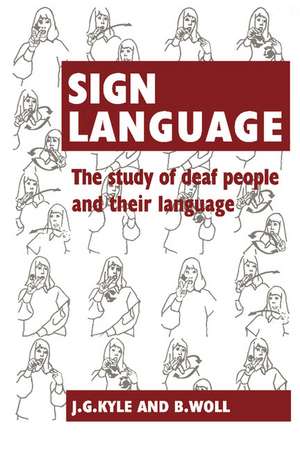
Sign Language: The Study of Deaf People and their Language
Autor Jim G. Kyle, Bencie Woll, G. Pullen, F. Maddixen Limba Engleză Paperback – 25 feb 1988
În cadrul programelor de studii lingvistice și de psihopedagogie specială, Sign Language se poziționează ca o resursă academică fundamentală pentru înțelegerea structurii și culturii comunității surzilor. Găsim în această lucrare, publicată de Cambridge University Press, o analiză riguroasă a British Sign Language (BSL), tratată nu doar ca un sistem gestual, ci ca o limbă complexă, cu o gramatică proprie și capacități de comunicare abstractă. Ne-a atras atenția modul în care autorii, printre care Jim G. Kyle și Bencie Woll, reușesc să îmbine rigoarea teoretică cu aplicațiile practice necesare în intervenția educațională.
Reținem structura logică a volumului, care debutează cu o perspectivă istorică și socială, înainte de a trece la mecanismele cognitive de achiziție a limbajului. Cartea explorează modul în care semnele apar, se modifică și capătă noi semnificații, oferind un cadru comparativ între BSL și limbile vorbite. Această abordare este o alternativă solidă la Language in Sign pentru cursurile de lingvistică aplicată, având avantajul unei integrări mai profunde a perspectivelor psihologice și a provocărilor specifice din sistemul de învățământ britanic. În timp ce Understanding Signed Languages oferă o introducere generală accesibilă studenților fără cunoștințe prealabile, volumul de față este calibrat pentru nivelul de cercetare și practică profesională, oferind date concrete despre interacțiunea dintre mișcare, spațiu și privire în construcția sensului.
Preț: 534.92 lei
Preț vechi: 660.39 lei
-19%
Carte tipărită la comandă
Livrare economică 13-27 iulie
Specificații
ISBN-10: 0521357179
Pagini: 328
Ilustrații: illustrations, index
Dimensiuni: 153 x 233 x 26 mm
Greutate: 0.47 kg
Editura: Cambridge University Press
Colecția Cambridge University Press
Locul publicării:Cambridge, United Kingdom
V-ar putea interesa
-
 Communication Interventions with Deaf PeopleRosalind Herman Gelbart-33%Preț: 764.73 lei1145.74 lei
 -
 Rose Signs Please and Thank youRose Ayling-Ellis-17%Preț: 48.37 lei58.61 lei
 -
 Rose Signs How Do You Feel?Rose Ayling-Ellis-17%Preț: 48.44 lei58.64 lei
 -
 British Sign Language For DummiesCity LitPreț: 163.80 lei
 -
 Indian Sign LanguageWilliam TomkinsPreț: 53.24 lei
 -
 Dictionary of British Sign LanguageDavid BrienPreț: 350.82 lei
 -
 Talking with Your Hands, Listening with Your EyesGabriel GraysonPreț: 170.03 lei
 -
 Preț: 105.34 lei
 -
 Let's Sign Pocket DictionaryCath SmithPreț: 86.72 lei
 -
 Preț: 353.68 lei
 -
 American Sign Language For Dummies with Online VideosAdan R. PenillaPreț: 154.94 lei
 -
 -11%Preț: 488.29 lei548.64 lei
 -
 Learn American Sign LanguageJames W. GuidoPreț: 165.20 lei
 -
 Learn American Sign Language, Second EditionJames W. Guido-15%Preț: 124.40 lei146.14 lei
 -
 -20%Preț: 95.92 lei120.41 lei
 -
 My First SignsAnnie KublerPreț: 52.70 lei
 -
 Preț: 145.97 lei
 -
 Let's Sign Early YearsCath SmithPreț: 85.55 lei
 -
 Preț: 80.92 lei
 -
 Preț: 194.64 lei
De ce să citești această carte
Recomandăm această carte profesioniștilor care lucrează cu persoane cu deficiențe de auz și studenților la lingvistică. Cititorul câștigă o înțelegere profundă a BSL ca sistem lingvistic de sine stătător, depășind prejudecata că limbajul semnelor este o simplă reprezentare iconică. Este un instrument esențial pentru a dezvolta o practică coerentă în educație și pentru a sprijini părinții auzitori în înțelegerea lumii copiilor lor.
Despre autor
Jim G. Kyle este un cercetător recunoscut în domeniul studiilor asupra persoanelor cu deficiențe de auz, fiind implicat în numeroase proiecte care vizează integrarea socială și lingvistică. Alături de Bencie Woll, un pionier în lingvistica limbajului semnelor în Marea Britanie, acesta a contribuit la recunoașterea academică a BSL. Expertiza lor combinată, alături de contribuțiile lui G. Pullen și F. Maddix, acoperă un spectru larg de la psihologia cognitivă la sociolingvistică, oferind lucrării o autoritate incontestabilă în literatura de specialitate publicată de Cambridge.