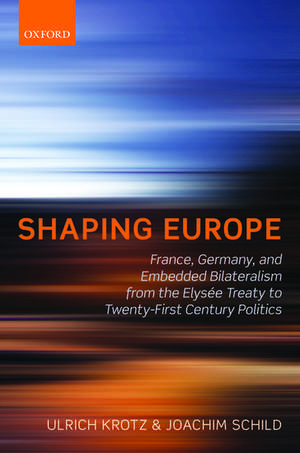
Shaping Europe: France, Germany, and Embedded Bilateralism from the Elysée Treaty to Twenty-First Century Politics
Autor Ulrich Krotz, Joachim Schilden Limba Engleză Hardback – 20 dec 2012
Preț: 870.84 lei
Preț vechi: 1263.83 lei
-31%
Puncte Express: 1306
Carte tipărită la comandă
Livrare economică 03-09 decembrie
Livrare prin curier în România Termenul estimat este afișat lângă disponibilitate.
Transport gratuit pentru acest produs Plată online sau ramburs, în funcție de opțiunile comenzii.
Retur gratuit în 14 zile Comandă securizată și suport în română.
Specificații
ISBN-13: 9780199660087
ISBN-10: 0199660085
Pagini: 356
Dimensiuni: 162 x 240 x 25 mm
Greutate: 0.7 kg
Editura: OUP OXFORD
Colecția OUP Oxford
Locul publicării:Oxford, United Kingdom
ISBN-10: 0199660085
Pagini: 356
Dimensiuni: 162 x 240 x 25 mm
Greutate: 0.7 kg
Editura: OUP OXFORD
Colecția OUP Oxford
Locul publicării:Oxford, United Kingdom
V-ar putea interesa
-
 Playing Our Game: Why China's Rise Doesn't Threaten the WestEdward Steinfeld-23%Preț: 216.11 lei279.73 lei
 -
 -33%Preț: 676.98 lei1005.47 lei
 -
 Coalition Governments in Western EuropeWolfgang C. Müller-28%Preț: 500.01 lei692.09 lei
 -
 Arguing Comparative PoliticsAlfred Stepan-25%Preț: 626.32 lei838.57 lei
 -
 -31%Preț: 948.71 lei1378.99 lei
 -
 Mobilizing for Democracy: Comparing 1989 and 2011Donatella Della Porta-31%Preț: 776.49 lei1125.12 lei
 -
 -31%Preț: 532.72 lei771.01 lei
 -
 Playing Our Game: Why China's Rise Doesn't Threaten the WestEdward S. Steinfeld-15%Preț: 232.60 lei273.86 lei
 -
 Women, Power and PoliticsAnne Stevens-26%Preț: 278.24 lei376.52 lei
 -
 Radical RightPippa NorrisPreț: 288.69 lei
 -
 Muslim PoliticsDale F. EickelmanPreț: 373.81 lei
 -
 JusticeRaymond WacksPreț: 77.42 lei
Recenzii
Shaping Europe is beyond doubt a field-impacting academic piece and a must-read for students of Franco-German relations as well as a broader readership interested in the patterns of European integration, past and present.
[A] stimulating study ... this significant work provokes reflection, and marks a valuable step forward in the study of the EU.
At the core of contemporary Europe lies the bilateral relationship between France and Germany. What accounts for the success of this joint leadership role, and is it likely to continue in the future? Krotz and Schild argue that the success of the Franco-German duo should be seen as the result of creative leadership [that] created a unique symbolic relationship. Franco-German reconciliation became a self-fulfilling prophecy, as publics, politicians, and officials began to expect and promote further cooperation over time.
Krotz and Schild make a powerful argument which should make their study of great interest to scholars of European integration and International Relations... [They] have produced an excellent book, which will become the new standard text for students of Franco-German relations.
Ulrich Krotz and Joachim Schilds study brings two major innovations. The first one is the ambition to cover in one book the whole period, including the most recent developments ... The second one is to open the black box of what the authors call embedded bilateralism' ... The mastery and fortunate combination of those two novelties brings a precise and comprehensive panorama of the past half century of Franco-German tandem.
Krotz and Schilds book should be highly welcomed by all EU scholars.
Krotz and Schild have done a great service in mapping the current and somewhat fraught Franco-German relationship onto its past ... the book is a careful and respectful piece of scholarship.
For the 50th anniversary of the Elysée Treaty, Ulrich Krotz and Joachim Schild have provided all students of European and international politics with a special gift- a theoretically highly original, empirically rich, and historically informed analysis of Europes most important relationship. This splendid book invites us to explore embedded bilateralism as a distinctive type of international relations. The rewards are fully commensurate with the political occasion this book marks.
Krotz and Schild provide a highly interesting and innovative study explaining the enduring bilateral relationship between France and Germany, and its impact on European integration. Rigorous in analysis and documentation, their book is particularly valuable because it highlights the multiple causes and effects of Franco-German embeddedness in Europe.
Many see the Euro-crisis revealing mounting tensions between Berlin and Paris. This remarkable book, covering a half century of Franco-German relations and European politics, reminds us that the obstacles faced by the two neighbors at the signing of the Elysée Treaty-and at various junctures since-while different, were no less politically momentous and historically significant than the challenges France and Germany encounter today.
[A] stimulating study ... this significant work provokes reflection, and marks a valuable step forward in the study of the EU.
At the core of contemporary Europe lies the bilateral relationship between France and Germany. What accounts for the success of this joint leadership role, and is it likely to continue in the future? Krotz and Schild argue that the success of the Franco-German duo should be seen as the result of creative leadership [that] created a unique symbolic relationship. Franco-German reconciliation became a self-fulfilling prophecy, as publics, politicians, and officials began to expect and promote further cooperation over time.
Krotz and Schild make a powerful argument which should make their study of great interest to scholars of European integration and International Relations... [They] have produced an excellent book, which will become the new standard text for students of Franco-German relations.
Ulrich Krotz and Joachim Schilds study brings two major innovations. The first one is the ambition to cover in one book the whole period, including the most recent developments ... The second one is to open the black box of what the authors call embedded bilateralism' ... The mastery and fortunate combination of those two novelties brings a precise and comprehensive panorama of the past half century of Franco-German tandem.
Krotz and Schilds book should be highly welcomed by all EU scholars.
Krotz and Schild have done a great service in mapping the current and somewhat fraught Franco-German relationship onto its past ... the book is a careful and respectful piece of scholarship.
For the 50th anniversary of the Elysée Treaty, Ulrich Krotz and Joachim Schild have provided all students of European and international politics with a special gift- a theoretically highly original, empirically rich, and historically informed analysis of Europes most important relationship. This splendid book invites us to explore embedded bilateralism as a distinctive type of international relations. The rewards are fully commensurate with the political occasion this book marks.
Krotz and Schild provide a highly interesting and innovative study explaining the enduring bilateral relationship between France and Germany, and its impact on European integration. Rigorous in analysis and documentation, their book is particularly valuable because it highlights the multiple causes and effects of Franco-German embeddedness in Europe.
Many see the Euro-crisis revealing mounting tensions between Berlin and Paris. This remarkable book, covering a half century of Franco-German relations and European politics, reminds us that the obstacles faced by the two neighbors at the signing of the Elysée Treaty-and at various junctures since-while different, were no less politically momentous and historically significant than the challenges France and Germany encounter today.
Notă biografică
Ulrich Krotz is Professor at the European University Institute (EUI), where he holds the Chair in International Relations in the Political Science Department and the Robert Schuman Centre for Advanced Studies. He received his Ph.D. from Cornell University, has taught at Oxford University and Brown University, and has held various research positions at Princeton University, the EUI, and Harvard University. He is author of Flying Tiger: International Relations Theory and the Politics of Advanced Weapons (Oxford University Press, 2011) and History and Foreign Policy in France and Germany (Palgrave Macmillan, forthcoming). Recent journal publications have appeared in World Politics, International Security, the European Journal of International Relations, European Security, Foreign Policy Analysis, and the Journal of Common Market Studies.Joachim Schild is Professor of Comparative Politics at the University of Trier. Previously he was a research associate at the Franco-German Institute, Ludwigsburg, and senior research associate at the German Institute for International and Security Affairs (Stiftung Wissenschaft und Politik, SWP) in Berlin, as well as a guest researcher at the Centre de Recherches Politiques (CEVIPOF) at Sciences Po, Paris. His books include Debating Europe: The European Parliament Elections, 2009 and Beyond (Nomos, 2011, edited with Robert Harmsen). He has published journal articles, among others, in the Journal of Common Market Studies and the Journal of European Public Policy.