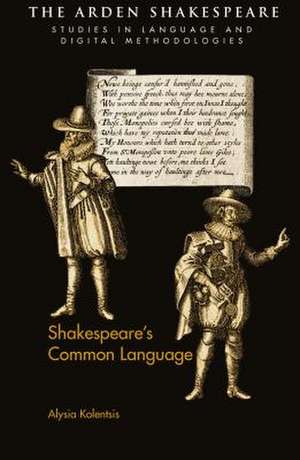
Shakespeare’s Common Language: Arden Shakespeare Studies in Language and Digital Methodologies
Autor Alysia Kolentsisen Limba Engleză Hardback – 23 ian 2020
Preț: 588.24 lei
Preț vechi: 875.28 lei
-33%
Puncte Express: 882
Carte tipărită la comandă
Livrare economică 30 noiembrie-14 decembrie
Livrare prin curier în România Termenul estimat este afișat lângă disponibilitate.
Transport gratuit pentru acest produs Plată online sau ramburs, în funcție de opțiunile comenzii.
Retur gratuit în 14 zile Comandă securizată și suport în română.
Specificații
ISBN-13: 9781350007017
ISBN-10: 1350007013
Pagini: 204
Dimensiuni: 129 x 198 x 15 mm
Greutate: 0.3 kg
Editura: Bloomsbury Publishing
Colecția The Arden Shakespeare
Seria Arden Shakespeare Studies in Language and Digital Methodologies
Locul publicării:London, United Kingdom
ISBN-10: 1350007013
Pagini: 204
Dimensiuni: 129 x 198 x 15 mm
Greutate: 0.3 kg
Editura: Bloomsbury Publishing
Colecția The Arden Shakespeare
Seria Arden Shakespeare Studies in Language and Digital Methodologies
Locul publicării:London, United Kingdom
V-ar putea interesa
-
 Preț: 402.10 lei
 -
 Shakespeare:The Poet & His PlaysStanley WellsPreț: 145.14 lei
 -
 Merely Players?: Actors' Accounts of Performing ShakespeareJonathan Holmes-18%Preț: 711.42 lei867.59 lei
 -
 -18%Preț: 1109.31 lei1352.81 lei
 -
 The Language of Shakespeare's PlaysB. I. Evans-18%Preț: 2565.67 lei3128.86 lei
 -
 Readings on the Character of Hamlet: compiled from over three hundred sources.Claude C H Williamson-18%Preț: 1508.83 lei1840.04 lei
 -
 Music in Shakespearean TragedyF W Sternfeld-18%Preț: 2491.83 lei3038.81 lei
 -
 Preț: 423.54 lei
 -
 Preț: 442.91 lei
 -
 -23%Preț: 321.33 lei416.55 lei
 -
 -33%Preț: 358.09 lei533.12 lei
 -
 Shakespeare and Jungian Typology: A Reading of the PlaysKenneth TuckerPreț: 222.68 lei
 -
 Shakespeare's Other Lives: "An Anthology of Fictional Depictions of the Bard"Maurice J. O'SullivanPreț: 226.18 lei
 -
 Preț: 299.13 lei
 -
 Shakespeare′s PromisesKerriganPreț: 236.12 lei
 -
 -14%Preț: 1150.15 lei1337.38 lei
 -
 Shakespeare and Fun: The Birth of Entertainment ValueDonald Hedrick-31%Preț: 484.84 lei701.55 lei
 -
 -37%Preț: 586.29 lei929.41 lei
 -
 -33%Preț: 622.30 lei924.56 lei
 -
 Rethinking Theatrical Documents in Shakespeare’s EnglandDr Tiffany Stern-33%Preț: 612.18 lei909.72 lei
 -
 Burbage and Shakespeare's StageCharlotte Carmichael StopesPreț: 116.47 lei
 -
 Elizabeth Barrett Browning and Shakespeare: 'This is Living Art'Dr Josie Billington-25%Preț: 279.90 lei374.01 lei
 -
 Adapting Canonical Texts in Children's LiteratureProf. Dr. Anja Müller-25%Preț: 277.98 lei369.51 lei
 -
 A Theatergoer's Guide to ShakespeareRobert Thomas Fallon-14%Preț: 116.06 lei134.43 lei
Cuprins
Introduction: Shakespeare's Common Language
Chapter 1: Language Change, Coriolanus, and 'Shall'
Chapter 2: Discourse Analysis, Troilus and Cressida, and 'Will'
Chapter 3: Pragmatics, Richard II, and 'This'
Chapter 4: Grammar, As You Like It, and 'If'
Notes
References
Index
Chapter 1: Language Change, Coriolanus, and 'Shall'
Chapter 2: Discourse Analysis, Troilus and Cressida, and 'Will'
Chapter 3: Pragmatics, Richard II, and 'This'
Chapter 4: Grammar, As You Like It, and 'If'
Notes
References
Index
Recenzii
Written in clear and accessible prose, Kolentsis's book on the linguistic aspects of Shakespeare's dialogues evolved from her dissertation research. In close readings of quotidian and easily overlooked words within dramatic dialogue (e.g., will/shall, if, here/this), Kolentsis (Univ. of Waterloo, Canada) reveals her profound knowledge of the Shakespearean corpus and linguistic methods. The core of the book is four self-contained chapters, each devoted to one play and each applying a linguistic approach (such as discourse analysis or historical sociolinguistics) to a small set of words in that play's dialogues. The structure of the chapters is well defined: each introduces the chapter's purpose, describes the theoretical or methodological basis of the linguistic approach being applied, and then delves into a close reading of a play. The consistency of the format allows readers or instructors to easily extract the portions that are most relevant to their research or teaching needs. Kolentsis's writing style, concise summaries of linguistic approaches, and thoughtful analyses of dialogue make this book appropriate for nonspecialists and specialists alike. Summing Up: Recommended. Lower-division undergraduates through faculty.
This book brings Shakespeare's verbal experimentation with some of the most frequently used "small" words of the English language (shall, will, this, and if) vividly to life. Writing in a highly accessible style, Kolentsis equips students with innovative approaches to close reading that fruitfully combine literary and linguistic analysis to illuminate key dynamics of the drama
This book brings Shakespeare's verbal experimentation with some of the most frequently used "small" words of the English language (shall, will, this, and if) vividly to life. Writing in a highly accessible style, Kolentsis equips students with innovative approaches to close reading that fruitfully combine literary and linguistic analysis to illuminate key dynamics of the drama