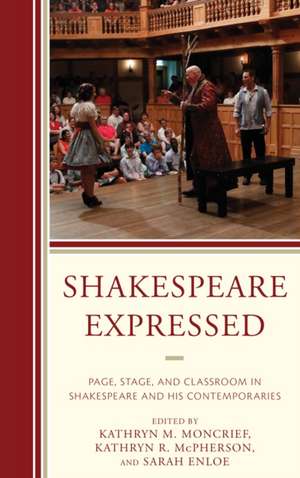
Shakespeare Expressed: Page, Stage, and Classroom in Shakespeare and His Contemporaries: The Fairleigh Dickinson University Press Series on Shakespeare and the Stage
Editat de Kathryn M. Moncrief, Kathryn R. McPherson, Sarah Enloeen Limba Engleză Paperback – 2 mai 2017


Preț: 383.45 lei
Preț vechi: 531.95 lei
-28%
Puncte Express: 575
Carte tipărită la comandă
Livrare economică 07-21 decembrie
Livrare prin curier în România Termenul estimat este afișat lângă disponibilitate.
Transport gratuit de la 400.00 lei Plată online sau ramburs, în funcție de opțiunile comenzii.
Retur gratuit în 14 zile Comandă securizată și suport în română.
Specificații
ISBN-13: 9781683930716
ISBN-10: 1683930711
Pagini: 314
Ilustrații: 19 BW Illustrations
Dimensiuni: 149 x 231 x 23 mm
Greutate: 0.48 kg
Editura: Bloomsbury Publishing
Colecția Fairleigh Dickinson University Press
Seria The Fairleigh Dickinson University Press Series on Shakespeare and the Stage
Locul publicării:New York, United States
ISBN-10: 1683930711
Pagini: 314
Ilustrații: 19 BW Illustrations
Dimensiuni: 149 x 231 x 23 mm
Greutate: 0.48 kg
Editura: Bloomsbury Publishing
Colecția Fairleigh Dickinson University Press
Seria The Fairleigh Dickinson University Press Series on Shakespeare and the Stage
Locul publicării:New York, United States
V-ar putea interesa
-
 South Pacific: Paradise RewrittenJim Lovensheimer-18%Preț: 382.73 lei464.45 lei
 -
 The Oxford Dictionary of PlaysMichael Patterson-27%Preț: 449.24 lei618.87 lei
 -
 Theatre, Education and PerformanceHelen NicholsonPreț: 248.75 lei
 -
 Not ShakespeareRichard W. SchochPreț: 371.20 lei
 -
 Women and Victorian TheatreKerry PowellPreț: 335.54 lei
 -
 The Stanislavsky System of ActingRose WhymanPreț: 347.11 lei
 -
 Shakespeare's ClownDavid WilesPreț: 346.41 lei
 -
 Shakespeare's GlobeChristie CarsonPreț: 249.71 lei
 -
 The Cambridge Introduction to ScenographyJoslin MckinneyPreț: 452.56 lei
 -
 The Stuart Court Masque and Political CultureMartin Butler-14%Preț: 902.89 lei1049.86 lei
 -
 Theatre CraftJohn CairdPreț: 346.81 lei
 -
 The Hemingway MonologuesBrian Gordon SinclairPreț: 84.13 lei
 -
 What We Do - Working in the TheatreBo MetzlerPreț: 86.14 lei
 -
 -18%Preț: 1154.01 lei1407.32 lei
 -
 Mother Cabrini's Mission to AmericaJoan K. AlbarellaPreț: 117.12 lei
 -
 Chu Chin ChowOscar AschePreț: 89.71 lei
 -
 Random WomenCarolyn J. CarpenterPreț: 92.12 lei
 -
 10 Minute Plays for Kids of All AgesCarlene M. GriffithPreț: 126.70 lei
 -
 Vegan SaintAcie CargillPreț: 37.64 lei
 -
 El Jardin de Los CerezosAnton ChejovPreț: 45.05 lei
 -
 Chat En PocheGeorges FeydeauPreț: 65.05 lei
 -
 Stop the Show!Brad SchreiberPreț: 100.89 lei
 -
 -16%Preț: 94.07 lei112.63 lei
 -
 Mary McCarthy's Theatre ChroniclesMary MccarthyPreț: 89.63 lei
 -
 Backwards Into FutureJr. Wiebel, Frederick C.Preț: 213.26 lei
 -
 Teatralne interpretacje dzie¿ Witolda GombrowiczaDominika SibigaPreț: 198.99 lei
 -
 Preț: 361.89 lei
Cuprins
Foreword: Lightning in a Bottle
Ralph Alan Cohen
Chapter 1: Introduction: Shakespeare Embodied, Expressed, and Enacted
Kathryn Moncrief and Kathryn McPherson:
I. The Body of the Actor
Chapter 2: Speaking in the Silence: Deaf Performance at the Oregon Shakespeare Festival
Lezlie Cross
Chapter 3: "I Have Given Suck:" The Maternal Body in Sarah Siddons' Lady Macbeth
Chelsea Phillips
Chapter 4: Competing Heights
Jemma Alix Levy
Chapter 5: The Mirror and the Monarchs: Suggestive Presences and Shakespeare's Cast-Size
Brett Gamboa
Chapter 6: Embodying Shakespeare: In the Classroom
Miriam Gilbert
II. Playing the Text
Chapter 7: Remember the Porter: Knock-Knock Jokes, Tragedy, and Other Unfunny Things
Chris Barrett
Chapter 8: Ghost in the Machine: Shakespeare, Stanislavski and Original Practices
Peter Kanelos
Chapter 9: "Speake[ing] the speech[es]:" Reassessing the Playability of the Earliest Printings of Hamlet
Matthew Vadnais
Chapter 10: A "Ha" in Shakespeare: The Soliloquy as Excuse and Challenge to the Audience
Bill Gelber
Chapter 11: A Knave to Know a Knock: Exploring Character Function in Scenic Structure
Symmonie Preston
III. Staging Choices
Chapter 12: Behind Closed Doors: Perspective and Painterly Technique on the Early Modern English Stage
Jennifer Low
Chapter 13: Shticky Shakespeare: Exploring Action as Eloquence
Sid Ray
Chapter 14: Seeing Ghosts: Hamlet and Modern Original Practices
Fiona Harris-Ramsby & Kathryn McPherson
Chapter 15: Remembrances of yours': Properties, Performance, and Memory in Shakespeare's Hamlet 3.1
Kathryn Moncrief
Chapter 16: The Mirror of All Christian Kings: Choral Medievalism in the Henry V Folio
Christina Gutierrez
Chapter 17: Playing with Character-Audience Members in Early Modern Playhouses
Sarah Enloe
IV. Playhouse and Playing Conditions
Chapter 18: Blackfriars Stage-Sitters and the Staging of The Tempest, The Maid's Tragedy and The Two Noble Kinsmen
Leslie Thomson
Chapter 19: "The Concourse of People on the Stage": An Alternative Proposal for Onstage Seating at the Second Blackfriars
Nova Myhill
Chapter 20: The Two Blackfriars Theatres: Discontinuity or Contiguity?
Jeanne McCarthy
Chapter 21: "Here sit we down.": The Location of Andrea and Revenge in The Spanish Tragedy
Annalisa Castaldo
Chapter 22: Thomas Middleton's Use of the Gallery Space
Christine Parker
Chapter 23: Performing Space: Playing the Architecture
Doreen Bechtol
V. Technical and Material Matters
Chapter 24: Light and Heat in the Playhouses
Ann Jennalie Cook
Chapter 25: Lighting Effects in the Early Modern Private Playhouses
Lauren Shell
Chapter 26: Sound Trumpets
Alisha Huber
Chapter 27: Play it again, Hal: The 1605 Revival of Henry V
Melissa Aaron
Chapter 28: Playing with Early Modern Special Effects
Cass Morris
Ralph Alan Cohen
Chapter 1: Introduction: Shakespeare Embodied, Expressed, and Enacted
Kathryn Moncrief and Kathryn McPherson:
I. The Body of the Actor
Chapter 2: Speaking in the Silence: Deaf Performance at the Oregon Shakespeare Festival
Lezlie Cross
Chapter 3: "I Have Given Suck:" The Maternal Body in Sarah Siddons' Lady Macbeth
Chelsea Phillips
Chapter 4: Competing Heights
Jemma Alix Levy
Chapter 5: The Mirror and the Monarchs: Suggestive Presences and Shakespeare's Cast-Size
Brett Gamboa
Chapter 6: Embodying Shakespeare: In the Classroom
Miriam Gilbert
II. Playing the Text
Chapter 7: Remember the Porter: Knock-Knock Jokes, Tragedy, and Other Unfunny Things
Chris Barrett
Chapter 8: Ghost in the Machine: Shakespeare, Stanislavski and Original Practices
Peter Kanelos
Chapter 9: "Speake[ing] the speech[es]:" Reassessing the Playability of the Earliest Printings of Hamlet
Matthew Vadnais
Chapter 10: A "Ha" in Shakespeare: The Soliloquy as Excuse and Challenge to the Audience
Bill Gelber
Chapter 11: A Knave to Know a Knock: Exploring Character Function in Scenic Structure
Symmonie Preston
III. Staging Choices
Chapter 12: Behind Closed Doors: Perspective and Painterly Technique on the Early Modern English Stage
Jennifer Low
Chapter 13: Shticky Shakespeare: Exploring Action as Eloquence
Sid Ray
Chapter 14: Seeing Ghosts: Hamlet and Modern Original Practices
Fiona Harris-Ramsby & Kathryn McPherson
Chapter 15: Remembrances of yours': Properties, Performance, and Memory in Shakespeare's Hamlet 3.1
Kathryn Moncrief
Chapter 16: The Mirror of All Christian Kings: Choral Medievalism in the Henry V Folio
Christina Gutierrez
Chapter 17: Playing with Character-Audience Members in Early Modern Playhouses
Sarah Enloe
IV. Playhouse and Playing Conditions
Chapter 18: Blackfriars Stage-Sitters and the Staging of The Tempest, The Maid's Tragedy and The Two Noble Kinsmen
Leslie Thomson
Chapter 19: "The Concourse of People on the Stage": An Alternative Proposal for Onstage Seating at the Second Blackfriars
Nova Myhill
Chapter 20: The Two Blackfriars Theatres: Discontinuity or Contiguity?
Jeanne McCarthy
Chapter 21: "Here sit we down.": The Location of Andrea and Revenge in The Spanish Tragedy
Annalisa Castaldo
Chapter 22: Thomas Middleton's Use of the Gallery Space
Christine Parker
Chapter 23: Performing Space: Playing the Architecture
Doreen Bechtol
V. Technical and Material Matters
Chapter 24: Light and Heat in the Playhouses
Ann Jennalie Cook
Chapter 25: Lighting Effects in the Early Modern Private Playhouses
Lauren Shell
Chapter 26: Sound Trumpets
Alisha Huber
Chapter 27: Play it again, Hal: The 1605 Revival of Henry V
Melissa Aaron
Chapter 28: Playing with Early Modern Special Effects
Cass Morris
Recenzii
This book would be most helpful for pedagogical and performative purposes; both for educators seeking to incorporate practical staging issues into their classrooms and for performance practitioners. It fosters an important conversation on the role of the practical by examining factors sometimes overlooked as tangential.
Shakespeare Expressed: Page, Stage, and Classroom in Shakespeareand His Contemporaries succeeds in capturing the spirit of the 2011 Blackfriars Conference. . . .The essays in this collection are filled with insight and provocative questions and are linked to engaging classroom activities that will invite teachers to incorporate them into their lesson planning, making the challenge of acquiring those skills more achievable.
The volume is tightly focused and distinctive for the way it brings together teachers and theater practitioners to think about language and performance. It's one of those rare volumes that will be of interest to actors and directors as well as academics.
Shakespeare Expressed: Page, Stage, and Classroom in Shakespeareand His Contemporaries succeeds in capturing the spirit of the 2011 Blackfriars Conference. . . .The essays in this collection are filled with insight and provocative questions and are linked to engaging classroom activities that will invite teachers to incorporate them into their lesson planning, making the challenge of acquiring those skills more achievable.
The volume is tightly focused and distinctive for the way it brings together teachers and theater practitioners to think about language and performance. It's one of those rare volumes that will be of interest to actors and directors as well as academics.