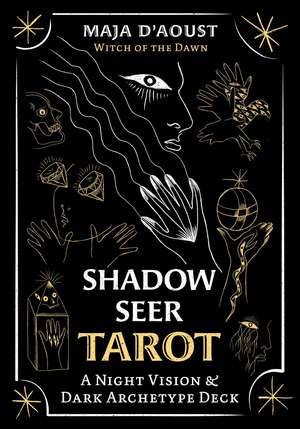
Shadow Seer Tarot: A Night Vision and Dark Archetype Deck
Autor Maja D'Aousten Limba Engleză Cards – 7 mai 2026
• Uses alchemical reconciliation through opposition to illuminate the shadows in our lives for a more complete sense of self
• Explores the dark side of the Major and Minor Arcana where the Fool becomes Hubris, the Magician becomes the Manipulator, and the Empress becomes the Cannibal Mother
• Offers techniques and card spreads to investigate the “darchetypes” that lurk in our personal and collective unconscious
As a tool for shadow work and divination, the Shadow Seer Tarot deck and guidebook give methods to see through the blind spots of ordinary tarot readings into the heart of what is often hidden. Using Hermetic principles, Maja D’Aoust defines oppositional energies as they relate to the cards of the tarot. With the alchemical method of reconciliation through opposition, she looks deeper into the familiar meanings of the Major and Minor Arcana to give readers insight into the shadow energies at work in their lives to reveal a path toward wholeness. By inverting the archetypes and revealing their shadow side, or “darchetypes,” Maja opens portals of understanding to the bad behaviors that we often attempt to conceal, repress, or deny. For example, shadow forms are represented in the suit of Cups by cards such as the Toxic Family, the Glutton, Addiction, and Betrayal. In the suit of Wands, the dark side of our drives and passions are exposed in cards like Propaganda, Slander, the False Martyr, and the Avoidant. Working with our secret shadows, rooted to the underworld and our ancestors, reveals deeper truths and a more balanced perception of the world.
Preț: 120.80 lei
Puncte Express: 181
Disponibil
Livrare economică 30 octombrie-11 noiembrie
Livrare prin curier în România Termenul estimat este afișat lângă disponibilitate.
Transport gratuit de la 400.00 lei Plată online sau ramburs, în funcție de opțiunile comenzii.
Retur gratuit în 14 zile Comandă securizată și suport în română.
Specificații
ISBN-13: 9798888503027
Pagini: 256
Ilustrații: Includes 78 b&w cards and 256-page book
Dimensiuni: 133 x 191 x 38 mm
Greutate: 0.59 kg
Editura: Inner Traditions/Bear & Company
Colecția Destiny Books
Pagini: 256
Ilustrații: Includes 78 b&w cards and 256-page book
Dimensiuni: 133 x 191 x 38 mm
Greutate: 0.59 kg
Editura: Inner Traditions/Bear & Company
Colecția Destiny Books
V-ar putea interesa
-
 Preț: 157.39 lei
 -
 Preț: 257.30 lei
 -
 -18%Preț: 112.08 lei136.92 lei
 -
 The Shadow Work Deck: 40-Card Deck, Guidebook, & WorkbookDanielle MassiPreț: 130.63 lei
 -
 Preț: 78.13 leiRecomandat
 -
 -18%Preț: 99.09 lei121.33 lei
 -
 Preț: 136.37 leiRecomandat
 -
 -20%Preț: 97.10 lei121.17 leiRecomandat
 -
 -35%Preț: 136.45 lei209.20 leiRecomandat
 -
 Preț: 138.02 lei
 -
 The Tarot of Light and ShadowJohn MatthewsPreț: 151.61 lei
 -
 The Witch's Shadow Work OracleClare GogertyPreț: 142.14 lei
 -
 -18%Preț: 117.26 lei143.17 lei
 -
 Shadow of Darkness OracleSirian ShadowPreț: 97.35 lei
 -
 Macabre Tarot Pocket Tin EditionSam RookPreț: 81.68 lei
 -
 -15%Preț: 62.98 lei74.44 leiRecomandat
 -
 -37%Preț: 130.48 lei206.86 lei
 -
 Celtic Elemental Tarot: 78-Card Deck and BookAyn Cates SullivanPreț: 127.86 leiRecomandat
 -
 Shadows of Tarot: A Tarot Spread JournalEmma Howard-32%Preț: 106.74 lei157.26 leiRecomandat
Notă biografică
Maja D’Aoust is a practicing Witch and scholar of alchemy and occult lore who has been reading tarot professionally for more than 20 years. She is the author of Familiars in Witchcraft, The Occult I Ching, Astrology of the Shadow Self, and creator of The White Witch Tarot. She lives in Los Angeles.
Extras
Ancestors, Rephaim, and Shadow Work
“Sacrifice of the Shades” Liturgy
You are summoned, O Rephaim of the earth,
You are invoked, O council of the Didanu!
Ulkn, the Raphi’, is summoned,
Trmn, the Raphi’, is summoned,
Sdn-w-rdn is summoned,
Tr’llmn is summoned,
the Rephaim of old are summoned!
You are summoned, O Rephaim of the earth,
You are invoked, O council of the Didanu.
Ugaritic Ritual Text KTU 1.161*
Although much of modern culture these days seems to reference the psychological shadow work of Carl Jung to be utilized for personal insight, this deck will include a more ancient and pagan method of performing shadow work, namely through the atavistic instincts of the ancestors. Drawing from the pagan sources that inspired Carl Jung, this deck provides an important link, ignored in most other sources, to the earlier concepts of the human shadow and its implications. Humans have been dealing with needs, both met and unmet, since we have existed, so we cannot be arrogant and assume our ancestors didn’t face similar conundrums. It is important, I think, for all of us to see how our animal bodies, our own and those of our predecessors, hold sway over everything we do every day. To do that, it helps to know a bit about where we come from.
Working with ancestors became taboo. I suppose it fell off due to the influence of Western Christianity, which presented speaking with the dead as a kind of satanic necromancy. The Judeo-Christian Bible’s prohibition of these so-called hedonistic practices effectively created a schism in our families and our past, a disconnect from the source of our bodies—strange since the Lord is referred to as “Father.” You may hold other views, and I welcome you to them. I don’t know about you, but I am tired of being a casualty of the battle of the gods. I am not interested in which deity is right or wrong, good or evil, or has the most followers and likes. I don’t want to play that game anymore. I want to learn about all of them, to include them all. One of the results of stigmatizing efforts to connect with our ancestors is that we dissociate from our past, forgetting and dishonoring what came before us. This results in a severe loss of our culture, knowledge, and wisdom and fosters a tendency to disparage cultures that revere their forebears and memories of what came before.
Pagan, Indigenous, and many alternative religions have a more balanced approach to continuing relationships with the ancestors. They honor, acknowledge, and venerate the predecessors, who in turn provide them with wisdom and insights about human beings. Even if we don’t like our personal ancestors, we would not be here without them, so it is necessary work, despite the toxic behaviors or seemingly primitive choices our ancestors may have done or made in the past. Learning from the shadows of the past is a valuable way to move forward into the future. We need to look honestly at what came before in order to build new time lines.
As I peered beyond the generally accepted sources of the Judeo-Christian Bible, which have influenced concepts of religions and their origins, I found myself looking into an area of western Asia called the Levant, or the risen lands. The area of the Levant includes all the modern-day main players—Israel, Syria, Palestine, Lebanon, and Turkey—comprising what were known as the Semitic people and the Canaanites, among others. Turkey has formed a major role in much of my personal research into Cybele and other chthonic goddesses, so it made sense to look at surrounding areas. Attempts to follow ancestor clues beyond the begats of the patriarchal lineages outlined in the Torah led me to the Rephaim in my research, a group of people, or perhaps ghosts of the underworld, associated with the Levant. There is much scholarly controversy surrounding the identity of the Rephaim. The Rephaim are identified simultaneously as the human ancestors of the biblical enemy Goliath, a race of giants, a certain group of the dead that occupy the underworld, and even monsters much like the titans or the Nephilim and Anakim.*
The ancient peoples of these lands were tribal and, before monotheism, had many gods and goddesses. The god of the Bible (who seemed to have several identities, including seventy-two names, such as Yahweh and El) was derived from these ancestral sources and eventually became the singular, monotheistic presence in the Judeo-Christian texts we know today. In the older tomes, there were primary goddess figures as well, known as Asherah, Inanna, and Ishtar, among others, who were well known and widespread before the eradication of all deities other than Yahweh. Even El or Al fell out of favor to the name Jehovah but is included in the seventy-two names of the god Yahweh. When the god of the Old Testament proclaimed “you shall have no other gods before me” (Exodus 20:3), the shadow darchetype Jealousy came into play. The other deities were eliminated in an ongoing war of the heavens to determine which god is the god, which continues today. (I understand these statements will be offensive for members of certain religions, but since I am a witch, who in these Judeo-Christian texts is ordered not to be suffered to live, I hope you will allow me some cheekiness.) The battle for acknowledgment and religious rites continues to play out on Earth, particularly in the Levant area, but getting to the roots of this old story may take several lifetimes. I am only addressing the religious texts and suppressed histories, but perhaps we can find some insights contained within them. A key source left behind for materials and writings of the pagan beliefs that fell out of popular awareness came out of the ancient city of Ugarit, modern-day Syria, wherein the Ugaritic texts were recovered, written in a cuneiform language that included the polytheistic deities such as Ba’al and Asherah. Most of the texts date to around the fourteenth to twelfth centuries BCE.
The ancient cultures of Syria and Palestine present a very different portrait of the Rephaim, compared to the favored narrative from biblical sources. Judeo-Christian sources present the Rephaim as terrifying and forbidding. The Ugaritic texts from Syria venerate the Rephaim as heroes and mighty warriors. Palestinian sources refer to the Rephaim as semideified ancestors. They were “Men of Renown,” giants or mighty men who did great things akin to Hercules. I guess depending on which side of the narrative you find yourself, someone is considered either a hero or a villain. There are sites of significance with monuments and ruins affiliated with the Rephaim, such as the Rujm el-Hiri or Wheel of Ghosts on the border of Israel and Syria, closed to the public as it is on an Israeli naval base in a war zone. The Rujm el-Hiri is sometimes called the Stonehenge of Israel and has an underground burial chamber beneath it. Palestine comes into play through Goliath, a giant who some scholars say was a descendent of the Rephaim, hence his enormous size. The area of Palestine and especially Gaza in ancient lore was known as the valley of the Rephaim. These are not anti-Semitic statements, nor against the Jewish faith, nor admonishing them, to be clear; rather they are inclusive of the other peoples in the story, the loser in the narrative of the biblical texts who is a hero in another culture. David took the head of Goliath, the enemy and oppositional persona, and, according to the legends, brought it to Golgotha, which interestingly became the site of the crucifixion of Christ in Christianity.
Esoteric history and remembering old sources of humanity’s bad behaviors based on needs could help to unravel the puzzle of the hate and wars that continue today. Hate and war are shadow behaviors after all. Shadow work means including the opposer, not showing preference to either side, but looking beyond the surface and into ancestry. We can understand that war happens because someone else did something awful, which justifies actions of offense and defense. We need to comprehend this because it happens in our own families, neighborhoods, and communities. We can’t, while trying to understand it, leave anything out because this creates a blind spot. But what we can do is help everyone by doing shadow work, which means we look at both sides of the conflict or dipole. In physics, a dipole (from the Greek dis polos, meaning “twice axis”) is a pair of equal and opposite electric charges or magnetic poles. In a conflict, each side is the shadow or opposite charge of the other, creating a dynamic energy that can both repel and attract.
“Sacrifice of the Shades” Liturgy
You are summoned, O Rephaim of the earth,
You are invoked, O council of the Didanu!
Ulkn, the Raphi’, is summoned,
Trmn, the Raphi’, is summoned,
Sdn-w-rdn is summoned,
Tr’llmn is summoned,
the Rephaim of old are summoned!
You are summoned, O Rephaim of the earth,
You are invoked, O council of the Didanu.
Ugaritic Ritual Text KTU 1.161*
Although much of modern culture these days seems to reference the psychological shadow work of Carl Jung to be utilized for personal insight, this deck will include a more ancient and pagan method of performing shadow work, namely through the atavistic instincts of the ancestors. Drawing from the pagan sources that inspired Carl Jung, this deck provides an important link, ignored in most other sources, to the earlier concepts of the human shadow and its implications. Humans have been dealing with needs, both met and unmet, since we have existed, so we cannot be arrogant and assume our ancestors didn’t face similar conundrums. It is important, I think, for all of us to see how our animal bodies, our own and those of our predecessors, hold sway over everything we do every day. To do that, it helps to know a bit about where we come from.
Working with ancestors became taboo. I suppose it fell off due to the influence of Western Christianity, which presented speaking with the dead as a kind of satanic necromancy. The Judeo-Christian Bible’s prohibition of these so-called hedonistic practices effectively created a schism in our families and our past, a disconnect from the source of our bodies—strange since the Lord is referred to as “Father.” You may hold other views, and I welcome you to them. I don’t know about you, but I am tired of being a casualty of the battle of the gods. I am not interested in which deity is right or wrong, good or evil, or has the most followers and likes. I don’t want to play that game anymore. I want to learn about all of them, to include them all. One of the results of stigmatizing efforts to connect with our ancestors is that we dissociate from our past, forgetting and dishonoring what came before us. This results in a severe loss of our culture, knowledge, and wisdom and fosters a tendency to disparage cultures that revere their forebears and memories of what came before.
Pagan, Indigenous, and many alternative religions have a more balanced approach to continuing relationships with the ancestors. They honor, acknowledge, and venerate the predecessors, who in turn provide them with wisdom and insights about human beings. Even if we don’t like our personal ancestors, we would not be here without them, so it is necessary work, despite the toxic behaviors or seemingly primitive choices our ancestors may have done or made in the past. Learning from the shadows of the past is a valuable way to move forward into the future. We need to look honestly at what came before in order to build new time lines.
As I peered beyond the generally accepted sources of the Judeo-Christian Bible, which have influenced concepts of religions and their origins, I found myself looking into an area of western Asia called the Levant, or the risen lands. The area of the Levant includes all the modern-day main players—Israel, Syria, Palestine, Lebanon, and Turkey—comprising what were known as the Semitic people and the Canaanites, among others. Turkey has formed a major role in much of my personal research into Cybele and other chthonic goddesses, so it made sense to look at surrounding areas. Attempts to follow ancestor clues beyond the begats of the patriarchal lineages outlined in the Torah led me to the Rephaim in my research, a group of people, or perhaps ghosts of the underworld, associated with the Levant. There is much scholarly controversy surrounding the identity of the Rephaim. The Rephaim are identified simultaneously as the human ancestors of the biblical enemy Goliath, a race of giants, a certain group of the dead that occupy the underworld, and even monsters much like the titans or the Nephilim and Anakim.*
The ancient peoples of these lands were tribal and, before monotheism, had many gods and goddesses. The god of the Bible (who seemed to have several identities, including seventy-two names, such as Yahweh and El) was derived from these ancestral sources and eventually became the singular, monotheistic presence in the Judeo-Christian texts we know today. In the older tomes, there were primary goddess figures as well, known as Asherah, Inanna, and Ishtar, among others, who were well known and widespread before the eradication of all deities other than Yahweh. Even El or Al fell out of favor to the name Jehovah but is included in the seventy-two names of the god Yahweh. When the god of the Old Testament proclaimed “you shall have no other gods before me” (Exodus 20:3), the shadow darchetype Jealousy came into play. The other deities were eliminated in an ongoing war of the heavens to determine which god is the god, which continues today. (I understand these statements will be offensive for members of certain religions, but since I am a witch, who in these Judeo-Christian texts is ordered not to be suffered to live, I hope you will allow me some cheekiness.) The battle for acknowledgment and religious rites continues to play out on Earth, particularly in the Levant area, but getting to the roots of this old story may take several lifetimes. I am only addressing the religious texts and suppressed histories, but perhaps we can find some insights contained within them. A key source left behind for materials and writings of the pagan beliefs that fell out of popular awareness came out of the ancient city of Ugarit, modern-day Syria, wherein the Ugaritic texts were recovered, written in a cuneiform language that included the polytheistic deities such as Ba’al and Asherah. Most of the texts date to around the fourteenth to twelfth centuries BCE.
The ancient cultures of Syria and Palestine present a very different portrait of the Rephaim, compared to the favored narrative from biblical sources. Judeo-Christian sources present the Rephaim as terrifying and forbidding. The Ugaritic texts from Syria venerate the Rephaim as heroes and mighty warriors. Palestinian sources refer to the Rephaim as semideified ancestors. They were “Men of Renown,” giants or mighty men who did great things akin to Hercules. I guess depending on which side of the narrative you find yourself, someone is considered either a hero or a villain. There are sites of significance with monuments and ruins affiliated with the Rephaim, such as the Rujm el-Hiri or Wheel of Ghosts on the border of Israel and Syria, closed to the public as it is on an Israeli naval base in a war zone. The Rujm el-Hiri is sometimes called the Stonehenge of Israel and has an underground burial chamber beneath it. Palestine comes into play through Goliath, a giant who some scholars say was a descendent of the Rephaim, hence his enormous size. The area of Palestine and especially Gaza in ancient lore was known as the valley of the Rephaim. These are not anti-Semitic statements, nor against the Jewish faith, nor admonishing them, to be clear; rather they are inclusive of the other peoples in the story, the loser in the narrative of the biblical texts who is a hero in another culture. David took the head of Goliath, the enemy and oppositional persona, and, according to the legends, brought it to Golgotha, which interestingly became the site of the crucifixion of Christ in Christianity.
Esoteric history and remembering old sources of humanity’s bad behaviors based on needs could help to unravel the puzzle of the hate and wars that continue today. Hate and war are shadow behaviors after all. Shadow work means including the opposer, not showing preference to either side, but looking beyond the surface and into ancestry. We can understand that war happens because someone else did something awful, which justifies actions of offense and defense. We need to comprehend this because it happens in our own families, neighborhoods, and communities. We can’t, while trying to understand it, leave anything out because this creates a blind spot. But what we can do is help everyone by doing shadow work, which means we look at both sides of the conflict or dipole. In physics, a dipole (from the Greek dis polos, meaning “twice axis”) is a pair of equal and opposite electric charges or magnetic poles. In a conflict, each side is the shadow or opposite charge of the other, creating a dynamic energy that can both repel and attract.
Cuprins
Navigating the Sea of Needs
Ancestors, Rephaim, and Shadow Work
A Vision of Hands
How to Use the Shadow Seer Tarot
The Major Arcana
Hubris – The Fool
The Manipulator – The Magician
The Abandoned Bride – The High Priestess
The Cannibal Mother – The Empress
The Tyrant – The Emperor
The Skinwalker – The Hierophant
Nemesis – The Lovers
The Swamp – The Chariot
Frailty – Strength
The Spectator – The Hermit
The Curse – Wheel of Fortune
Bureaucracy – Justice
Pity Party – The Hanged Man
The Murderer – Death
Impulse – Temperance
The Scapegoat – The Devil
The Gaslighter – The Tower
Forlorn – The Star
The Deceiver – The Moon
The Destroyer – The Sun
The Punisher – Judgment
Apocalypse – The World
The Minor Arcana
Cups
Ace Hatred
2 Betraya
3 Debauchery
4 Indulgence
5 Misery
6 The Spoiled Brat
7 Addiction
8 Rumination
9 The Glutton
10 The Toxic Family
Page The Con Man
Knight The Player
Queen The Femme Fatale
King The Diva
Wands
Ace Propaganda
2 The Colonizer
3 Quid Pro Quo
4 Divorce
5 Rivalry
6 The Self-Righteous
7 King of the Hill
8 Slander
9 Ego Wound
10 The False Martyr
Page The Avoidant
Knight The Abandoner
Queen Vanity
King Irascibility
Pentacles
Ace Eminent Domain
2 Usury
3 The Cult
4 Jealousy
5 The Parasite
6 The Aggrandizer
7 Pride
8 The Slave
9 The Copycat
10 The Legacy
Page Validation Seeker
Knight The Slumlord
Queen The Madam
King The Machinator
Swords
Ace Cruelty
2 Vacillation
3 Self-Pity
4 Suicide
5 The Narcissist
6 The Plunderer
7 Appropriation
8 Paranoia
9 Dread
10 Annihilation
Page Gossip
Knight Violence
Queen The Prude
King The Merciless
Resources
About the Author
Ancestors, Rephaim, and Shadow Work
A Vision of Hands
How to Use the Shadow Seer Tarot
The Major Arcana
Hubris – The Fool
The Manipulator – The Magician
The Abandoned Bride – The High Priestess
The Cannibal Mother – The Empress
The Tyrant – The Emperor
The Skinwalker – The Hierophant
Nemesis – The Lovers
The Swamp – The Chariot
Frailty – Strength
The Spectator – The Hermit
The Curse – Wheel of Fortune
Bureaucracy – Justice
Pity Party – The Hanged Man
The Murderer – Death
Impulse – Temperance
The Scapegoat – The Devil
The Gaslighter – The Tower
Forlorn – The Star
The Deceiver – The Moon
The Destroyer – The Sun
The Punisher – Judgment
Apocalypse – The World
The Minor Arcana
Cups
Ace Hatred
2 Betraya
3 Debauchery
4 Indulgence
5 Misery
6 The Spoiled Brat
7 Addiction
8 Rumination
9 The Glutton
10 The Toxic Family
Page The Con Man
Knight The Player
Queen The Femme Fatale
King The Diva
Wands
Ace Propaganda
2 The Colonizer
3 Quid Pro Quo
4 Divorce
5 Rivalry
6 The Self-Righteous
7 King of the Hill
8 Slander
9 Ego Wound
10 The False Martyr
Page The Avoidant
Knight The Abandoner
Queen Vanity
King Irascibility
Pentacles
Ace Eminent Domain
2 Usury
3 The Cult
4 Jealousy
5 The Parasite
6 The Aggrandizer
7 Pride
8 The Slave
9 The Copycat
10 The Legacy
Page Validation Seeker
Knight The Slumlord
Queen The Madam
King The Machinator
Swords
Ace Cruelty
2 Vacillation
3 Self-Pity
4 Suicide
5 The Narcissist
6 The Plunderer
7 Appropriation
8 Paranoia
9 Dread
10 Annihilation
Page Gossip
Knight Violence
Queen The Prude
King The Merciless
Resources
About the Author
Recenzii
“Maja D’Aoust has created an effective tool to recognize and reclaim the disowned parts of ourselves. Shadow Seer Tarot allows a person to work directly with unconscious aspects of the self that have been defensively hidden from view. D’Aoust offers us a way to resolve stuck patterns and restore volition through conscious awareness.”
“In a time of immense darkness, Shadow Seer Tarot is a vital guide for the modern seeker. The enchantingly surreal deck of ‘darchetypes’ gives us a means of perceiving the shadow within. Drawing on the wisdom of ancient Ugaritic texts, Maja D’Aoust unveils the ancestral archetypes and dark, primordial forces that abide in the instinctual psyche and underlie humanity’s compulsions for hatred and war. As D’Aoust writes, ‘perhaps the one job of each human to the collective is to rear and domesticate their darkness.’ Through this inner work, we can contribute to rectifying the collective shadow of humanity.”
“In a time of immense darkness, Shadow Seer Tarot is a vital guide for the modern seeker. The enchantingly surreal deck of ‘darchetypes’ gives us a means of perceiving the shadow within. Drawing on the wisdom of ancient Ugaritic texts, Maja D’Aoust unveils the ancestral archetypes and dark, primordial forces that abide in the instinctual psyche and underlie humanity’s compulsions for hatred and war. As D’Aoust writes, ‘perhaps the one job of each human to the collective is to rear and domesticate their darkness.’ Through this inner work, we can contribute to rectifying the collective shadow of humanity.”
Descriere
Work with the “darchetypes” of your shadow self through the tarot