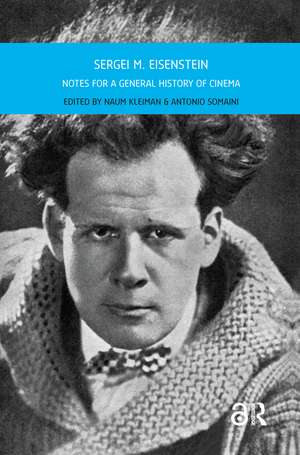
Sergei M. Eisenstein: Notes for a General History of Cinema: Film Theory in Media History
Editat de Naum Kleiman, Antonio Somainien Limba Engleză Hardback – 25 apr 2016
Apreciem această apariție editorială ca fiind un eveniment de o importanță capitală pentru studiile media, oferind pentru prima dată publicului anglofon acces la notele târzii ale lui Sergei M. Eisenstein. Editorii Naum Kleiman și Antonio Somaini, autorități incontestabile în recuperarea moștenirii teoretice a cineastului rus, au compilat un volum care redefinește modul în care înțelegem originile artei cinematografice. Spre deosebire de abordările monografice clasice, precum The Cinema of Eisenstein de David Bordwell, care se concentrează pe analiza tehnică a filmelor și a montajului, lucrarea de față extinde cadrul teoretic prin date noi extrase din manuscrisele anilor 1946-1947, propunând o perspectivă de arheologie media.
Observăm o structură riguroasă, împărțită în două secțiuni: prima redă notele originale ale lui Eisenstein, organizate tematic sub titluri precum „Mificarea dinamică” sau „Moștenitorul”, iar a doua oferă un aparat critic dens. Eisenstein nu urmărește aici o cronologie a regizorilor sau a capodoperelor, ci plasează cinematograful într-un sistem general al istoriei artelor, văzându-l ca moștenitor al procesiunilor rituale și al dioramelor. Comparativ cu volumul Writings, 1922-1934, care documentează anii de formare și entuziasmul revoluționar, acest text dezvăluie un teoretician matur, preocupat de locul filmului în antropologia culturală. Credem că prezența celor 89 de ilustrații alb-negru și a eseului critic semnat de experți precum François Albera transformă acest volum dintr-o simplă arhivă într-un instrument de lucru esențial pentru orice cercetător al culturii vizuale.


Preț: 973.66 lei
Preț vechi: 1187.39 lei
-18%
Carte tipărită la comandă
Livrare economică 30 noiembrie-14 decembrie
Specificații
ISBN-10: 9089648445
Pagini: 546
Ilustrații: 1 color plate, 126 halftones, 1 line drawing
Dimensiuni: 156 x 234 x 36 mm
Greutate: 1.17 kg
Ediția:1
Editura: Taylor & Francis
Colecția Routledge
Seria Film Theory in Media History
Locul publicării:Oxford, United Kingdom
V-ar putea interesa
-
 Beauty and Art: 1750-2000Elizabeth Prettejohn-23%Preț: 147.22 lei192.41 lei
 -
 -19%Preț: 361.07 lei446.15 lei
 -
 Spanish Cinema: The Auteurist TraditionPeter Evans-28%Preț: 439.47 lei613.15 lei
 -
 -30%Preț: 286.98 lei412.54 lei
 -
 StoryRobert McKeePreț: 206.85 lei
 -
 FiascoJames Robert ParishPreț: 120.60 lei
 -
 Preț: 434.47 lei
 -
 Preț: 243.13 lei
 -
 Matisse and the Subject of ModernismAlastair Wright-8%Preț: 465.61 lei506.10 lei
 -
 Seeing is BelievingPeter Biskind-27%Preț: 89.02 lei121.61 lei
Public țintă
AcademicDe ce să citești această carte
Recomandăm această lucrare oricărui specialist în teoria filmului sau istoria artei care dorește să exploreze latura filosofică a lui Eisenstein. Cititorul va descoperi o viziune fascinantă asupra cinematografiei, privită nu doar ca tehnologie modernă, ci ca o culminare a unor tradiții vizuale milenare. Este o resursă academică fundamentală care completează golurile din bibliografia obligatorie a studiilor media contemporane.
Despre autor
Naum Kleiman este unul dintre cei mai respectați specialiști în opera lui Eisenstein la nivel mondial. În calitate de director al Muzeului Filmului din Moscova și al Centrului Eisenstein, Kleiman și-a dedicat cariera conservării și editării textelor teoretice ale marelui regizor, fiind responsabil pentru edițiile rusești de referință. Expertiza sa este dublată în acest volum de cea a lui Antonio Somaini, profesor de teoria filmului și media, asigurând o rigoare academică ce face legătura între arhivele rusești și contextul teoretic internațional actual.
Descriere scurtă
Cuprins
Notă biografică
Antonio Somaini is professor of film and visual culture studies at the Université Sorbonne Nouvelle Paris 3.