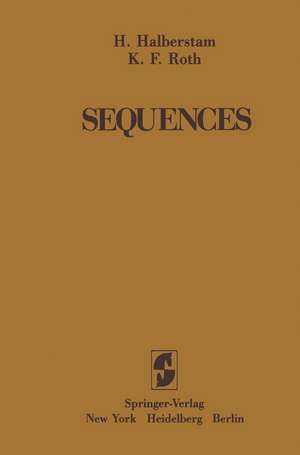
Sequences
Autor H. Halberstam, K. F. Rothen Limba Engleză Paperback – 14 oct 2011
Preț: 373.93 lei
Puncte Express: 561
Carte tipărită la comandă
Livrare economică 28 noiembrie-12 decembrie
Livrare prin curier în România Termenul estimat este afișat lângă disponibilitate.
Transport gratuit de la 400.00 lei Plată online sau ramburs, în funcție de opțiunile comenzii.
Retur gratuit în 14 zile Comandă securizată și suport în română.
Specificații
ISBN-13: 9781461382294
ISBN-10: 1461382297
Pagini: 316
Ilustrații: 293 p.
Dimensiuni: 155 x 235 x 18 mm
Greutate: 0.48 kg
Ediția:Softcover reprint of the original 1st ed. 1983
Editura: Springer
Locul publicării:New York, NY, United States
ISBN-10: 1461382297
Pagini: 316
Ilustrații: 293 p.
Dimensiuni: 155 x 235 x 18 mm
Greutate: 0.48 kg
Ediția:Softcover reprint of the original 1st ed. 1983
Editura: Springer
Locul publicării:New York, NY, United States
V-ar putea interesa
-
 -33%Preț: 978.94 lei1456.58 lei
 -
 Advanced Topics in Computational Number TheoryHenri Cohen-15%Preț: 677.01 lei796.48 lei
 -
 Elementary Methods in Number TheoryMelvyn B. Nathanson-15%Preț: 618.64 lei727.80 lei
 -
 Fibonacci and Catalan NumbersGrimaldi-9%Preț: 758.66 lei833.70 lei
 -
 -14%Preț: 887.18 lei1031.60 lei
 -
 Exercises in ProbabilityL. Chaumont-11%Preț: 442.31 lei496.98 lei
 -
 Preț: 434.29 lei
 -
 One, Two, ThreeDavid BerlinskiPreț: 104.36 lei
 -
 -18%Preț: 783.70 lei955.73 lei
 -
 A Classical Introduction to Modern Number TheoryKenneth Ireland-15%Preț: 536.60 lei631.29 lei
 -
 Lectures on N_X(p)Jean Pierre Serre-18%Preț: 890.81 lei1086.36 lei
 -
 Right-Brained Addition & SubtractionSarah MajorPreț: 291.00 lei
 -
 Elementary Number TheoryGareth A. JonesPreț: 266.17 lei
 -
 Introduction to Modern Number TheoryYu I. Manin-18%Preț: 1050.62 lei1281.24 lei
 -
 Intersections of Hirzebruch-Zagier Divisors and CM CyclesBenjamin HowardPreț: 348.48 lei
Public țintă
ResearchCuprins
I. Addition of Sequences: Study of Density Relationships.- § 1. Introduction and notation.- § 2. Schnirelmann density and Schnirelmann’s theorems. Besicovitch’s theorem.- § 3. Essential components and complementary sequences.- § 4. The theorems of Mann, Dyson, and van der Corput.- § 5. Bases and non-basic essential components.- § 6. Asymptotic analogues and p-adic analogues.- § 7. Kneser’s theorem.- § 8. Kneser’s theorem (continued): the ?-transformations.- § 9. Kneser’s theorem (continued): proof of Theorem 19—sequence functions associated with the derivations of a system.- § 10. Kneser’s theorem (continued): proofs of Theorems 16? and 17?.- § 11. Hanani’s conjecture.- II. Addition of Sequences: Study of Representation Functions by Number Theoretic Methods.- § 1. Introduction.- § 2. Auxiliary results from the theory of finite fields.- § 3. Sidon’s problems.- § 4. The Erdös—Fuchs theorem.- III. Addition of Sequences: Study of Representation Functions by Probability Methods.- § 1. Introduction.- § 2. Principal results.- § 3. Finite probability spaces: informal discussion.- § 4. Measure theory: basic definitions.- § 5. Measure theory: measures on product spaces.- § 6. Measure theory: simple functions.- § 7. Probability theory: basic definitions and terminology.- § 8. Auxiliary lemmas.- § 9. Probability theory: some fundamental theorems.- § 10. Probability measures on the space of (positive) integer sequences.- § 11. Preparation for the proofs of Theorems 1–4.- § 12. Proof of Theorem 1.- § 13. Proof of Theorem 2.- § 14. Proof of Theorem 3.- § 15. Quasi-independence of the variables rn.- §16. Proof of Theorem 4—sequences of pseudo-squares.- IV. Sieve Methods.- § 1. Introduction.- § 2. Notation andpreliminaries.- § 3. The number of natural numbers not exceeding x not divisible by any prime less than y.- § 4. The generalized sieve problem.- § 5. The Viggo Brun method.- § 6. Selberg’s upper-bound method: informal discussion.- §7. Selberg’s upper-bound method.- § 8. Selberg’s lower-bound method.- § 9. Selberg’s lower-bound method: further discussion.- § 10. The ‘large’ sieves of Linnik and Rényi.- V. Primitive Sequences and Sets of Multiples.- § 1. Introduction.- § 2. Density.- § 3. An inequality concerning densities of unions of congruence classes.- § 4. Primitive sequences.- § 5. The set of multiples of a sequence: applications including the proofs of Theorems 4 and 5.- § 6. A necessary and sufficient condition for the set of multiples of a given sequence to possess asymptotic density.- § 7. The set of multiples of a special sequence.- § 8. Proof of Theorem 15.- § 2. The distribution of prime numbers.- § 3. Mean values of certain arithmetic functions.- § 4. Miscellanea from elementary number theory.- References.- Postscript.- Author Index.