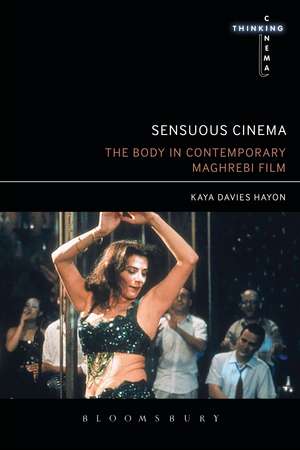
Sensuous Cinema: The Body in Contemporary Maghrebi Film: Thinking Cinema
Autor Dr Kaya Davies Hayonen Limba Engleză Hardback – 9 aug 2018
This new addition to the Thinking Cinema series interweaves corporeal phenomenology with theological and feminist scholarship on the body from the Maghreb and the Middle East to examine how Maghrebi(-French) people of different genders, ethnicities, sexualities, ages and classes have been represented corporeally in contemporary Maghrebi and French cinemas. Via detailed textual and phenomenological analyses of films such as Red Satin (Amari 2002), Exiles (Gatlif 2004), Couscous (Kechiche 2007) and Salvation Army (Taïa 2014), Kaya Hayon Davies conveys the pivotal role that corporeality plays in articulating identity and the emotions in these films.




Preț: 770.82 lei
Preț vechi: 1147.00 lei
-33%
Puncte Express: 1156
Carte tipărită la comandă
Livrare economică 27 noiembrie-11 decembrie
Livrare prin curier în România Termenul estimat este afișat lângă disponibilitate.
Transport gratuit pentru acest produs Plată online sau ramburs, în funcție de opțiunile comenzii.
Retur gratuit în 14 zile Comandă securizată și suport în română.
Specificații
ISBN-13: 9781501335983
ISBN-10: 1501335987
Pagini: 192
Ilustrații: 6 bw illus
Dimensiuni: 166 x 234 x 16 mm
Greutate: 0.43 kg
Editura: Bloomsbury Publishing
Colecția Bloomsbury Academic
Seria Thinking Cinema
Locul publicării:New York, United States
ISBN-10: 1501335987
Pagini: 192
Ilustrații: 6 bw illus
Dimensiuni: 166 x 234 x 16 mm
Greutate: 0.43 kg
Editura: Bloomsbury Publishing
Colecția Bloomsbury Academic
Seria Thinking Cinema
Locul publicării:New York, United States
V-ar putea interesa
-
 Flaming Classics: Queering the Film CanonAlexander DotyPreț: 392.70 lei
 -
 Preț: 375.45 lei
 -
 Atomic Bomb Cinema: The Apocalyptic Imagination on FilmJerome F. ShapiroPreț: 428.62 lei
 -
 Preț: 435.04 lei
 -
 The Coming of SoundDouglas Gomery-18%Preț: 1111.68 lei1355.70 lei
 -
 Artistic Citizenship: A Public Voice for the ArtsMary Schmidt CampbellPreț: 462.00 lei
 -
 -10%Preț: 177.60 lei196.64 lei
 -
 The Movies That Changed UsNick ClooneyPreț: 122.29 lei
 -
 Preț: 382.77 lei
 -
 Doing Their BitMichael S. ShullPreț: 234.49 lei
 -
 African Video Film TodayFoluke OgunleyePreț: 235.32 lei
 -
 -34%Preț: 382.73 lei576.82 lei
 -
 People Like Ourselves: Portrayals of Mental Illness in the MoviesJacqueline Noll Zimmerman-34%Preț: 410.88 lei625.39 lei
 -
 Hollywood's IndianPeter C. RollinsPreț: 192.57 lei
 -
 British Cinema and the Second World WarRobert Murphy-21%Preț: 282.05 lei355.49 lei
 -
 Passionate ControversyCarolyn HackPreț: 104.81 lei
 -
 Transnational Arab Stardom: Glamour, Performance and PoliticsDr Kaya Davies Hayon-36%Preț: 616.72 lei959.82 lei
 -
 Sprechtraining für SchauspielerBarbara Maria BernhardPreț: 121.06 lei
Cuprins
1. Introduction
2. The Corporeality of Exile in Contemporary Maghrebi-French Filmmaking
3. Dance, Performance and the Moving Body
4. Embodying Islam: Women in Maghrebi Cinema
5. Queer Desires in(-between) the Maghreb and France
6. Conclusion
Filmography
Bibliography
Index
2. The Corporeality of Exile in Contemporary Maghrebi-French Filmmaking
3. Dance, Performance and the Moving Body
4. Embodying Islam: Women in Maghrebi Cinema
5. Queer Desires in(-between) the Maghreb and France
6. Conclusion
Filmography
Bibliography
Index
Recenzii
The strength of the book lies in the descriptions of scenes that the author picks to portray sensuality ... the book will be of interest to those who wish to learn about the tensions that arise in portrayals of religiosity in films coming from Maghreb and its diaspora. It serves as an opening to a more comprehensive study of sensuality in Maghrebi cinema, including the corpus not available with French or English subtitles.
Kaya Davies Hayon offers a compelling and nuanced reading of contemporary Maghrebi films focusing on corporeal desire as they challenge the sociopolitical and cultural normative practices of Maghrebi societies.
Sensuous Cinema is an original, thoughtful account of the role of the body and 'embodied subjectivities' in contemporary Maghrebi and Maghrebi-French filmmaking. Davies Hayon productively draws on a range of critical traditions, such as the cinematic haptic, phenomenology, queer theory, and Western and Muslim feminism to offer a careful and sensitive analysis of a number of under-examined works. This book is a valuable contribution to the study of recent North African filmmakers and filmmaking practices, and will be of interest to scholars and students of film studies, French and Francophone visual culture, postcolonial studies, and gender and sexuality.
Sensuous Cinema provides novel insight into corporeality as a defining concern of recent films about characters of Maghrebi heritage, and unearths fascinating connections between conceptions of embodied subjectivity from different regions of the world. In these ways, this carefully researched and astutely argued book makes a distinctive and powerful contribution to the contemporary debate over how films explore the significance of bodies.
Kaya Davies Hayon offers a compelling and nuanced reading of contemporary Maghrebi films focusing on corporeal desire as they challenge the sociopolitical and cultural normative practices of Maghrebi societies.
Sensuous Cinema is an original, thoughtful account of the role of the body and 'embodied subjectivities' in contemporary Maghrebi and Maghrebi-French filmmaking. Davies Hayon productively draws on a range of critical traditions, such as the cinematic haptic, phenomenology, queer theory, and Western and Muslim feminism to offer a careful and sensitive analysis of a number of under-examined works. This book is a valuable contribution to the study of recent North African filmmakers and filmmaking practices, and will be of interest to scholars and students of film studies, French and Francophone visual culture, postcolonial studies, and gender and sexuality.
Sensuous Cinema provides novel insight into corporeality as a defining concern of recent films about characters of Maghrebi heritage, and unearths fascinating connections between conceptions of embodied subjectivity from different regions of the world. In these ways, this carefully researched and astutely argued book makes a distinctive and powerful contribution to the contemporary debate over how films explore the significance of bodies.