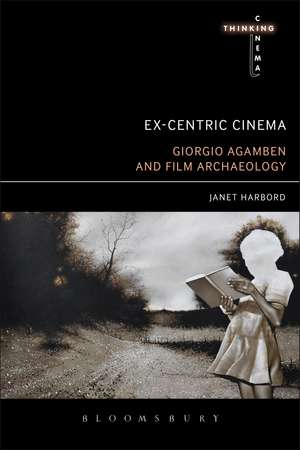
Ex-centric Cinema: Giorgio Agamben and Film Archaeology: Thinking Cinema
Autor Janet Harborden Limba Engleză Paperback – 20 oct 2016
Descoperim în această monografie teoretică, Ex-centric Cinema, o invitație de a privi dincolo de ecranele convenționale pentru a recupera o istorie a imaginilor în mișcare care a rămas, în mare parte, neexplorată. Janet Harbord ne propune o metodă de „arheologie cinematografică” bazată pe filosofia lui Giorgio Agamben, prin care remarcăm cum instituționalizarea filmului a prioritizat povestea și interioritatea umană, neglijând forța brută a gestului și a tehnologiei.
Simțim în text o textură densă a ideilor, unde cinema-ul este tratat nu doar ca divertisment, ci ca un „aparat” aflat într-o continuă reconstrucție. Structura volumului ne ghidează de la originile mute ale imaginii, unde gestul era suveran, către o analiză fascinantă a modurilor de existență non-umană. Capitolele despre animale, copii și fantome acționează ca niște lentile care fragmentează logica antropocentrică obișnuită, oferind o perspectivă ex-centrică asupra artei vizuale. Ca și Cinema and Agamben, lucrarea pune în valoare legătura profundă dintre imaginea în mișcare și gândirea filosofică contemporană, dar cu un accent pe potențialul nerealizat al cinema-ului, pe care Harbord îl numește un „proiect incomplet”.
Această abordare se aliniază cu preocupările anterioare ale autoarei din Film Cultures, unde analiza depășea granițele teoriei clasice, însă Ex-centric Cinema aduce o rigoare arheologică sporită. Recomandăm acest volum pentru felul în care reușește să lege experimentele timpurii ale Fraților Lumière de estetica modernă a lui Wong Kar-wai, transformând experiența lecturii într-o căutare a „comunității ce va veni” prin intermediul imaginilor.




Preț: 213.83 lei
Preț vechi: 281.23 lei
-24%
Carte tipărită la comandă
Livrare economică 28 noiembrie-12 decembrie
Specificații
ISBN-10: 1628922419
Pagini: 272
Ilustrații: 10 bw illus
Dimensiuni: 152 x 229 x 24 mm
Greutate: 0.43 kg
Editura: Bloomsbury Publishing
Colecția Bloomsbury Academic
Seria Thinking Cinema
Locul publicării:New York, United States
V-ar putea interesa
-
 The Fatal AllianceDavid ThomsonPreț: 192.72 lei
 -
 Camp TV of the 1960s: Reassessing the Vast WastelandIsabel Pinedo-31%Preț: 591.65 lei855.62 lei
 -
 Preț: 316.31 lei
 -
 Simon StarlingDieter Roelstraete-21%Preț: 195.30 lei248.46 lei
 -
 -36%Preț: 550.53 lei864.04 lei
 -
 Preț: 223.74 lei
 -
 Black Boys: The Social Aesthetics of British Urban FilmClive Chijioke Nwonka-36%Preț: 584.91 lei912.39 lei
 -
 Japanese Horror Cinema and Deleuze: Interrogating and Reconceptualizing Dominant Modes of ThoughtDr. Rachel Elizabeth Barraclough-26%Preț: 207.60 lei279.55 lei
 -
 Global Cult Cinemas: Decolonizing Cult Film StudiesIain Robert Smith-29%Preț: 597.48 lei839.12 lei
 -
 -33%Preț: 582.43 lei863.52 lei
 -
 Walled Life: Concrete, Cinema, ArtJenny Stümer-26%Preț: 207.35 lei278.88 lei
 -
 City Limits: Filming Belfast, Beirut and Berlin in Troubled TimesProfessor or Dr. Stephanie Schwerter-26%Preț: 208.39 lei280.51 lei
 -
 Color It True: Impressions of CinemaProfessor Murray Pomerance-25%Preț: 209.76 lei280.23 lei
 -
 -30%Preț: 536.59 lei768.32 lei
 -
 Resisting James Bond: Power and Privilege in the Daniel Craig EraChristoph Lindner-15%Preț: 157.83 lei185.29 lei
 -
 -35%Preț: 599.09 lei928.66 lei
 -
 Preț: 207.73 lei
 -
 Preț: 150.75 lei
 -
 The New American War FilmRobert BurgoynePreț: 160.11 lei
 -
 Drawing Processes of Life: Molecules, Cells, OrganismsGemma Anderson-TempiniPreț: 271.98 lei
 -
 Mean StreetsDemetrios Matheou-34%Preț: 64.89 lei97.68 lei
 -
 The Richard Dyer ReaderGlyn Davis-32%Preț: 606.53 lei888.82 lei
 -
 Preț: 357.55 lei
 -
 Woman in Art: Helen Rosenau's 'Little Book' of 1944Griselda PollockPreț: 324.00 lei
 -
 Spanish Meta-Art and Contemporary Cinema: Mirrors to the UnconsciousGuillermo Rodríguez-Romaguera-33%Preț: 581.66 lei863.01 lei
 -
 -32%Preț: 583.22 lei863.95 lei
De ce să citești această carte
Recomandăm această carte cercetătorilor și studenților la cinematografie care doresc să depășească analizele narative clasice. Cititorul câștigă o nouă metodă de interpretare a filmului, văzut acum ca un spațiu al posibilităților neexplorate. Este un volum esențial pentru a înțelege cum filosofia lui Agamben poate ilumina legătura dintre tehnologie, gest și identitate, oferind un argument solid pentru reevaluarea istoriei vizuale dincolo de perspectiva umană.
Despre autor
Janet Harbord este profesor de studii de film la Queen Mary, University of London. Este o voce autoritară în domeniul filosofiei imaginii în mișcare, fiind autoarea unor volume de referință precum Film Cultures (2002) și monografii dedicate unor cineaști experimentali, cum este lucrarea despre Chris Marker. Cercetările sale, susținute de instituții prestigioase precum AHRC și Leverhulme Trust, traversează granițele dintre teoria filmului, neurodiversitate și arheologia media. În Ex-centric Cinema, Harbord își rafinează expertiza, integrând gândirea politică și estetică pentru a oferi o nouă paradigmă de înțelegere a mediului cinematografic contemporan.
Descriere
Ex-centric Cinema takes an archaeological approach to the study of cinema through the writings of philosopher Giorgio Agamben, arguing that whilst we have a century-long tradition of cinema, the possibility of what cinema may have become is not lost, but co-exists in the present as an unexcavated potential. The term given to this history is ex-centric cinema, describing a centre-less moving image culture where animals, children, ghosts and machines are privileged vectors, where film is always an incomplete project, and where audiences are a coming community of ephemeral connections and links. Discussing such filmmakers as Harun Farocki, the Lumiere Brothers, Guy Debord and Wong Kar-wai, Janet Harbord draws connections with Agamben to propose a radically different way of thinking about cinema.
Cuprins
1 Ex-centric Cinema: An Archaeological Method
2 Mute Cinema: Gesture and the Impression of Character
3 Animal: Cinema as an Anthropological Machine
4 Profaning the Cinematic: Children, Assistants, Ghosts
5 Conditions of Cinematic Possibility: Repetition and Stoppage
6 The Coming Community
Bibliography
Index
Recenzii
Ex-centric Cinema introduces readers to a radically different way of thinking about cinema, which is attentive to lost or occluded potentials that can be re-activated. This is the first major study of Agamben's fragmentary work on cinema and the image, and also a major intervention in film studies. Harbord writes with clarity and elegance of expression.
Both beautifully written and theoretically astute, Ex-centric Cinema powerfully revitalizes film philosophy and methodology, while also providing an indispensable reading of Agamben's work in relation to cinema studies and media archaeology.
(Bloomsbury translation)
A materialistic and materially comprehensive revision of film history.