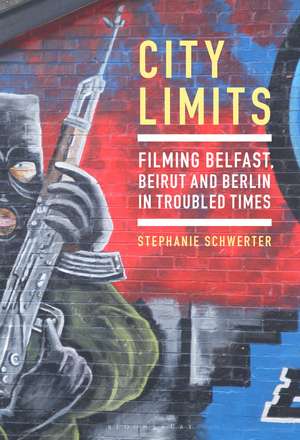
City Limits: Filming Belfast, Beirut and Berlin in Troubled Times
Autor Professor or Dr. Stephanie Schwerteren Limba Engleză Paperback – 27 iul 2023
Preț: 208.39 lei
Preț vechi: 280.51 lei
-26%
Puncte Express: 313
Carte tipărită la comandă
Livrare economică 28 noiembrie-12 decembrie
Livrare prin curier în România Termenul estimat este afișat lângă disponibilitate.
Transport gratuit de la 400.00 lei Plată online sau ramburs, în funcție de opțiunile comenzii.
Retur gratuit în 14 zile Comandă securizată și suport în română.
Specificații
ISBN-13: 9781501380426
ISBN-10: 1501380427
Pagini: 312
Ilustrații: 50 bw illus
Dimensiuni: 152 x 229 x 25 mm
Greutate: 0.42 kg
Editura: Bloomsbury Publishing
Colecția Bloomsbury Academic
Locul publicării:New York, United States
ISBN-10: 1501380427
Pagini: 312
Ilustrații: 50 bw illus
Dimensiuni: 152 x 229 x 25 mm
Greutate: 0.42 kg
Editura: Bloomsbury Publishing
Colecția Bloomsbury Academic
Locul publicării:New York, United States
V-ar putea interesa
-
 Homemade EstheticsClement GreenbergPreț: 415.60 lei
 -
 Reality Transformed – Film and Meaning and TechniqueIrving SingerPreț: 338.99 lei
 -
 -30%Preț: 474.07 lei675.32 lei
 -
 A Guide to Apocalyptic CinemaCharles P. Mitchell-44%Preț: 344.72 lei618.86 lei
 -
 British Cinema in DocumentsSarah StreetPreț: 387.91 lei
 -
 Cinema and NationMette Hjort-18%Preț: 1121.20 lei1367.32 lei
 -
 British Cinema, Past and PresentJustine Ashby-18%Preț: 1125.94 lei1373.10 lei
 -
 Flaming Classics: Queering the Film CanonAlexander DotyPreț: 392.70 lei
 -
 Modernist SexualitiesHugh StevensPreț: 220.58 lei
 -
 Colonial India and the Making of Empire CinemaPrem ChowdhryPreț: 216.51 lei
 -
 100 years of European cinemaDiana HolmesPreț: 213.44 lei
 -
 Preț: 223.62 lei
 -
 Bad at the BijouWilliam R. HornerPreț: 224.35 lei
 -
 Mavericks on the BorderJ Douglas CanfieldPreț: 233.93 lei
 -
 -23%Preț: 469.41 lei609.62 lei
 -
 Post-war Cinema and ModernityJohn Orr-23%Preț: 647.05 lei840.33 lei
 -
 Robert Zandvliet: The Varick SeriesElaine EquiPreț: 285.68 lei
 -
 The Myth of HarmSarah Cleary-36%Preț: 584.04 lei911.87 lei
 -
 Interpretation and Film StudiesPhillip Novak-15%Preț: 615.57 lei724.21 lei
 -
 Explorations in Cinema through Classical Indian TheoriesGopalan Mullik-15%Preț: 674.55 lei793.58 lei
 -
 Hans Ulrich ObristMilan GrygarPreț: 115.74 lei
Cuprins
1. Historical and Cultural Background
2. Urban Space and Territoriality
3. Tropes of Violence
4. Representing Division through Humor
5. Between Present, Past and Future
Conclusion
Bibliography
Index
2. Urban Space and Territoriality
3. Tropes of Violence
4. Representing Division through Humor
5. Between Present, Past and Future
Conclusion
Bibliography
Index
Recenzii
This book is an insightful and ambitious examination of the representation and imagination of the divided cities of Belfast, Beirut and Berlin in cinema. Schwerter investigates aspects highly relevant to film and conflict studies as well as to the interdisciplinary field of cultural studies, centered on comparative film analyses of altogether 35 films.
City Limits: Filming Belfast, Beirut and Berlin in Troubled Times provides a fascinating overview and profound analysis of the cinematographic representation of these troubled cities. The author establishes significant links between Belfast, Beirut and Berlin and analyses the extent to which filmmakers have reflected the characteristics of the three places in diverse filmic productions. The book examines the historical and cultural background of these territories, investigating the earliest film representation of all three metropolises, before studying features of the cityscape. While Belfast, Beirut and Berlin share a history of sectarian and political violence, the author also reflects the numerous examples of humorous films produced in or about the cities. This is a captivating study which sheds light on a shamefully neglected area of cultural studies, providing a concise and coherent analysis which is backed up by highly-relevant and updated bibliographical sources.
City Limits is an in-depth study of how cinema responds to political conflict. Schwerter combines fine-grained attention to the history of the German, Lebanese and Northern Irish contexts with lucid, comparatively oriented accounts of the films. In her encompassing analysis, she not only casts new light on high-profile box office hits, but also provides welcome insight on less familiar productions that evidently deserve more attention. Throughout, the overarching motif of the divided city provides a fruitful prism, revealing both important continuities and interesting divergences in cinematic approaches. Although no one in their right mind would want to go back to the past state of the divided cities of Belfast, Beirut and Berlin scrutinised in this study, Schwerter makes a powerful case for why we should return to these compelling, intriguing films.
[The book] provid[es] a fascinating analysis of how films about three different cities during periods of conflict and post-conflict link to one another through cinematic tropes and themes to formulate a novel study that demonstrates the alignment among the films.
City Limits: Filming Belfast, Beirut and Berlin in Troubled Times provides a fascinating overview and profound analysis of the cinematographic representation of these troubled cities. The author establishes significant links between Belfast, Beirut and Berlin and analyses the extent to which filmmakers have reflected the characteristics of the three places in diverse filmic productions. The book examines the historical and cultural background of these territories, investigating the earliest film representation of all three metropolises, before studying features of the cityscape. While Belfast, Beirut and Berlin share a history of sectarian and political violence, the author also reflects the numerous examples of humorous films produced in or about the cities. This is a captivating study which sheds light on a shamefully neglected area of cultural studies, providing a concise and coherent analysis which is backed up by highly-relevant and updated bibliographical sources.
City Limits is an in-depth study of how cinema responds to political conflict. Schwerter combines fine-grained attention to the history of the German, Lebanese and Northern Irish contexts with lucid, comparatively oriented accounts of the films. In her encompassing analysis, she not only casts new light on high-profile box office hits, but also provides welcome insight on less familiar productions that evidently deserve more attention. Throughout, the overarching motif of the divided city provides a fruitful prism, revealing both important continuities and interesting divergences in cinematic approaches. Although no one in their right mind would want to go back to the past state of the divided cities of Belfast, Beirut and Berlin scrutinised in this study, Schwerter makes a powerful case for why we should return to these compelling, intriguing films.
[The book] provid[es] a fascinating analysis of how films about three different cities during periods of conflict and post-conflict link to one another through cinematic tropes and themes to formulate a novel study that demonstrates the alignment among the films.